No Child Left Behind: Two Mothers, One Mission.
Mothers of Muxima: A Mission of Health and Hope"

- Portuguese
- English
In the early morning light of Muxima, a small village of the Icolo e Bengo Province, Faustina Bernardo Kijima wraps her baby boy in a soft cloth and steps out into the warm Angolan air. Her destination is familiar: the local hospital where she first held her son in her arms, where nurses greeted her with kindness and, importantly, where she learned that protection begins with a single dose.
“I felt motivated the first time I came,” she says, with her eyes lighting up. “The nurses and doctors treated us so well, they took great care of my baby. That’s why I keep coming back.”
Faustina lives close to the hospital and getting there is easy, motorcycles and cars are always available. But what matters most to her is the care. “When I arrive with my baby in my arms, they help me fast. They give me helpful advice and medicine when he’s sick, and make sure he recovers quickly.
She laughs gently, recalling the only challenge she faces: “He moves around a lot when they vaccinate him. I can’t hold him still, but the nurses help me.”

Across town in one of the neighborhoods of Icolo e Bengo, Iracelma prepares her own visit to the hospital. Born in Quissama, she now lives just 15 minutes away from the health facility. Her journey is short, but the impact is lasting.
“Whenever my baby is vaccinated, I feel safe,” she says. “He’s free from disease and from malnutrition. He also plays more, and I can feel that he is healther. I wouldn’t change anything about the service, it’s perfect.” She says with a smile"
Iracelma learned about the importance of vaccines during her pregnancy. Nurses explained the schedule, the benefits, and how each dose builds a shield around her child. “I go through the screening, then to the vaccination room. If there are many children, it takes around 20 minutes. Otherwise, just five.”
Her voice is steady and confident. “I know the vaccine protects him. That’s why I come.”

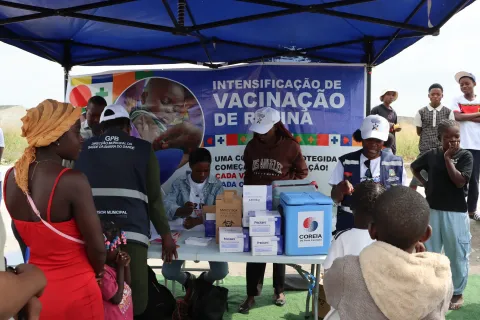
These two mothers are part of a growing movement in Angola. A country where, in 2021, over 553,000 children had not received a single dose of the pentavalent vaccine. The COVID-19 pandemic significantly disrupted health services, leaving many children vulnerable. However, in 2023, the Ministry of Health, with support from UNICEF, WHO, and Gavi, launched a recovery plan targeting 22 high-burden municipalities.
In Icolo e Bengo, where the immunization need is greatest, UNICEF mobilized additional funding from The Church of Jesus Christ of Latter-day Saints. Over 100,000 doses of the pentavalent vaccine were delivered. Through microplanning, mobile outreach, and community engagement, thousands of children received their first and third doses.
Steve Macheso, UNICEF Angola Immunization Specialist, highlights that ''In Quissama, we’re using Kobo Collect to map zero-dose and under-vaccinated children across some of Angola’s most rural areas, where rivers, forests, and long distances often separate families from health facilities. This is not just about data collection, it’s about building local capacity to identify missed children, track progress, and plan vaccination activities based on real evidence from their own communities''

Faustina and Iracelma’s stories reflect the heart of this effort. They are not just recipients of care, they are advocates, protectors, and leaders in their communities.
“I suggest all mothers bring their children for vaccination,” Faustina says. “It’s the best protection.”
UNICEF continues to support Angola’s journey strengthening cold chain systems, training health workers, and using data tools to reach specifically zero-dose children and those with disabilities. The goal is clear: reduce the number of zero-dose children by 10 per cent and increase routine immunization coverage by 10 percentage points by 2025.
Every child has the right to a healthy future. And every mother, like Faustina and Iracelma, deserves the support to make that future real.