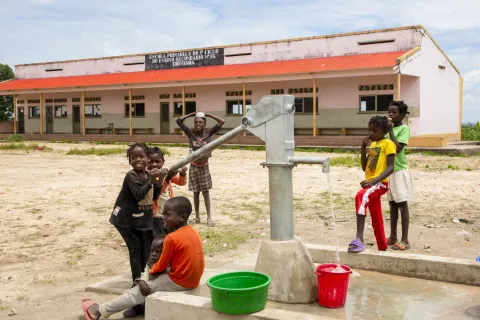
Access to clean water transforms drought-affected communities.
With the rehabilitation of water holes, the continuous supply is guaranteed, reducing risks to health and safety in the community.

- Portuguese
- English
Drought in southern Angola has been a constant challenge, compounded by climatic variations. In Cunene and Huíla, the lack of water has compromised the livelihoods of communities, affecting not only domestic life, but also health, education, and food security. For years, families have depended on distant and often contaminated water sources, facing daily challenges to obtain this essential resource for life.
"The probes were very far away. We had to walk great distances to have water, sometimes several times a day. It was very tiring," recalled Ana Fernanda, a resident of the Kuawa neighborhood and cleaning assistant at School No. 16, where one of the water points rehabilitated by the local authorities with the support of UNICEF is located.
Like several other inhabitants of her community, Ana does not hide the satisfaction of having a water point closer to her "With the rehabilitation of this probe in the neighborhood, the reality has changed. Now we have water close to home."

With funding from the Central Emergency Response Fund (CERF), UNICEF has rehabilitated 24 boreholes that serve schools, health centers specializing in the treatment of malnourished children, and communities, bringing concrete improvements to the daily lives of populations and contributing to the permanence of children in school.
The rehabilitated boreholes directly benefit more than 68 thousand people. In addition to the community, the regained access to water services also benefits livestock and, in some cases, family gardens for increased food production and better hygiene practices.
The improvement in the community is visible. People no longer must travel miles looking for water. But there are still challenges: the desire for home supply and the urgency of more investments to expand the distribution network.
But it is not only families who feel the positive effect of the rehabilitation of water points. Lídia Lucas, head of human resources at the health center in the Tchitulo neighborhood, sees the benefits of water beyond domestic use.
"Water is the heart of our work here at the health center. Without it, hospital hygiene is compromised, and the risk of infections increases. Now, with the current supply and the storage tank, we are able to ensure a safer environment for patients."
But it is not only the health center that has changed. "We have a community laundry where residents wash their clothes and even the hospital bedding. Water gushing from taps greatly reduces the risk of contamination. That gives us more peace of mind." Concluded.

Joaquina João, a resident of the Patrício Lumumba neighborhood, visibly happy, smiles when talking about the difference that the rehabilitated hole has brought.
"Before, we spent a lot of time to fetch water. Now, we can do more things with this time. I would like water to reach our homes. It would be very good."

The borehole rehabilitation interventions were carried out using solar-powered pumping systems, replacing the old hand pumps. The change had a direct impact on the lives of the population, reducing the physical effort required to extract water.
Previously, this was a task often performed by children, who spent hours operating the pumps to ensure the supply of water to their families. Now, health centers can operate more safely, and children can go to school without worry.