STEM Learning: How Science Can Be A Child’s Best Friend

Cultivating Modern Knowledge for 21st-Century Skills

UNICEF Thailand
A girl wearing a blue polo shirt is happily reading a book and smiling. She is in a room with several bunk beds, and other children are sitting on the beds in the background.
UNICEF Thailand/2024/Roisri
27 June 2024

In the hot sun of Northern Thailand, a group of school children get to work in the picturesque rice terraces of Baan Mae Salap in Mae Hong Son province. They dig deep into the soil, churning up earth as deep as 30 centimetres. But this is not an act of vandalism or even farming, but of learning.

“If we only sit and study in the classroom, we will never know how acidic or alkaline the soil truly is. But this scientific project allows us to learn more deeply,” says Jaruwan Kordoo, a 15-year-old boarding student at Chumchon Bahn Numdip School, an Educational Opportunity Expansion School in Mae Hong Son.

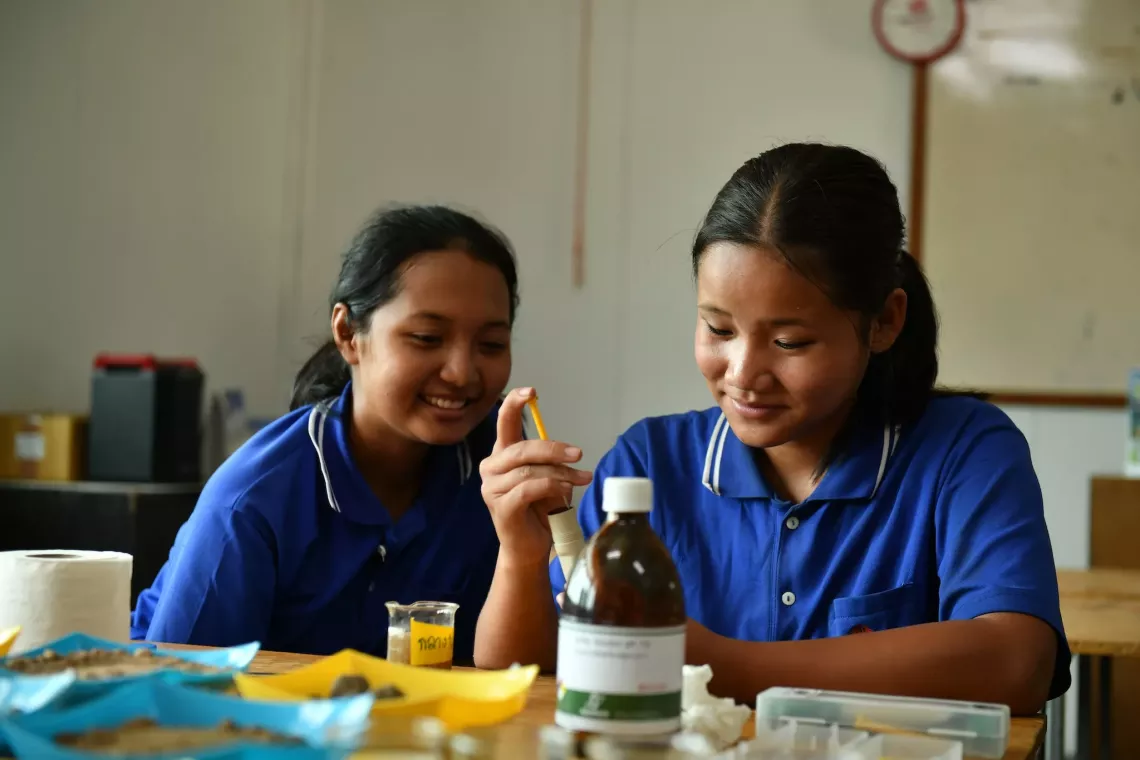
Two girls wearing blue polo shirts are engaged in a science activity in a laboratory. One is holding a test tube while the other smiles beside her. There are various laboratory equipment items on the table. Two girls wearing blue polo shirts are engaged in a science activity in a laboratory. One is holding a test tube while the other smiles beside her. There are various laboratory equipment items on the table.
UNICEF Thailand/2024/Roisri Rinlada Mahanapat, 15, (right) uses scientific equipment fluently. Rinlada, who both parents are farmers, initiated a soil research experiment in her hometown as wanting to know what the soil conditions of her terraced rice fields were like. Her friend, Jaruwan Kordoo, 15, (left), and five other friends worked together to complete this research.
Two girls wearing blue polo shirts are engaged in a planting activity in a classroom. One is holding a bag of soil, and the other is handling soil with her hands covered in dirt. Both are smiling happily. Two girls wearing blue polo shirts are engaged in a planting activity in a classroom. One is holding a bag of soil, and the other is handling soil with her hands covered in dirt. Both are smiling happily.
UNICEF Thailand/2024/Roisri Sidapond Preedipa, 15, (left) and Nichamon Chuenprasob, 15, mix the dirt they have collected with water to see the difference in the soil and put the note for each sample. It’s part of the STEM programme (science, technology, engineering, mathematics) that has been pushed to integrate the real experimental experience into the learning programmes to cultivate more students to be interested in these careers.
A group of students wearing blue sports uniforms are engaged in a planting activity in a field. One of them is using a hoe to dig the soil while the others are helping to manage the soil and seedlings. The surroundings include fields and mountains in the background. A group of students wearing blue sports uniforms are engaged in a planting activity in a field. One of them is using a hoe to dig the soil while the others are helping to manage the soil and seedlings. The surroundings include fields and mountains in the background.
UNICEF Thailand/2024/Roisri Children in school uniforms walked into the middle of an empty rice terraces before starting to dig in the middle of the empty rice fields after the harvest season. In this village, rice is farmed only once a year according to the season as they needs rainwater must be used to grow rice. After some research, they found that the soil from the top levels was the most fertile. They also advised villagers to plant legumes to add nutrients to the soil when outside of the rice growing season.

Jaruwan and her 4 friends - Rinlada Mahanapat, Nichamon Chuenprasob, Sidapond Preedipa and Patchara Chevitprasert – worked under the supervision of teacher Narunat Wattawong, as part of a new generation of students benefiting from UNICEF’s work in Thailand on STEM (Science, Technology, Engineering, and Mathematics) education.  

UNICEF is working with partners to improve STEM learning outcomes with a particular emphasis on equity (focusing on expanding STEM education into rural and small schools) and gender (girls are less likely to pursue STEM careers than boys, even though it is a key skill for the 21st century). One crucial partner is the Institute of the Promotion of Teaching Science and Technology (IPST), a government agency with a mission to integrate STEM subjects into wider education and improve teaching and curriculum. Within three years, this initiative aims to benefit 25,000 children and 500 teachers directly, with many more teachers supported through online training. 

A girl is standing in a cattle pen, smiling happily. She is wearing a dark green t-shirt. In the background, there are several cows and a wooden pen. A girl is standing in a cattle pen, smiling happily. She is wearing a dark green t-shirt. In the background, there are several cows and a wooden pen.
UNICEF Thailand/2024/Roisri Rinlada Mahanapat, 15, and her cattles at Ban Maeslap. Seeing her parents work as rice farmers, Rinlada wanted to do soil research in her hometown for a school science project. Every morning, people in her village let their cattle go to graze in their fields. themselves to help control the amount of grass It also helps prevent the environment from getting worse than before from burning grass to prepare for agriculture. This helps reduce environmental problems including global warming and dust and smoke which is yearly problem.
Several test tubes containing different colored liquids are arranged on a table, labeled with tags such as “Top 2/1", “Top 1/2", “Middle 1/1". In the background, students wearing blue polo shirts are engaged in a science activity Several test tubes containing different colored liquids are arranged on a table, labeled with tags such as “Top 2/1", “Top 1/2", “Middle 1/1". In the background, students wearing blue polo shirts are engaged in a science activity
UNICEF Thailand/2024/Roisri Various beakers lined up according to different soil conditions. It has been tested through chemicals to separate different compounds to get the answer that the soil in each area of the rice terraces are in good condition. With STEM learning process, children will analyze and make reports and adaptation many times before presenting their project together with students from other countries around the world through the GLOBE programme.

Rinlada Mahanapat, 15, is one of the most confident girls in the group. Although initially reluctant to join the project, she eventually took the lead in choosing the terraced rice fields in Mae Salap Village, her hometown, to be the research site. Teacher Narunat observes that the students never previously paid much attention to how much rice their parents harvested, but researching the soil helped them understand that the decrease in the rice yield has to do with quality of the soil or the weather.  

“I really enjoyed our participation in this project. I have seen other countries’ projects and seen the difference made, such as Sweden replacing plastic with seaweed. It's useful for me to see other countries do projects for the environment like this. Together with my friends, I'm proud to be able to share the knowledge gained from our soil quality research with the farmers in my home,” says Rinlada.  

Her research results will help her to promote the importance of the environment in her village. Step farming is a good option for agricultural work in this area because it reduces the amount of soil washed away. In addition, her village’s approach to letting livestock such as cows and buffalos eat grass in the rice fields - instead of burning it - can help preserve the ecosystem, while animal manure adds valuable minerals and nutrients to the soil.

A group of students wearing blue polo shirts are engaged in a science activity in a classroom. One student is holding soil in her hands while the teacher guides her. Two other students are observing and participating. On the table, there are various colored trays filled with soil samples.
UNICEF Thailand/2024/Roisri Teacher Narunart Wattawong, 59, science teacher at Baan Namdip Community School, coaches children closely in all science teaching at the school. She has worked as a science teacher here for 27 years. Her dedication has made it possible for the school to have one of the most well-equipped science laboratories even though it is a small school.

Nurturing love for science is best started in childhood. A good example is Teacher Narunat herself. She was inspired to become a teacher by the positive impression made by a female science teacher when she was young. That teacher encouraged her to learn through questioning and observing her surroundings. These are primary scientific methods and put her on the path to becoming a science teacher at Ban Namdip School for 27 years.

She says that although STEM projects often take up a lot of time, children have fun and learn along the way. “STEM projects obviously stimulate children's interests. Some students used to pay little attention to science or mathematics but when we get them involved and working with other talented children, we can see that they greatly develop. If these kids invent something, they are ahead of their peers because they have more ideas and experience. These children discover ways of solving problems that we never expected.”

Two girls wearing blue polo shirts are engaged in a science activity in a classroom. One girl is holding soil in her hand and looking at it with interest, while the other girl sits beside her and smiles happily.
UNICEF Thailand/2024/Roisri Sidapond examines the soil in her hands during research that she is doing with her friends. This soil research project has brought soils from the rice terraces of Ban Mae Salap where her friends live.

“Doing a science project made me open up to the world of science more,” says Sidapond Preedipa, 15, another girl in the same research group. “From having never done it before, I got to try it and see new things. When we were studying in classrooms, I didn't fully understand. But when I came to do a science project, it made me like science more. I am proud of myself for being able to do it. Getting to that point was stressful, but I got through it all with support from friends, teachers and parents. Everyone is proud of the project.”

For all its benefits, promoting STEM learning in remote areas faces multiple challenges, such as a lack of trained teachers. Teacher Narunat will retire next year, resulting in the school having one less science teacher, and it is not yet known whether the substitute teacher will have science teaching skills or not.

A girl wearing a polo shirt is standing and smiling while holding a large bag of soil in a classroom. In the background, there are windows and tables with various experimental equipment.
UNICEF Thailand/2024/Roisri The hands-on project on soil research makes Sidapond so proud of herself that she finally completes the project with all her friends. “When we were studying, we didn't fully understand. But when I came to do a science project, it made me like science even more,” says Sidaporn.

“The biggest challenge for STEM education in remote schools is the level of teaching knowledge”, confirms Kankamol Koonnarat, Baan Namdip School Director. “We may have science teachers, math teachers and computer teachers but if they do not have knowledge and understanding of the content or cannot design the learning content properly, STEM teaching won’t be fully developed.”  

Teacher Narunat hopes that by sharing her passion, some children may become tomorrow’s teachers - but her primary goal is to help them learn to love science and apply it whatever their future holds. “I want children to use scientific knowledge to practice solving problems in a step-by-step, in systematic way. I want them to practice solving problems through observations. Let them use these skills throughout their own lives and work life, no matter what area they work in.”

As with so much of UNICEF's work, partnership is crucial to STEM-based learning initiatives like the one described here. Both Pandora and BMW Group stepped up to support this initiative, and we are grateful for their forward-thinking approach and generosity.