


Childrens books are a powerful tool enhancing the brain development of a young child, especially their all-important language skills. Stories not only bring happiness and enjoyment, but also add new words to a child’s vocabulary, help them develop and practice their comprehension, and lay the foundation for them to understand the concept of reading. Early Childhood Development (ECD) teachers should therefore have the skills to promote early reading so that they can maximize its power to fully promote children’s development.
UNICEF is currently supporting the project “Ready To Learn: strengthening early childhood development through reading promotion in ECD centers”. The goal is to build the capacity of teachers in the ECD centers in Bangkok. In cooperation with Bangkok Metropolitan Administration, 865 teachers have so far received specialist training on promoting early reading skills. In addition, 79 teachers have also received additional training to use the Thai level-reading books.

“Before I joined the project, I would use childrens books to tell stories to the children, but using my own words and adding more than what is written,” says Ms. Sarinrat Anrattanasathian, a kindergarten 1 teacher from Wat Chan Pradittharam School, who is among 865 teachers who received the training project. How she used the children books was actually similar to other teachers. Data collection before the project began found that most teachers did not know the difference between “reading” and “telling stories”. They tended to focus on making storytelling fun and often asking questions as they go, rather than allowing children to use their own imagination.
In the training by the Creative for Reading Foundation, which UNICEF supported, the teachers were encouraged to simply read the words on the pages as this helps to develop children’s foundational understanding of reading and writing. Children will learn that those wiggly symbols are actually letters that can represent different sounds, which can then be combined together to form words. In addition, children are allowed to think for themselves, instead of being directed by adults.
“At first when I attended that training, I was stressed about how we would use it with children, whether they would understand or not, and how they would use their imagination. In the first week, the children were not very interested. But I adjusted my reading method by reading slowly and pointing at the letters with my fingers,” says Sarinrat, explaining the techniques she learned. “During the second week, the children started speaking sentences from the storybooks when they went to the bathroom. This made me feel happy. I felt that the reading started to have a positive effect on the children’s speech development.”

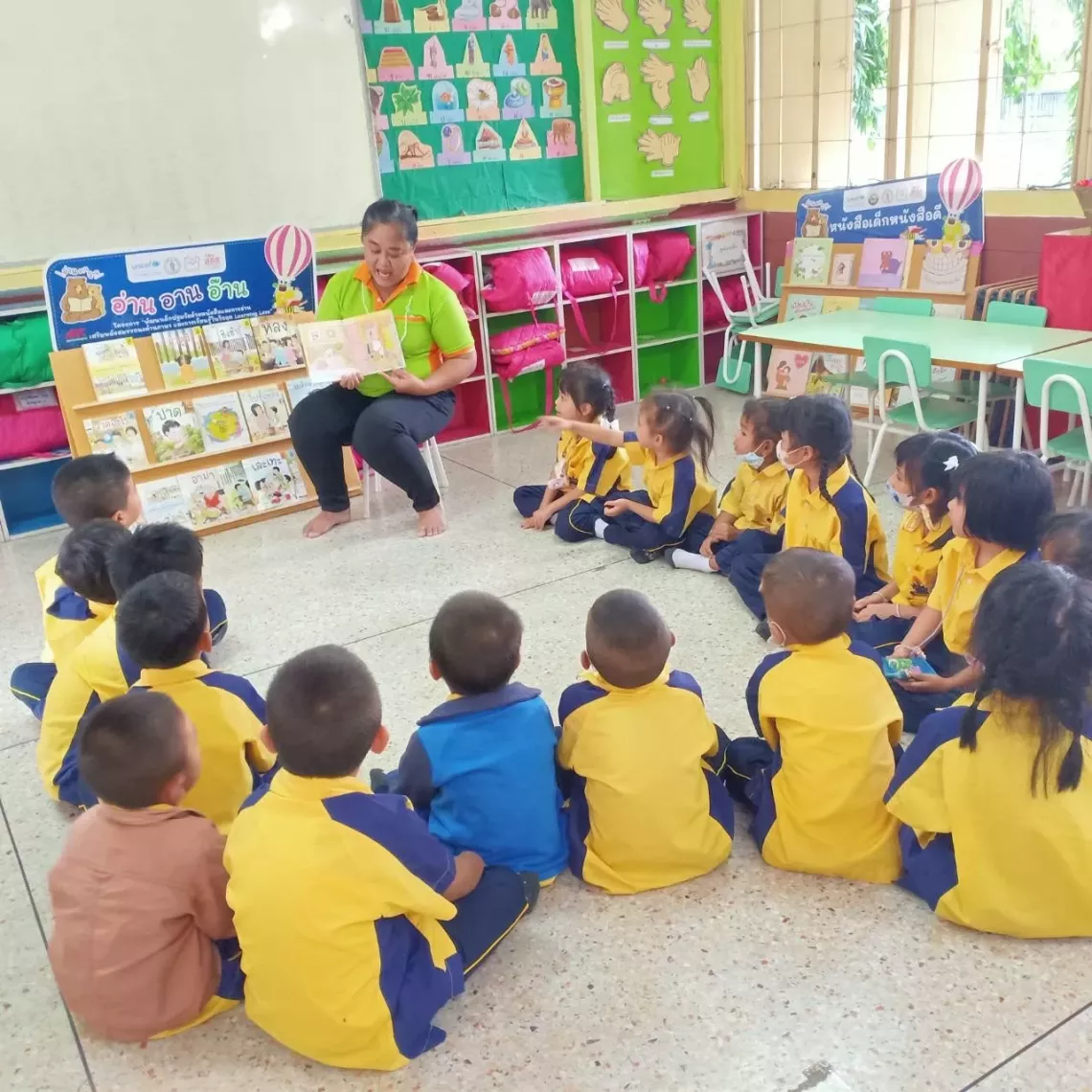
“After that, I gradually brought other storybooks to read to the children,” Sarinrat continues. Instead of reading only 2-3 books a week, she increased it to 3-6 books a day. “If I forget, the children will immediately ask if I’m not reading to them today. When I read the same books and they start to remember the stories, they will bring the books to read by themselves. Some will also copy me and read to their friends.”
In addition to reading at school, promoting reading at home is also important. It is a concern that only 1 in 3 young children in Thailand have at least 3 children's books at home, as revealed by recent UNICEF research (MICS2022). Therefore, Sarinrat encourages children to borrow books to take home to replace screen time. "At first, it was like forcing children to take books home. I asked them read at home and come back to tell the class about it. At first the children and their parents probably didn’t want to do it, but they had to otherwise the children would not be able to tell to the class. Later, parents became more interested. Some even called to ask how to read correctly."
After following this approach for a while, parents themselves saw changes in their children. Children played less on their phones and paid more attention to storybooks. In addition, when parents or caregivers read books to children, it built a good relationship and encouragedthem to talk more to each other.
When the positive results became clear, it was no longer difficult to convince parents. As Sarinrat happily concludes, "In the beginning, I had to check if the children had returned the books to school. But now I don't have to check because they will return them to the bookshelf on time. The children now love their books.”


