A new start for Soanomena thanks to a modern school with a desk for every child
Eco-villages bring model schools closer to home and help tackle Madagascar’s learning crisis.

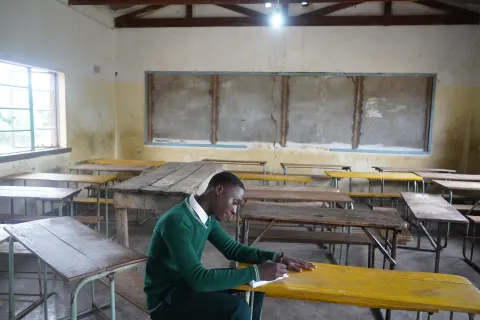
Imagine trying to practice your handwriting sitting on a concrete floor and without a desk. Imagine this in a classroom so crowded that groups of students have to rotate in and out due to lack of space.
This was the daily reality for Soanomena, now 12 years old, when she first started school in Ankaranabo in southern Madagascar. Born into a family of farmers who grow green vegetables and cassava, she was always eager to learn, but the limitations of the local school presented many obstacles for both students and teachers.
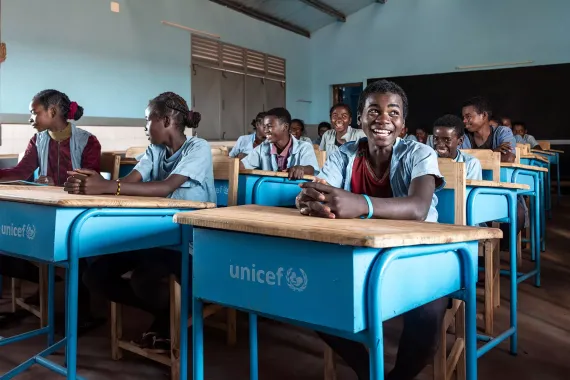
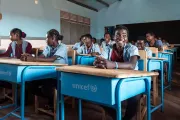
Fast forward a few years: With a renovated and larger school that has a desk for every student, and with new water and sanitation infrastructure in place, Soanomena has made a new start.
“I'm more excited about studying now; this environment is good for us.”
Will, effort and hard work
In the past, there was only a primary school in Ankaranabo Nord. Children as young as 11 had to walk 15 kilometers each way to the nearest secondary school. Trekking 30 kilometers every day to get to school and back home was a heavy toll on the children, and in 2009 the local authorities decided to create the Ankaranabo Collège d'Enseignement Général. At that time, the community built a two-classroom school for 45 students using local materials.
The community invested phenomenal will, effort and hard work to establish a school closer to home. Yet the learning environment was under-resourced. and the two classrooms became increasingly cramped over the years.
The situation in Ankaranabo was not unique. Madagascar is facing a learning crisis: Only 69 per cent of children enter primary school. Among these, only four out of ten complete primary school and only one in ten completes secondary school. More than half of children who finish primary school have not acquired basic reading or math skills.

Rocketing enrollment numbers
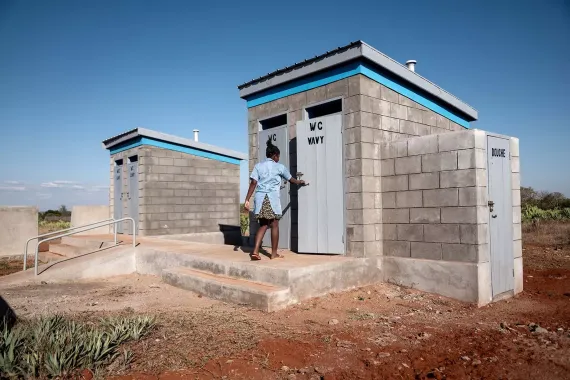
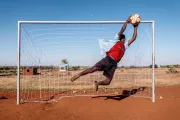
Together with partners, UNICEF works on several fronts to bring children into the education system and to improve the quality of their learning. In Ankaranabo, a UNICEF initiative has resulted in the construction of four new classrooms, modern classroom furniture, education materials, a sports field and hand-washing facilities. Separate bathrooms for boys and girls enable girls to manage their period in privacy.
Thanks to a UNICEF partnership with the private sector, the new school is also equipped with computer hardware and connected to the Internet, which has opened the way for digital learning.
The transformation has reverberated throughout the community. Enrollment has rocketed from 45 students to 174. Thanks to the new facilities and desks, both teachers and students have a new motivation, and Soanomena and the other children can study optimally.
“In the future, I'd like to become a teacher. I'd enjoy teaching in an environment like this,” confides Soanomena.
The upgrade of Soanomena’s school is part of UNICEF’s eco-village project which also brings climate-sensitive improvements to the water, sanitation and hygiene infrastructure of Madagascan communities such as Ankaranabo.
Based on a story originally published on UNICEF Madagascar.