What do climate-smart, green schools look like? Just ask the students leading the way in Nepal
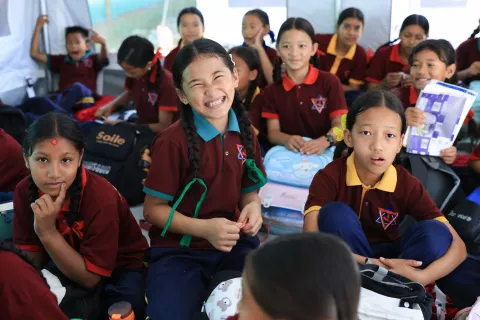
Students from the Kathmandu Valley Eco Clubs demonstrate how they are taking matters into their own hands when it comes to the environment

Kathmandu, Nepal: Green leaves swayed gently in the breeze, standing out against the thick gray of the monsoon sky as we arrived at the Shree Gamvir Samudra Setu Secondary School nestled alongside the Bagmati River in the Kathmandu Valley. The school grounds looked calm, clean and alive with students laughing and playing during their break period. The walls of the school compound were decorated with emergency preparedness posters - essential for a school vulnerable to floods and for a city that is still recovering from a devastating earthquake a decade ago.
At this school, the safety of students lies in the hands of school management and also in the hands of the students themselves. This mighty team calls themselves the “Eco Club.”
What is the eco club?
The Eco Club contributes to upkeeping the four core dimensions of the Global Green School Quality Standard, in line with the Comprehensive School Safety Framework.
This means that students are helping lead the way to create a more climate-resilient and environmentally friendly school.
With help from teachers, students are leading emergency evacuation drills, growing plants, composting, educating themselves and peers on environmental protection, bee farming, conducting waste management initiatives to reduce harmful burning of plastic in and around the school, and some are even go above and beyond by leading trash pickups in their own community!
Green spaces in schools matter, especially in cities like Kathmandu, where green space constitutes only two per cent of the land[1], far from global standard of 15 per cent set by WHO. The head teachers were just as excited as the students to show off their school greening, now that green has started to replace the mud that coats the ground during monsoon season. The Eco Club, however, was especially ecstatic about showing off the vegetables they are growing on the school grounds.
With crops ranging from spicy peppers, eggplants, tomatoes and lettuce- the students wait in anticipation for harvest, where they plan to sell their vegetables to the school and community for profit- which doesn’t quite reach their pockets. Instead, proceeds will go towards funding future Eco Club initiatives!


This school, with help from the Eco Club, is doing more than school greening. They are also taking waste management more seriously. Students are not afraid to show off their compost bin, which helps them grow healthy vegetables. When it comes to plastic and non-recyclable waste, the school has strict rules, including a rule the Eco Club initiated- no plastic candy wrappers allowed!
Previously, small plastic wrappers used to litter the playground, making the school environment feel dull and unclean. Before these climate-smart and environmentally friendly initiatives, trash was also dumped into one large bin. Now, fabrics are saved, reused, and given new life by being stitched into pencil cases, eco bags, and dish towels, while plastic containers are used for propagating and growing plants. The Eco Club is also segregating the various types of trash and recycling- they even stay after school on Fridays to finish it before waste collection comes! Their efforts are helping reduce their school’d carbon footprint and the burning of plastic waste.
“It’s our job to protect the environment,” Sohan, one of the Eco Club members, says passionately.


While these green activities are stimulating their minds and are a part of the shifts that lead to the greening of a nation, students are also learning about emergency preparedness in the face of climate and environmental disasters that threaten their country. Nepal stands on the frontlines of the global climate crisis, with 80 per cent of Nepal’s population facing climate-induced risks [Source].
“Almost all the Eco Club students have undergone emergency preparedness training,” the head teacher at the school shares proudly. To demonstrate their knowledge, students explained their evacuation plans and what their role is when a disaster strikes- keeping students calm, safe, and alert.
“If you look at the calendar, you’ll see the most dangerous seasonal risks are in red,” Numa, an Eco Club member, shares, pointing to the calendar that showcases the seasonal realities of climate risks in Nepal - including the current monsoon season.
“As you can see, there is a lot of red," she says.

“We want to leave this earth a better place,” Sohan adds.
This school is just one of several schools undergoing a green makeover. It is a part of the "Strengthening a Climate Smart, Green, and Resilient Education System in Nepal," a joint initiative by UNICEF and UNESCO in collaboration with the Government of Nepal and supported by the Government of Norway.
UNICEF and its partners are working alongside the children of Nepal in hundreds of additional schools to build a more climate resilient and green education system.