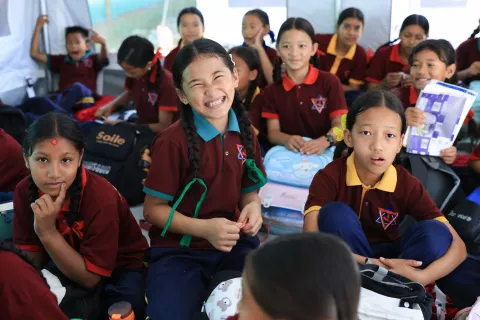
Twin sisters learning against all odds
Where support creates possibility

At first glance, it is the quiet smiles that Tamanna and Tanisha exchange that catch your eye. A glance, a grin, a shared laugh, small gestures that speak of a bond forged far deeper than most. At just 13 years old, these identical twin sisters have learned how to lean on one another in a world that once rarely made room for them and have also overcome barriers to learning.
Tamanna and Tanisha were born with physical and cognitive disabilities in a remote, hilly district of Nepal’s Sudurpaschim Province. They come from the so-called Dalit community, one of the most marginalized groups in the country.
From the day they were born, the odds were stacked against them: poverty, disability, gender, caste and geography all intersecting to limit their opportunities.

Still, their parents work tirelessly to provide for their family. Their mother earns a modest income as a tailor, while their father is a tractor driver for the local market.
While care has never been in short supply in their home, time and resources certainly have.
Long working hours often meant the girls were left alone, and their parents worried constantly about their safety and future, especially Tamanna, who particularly struggled to learn basic literacy and numeracy.
Neither their parents nor their teachers had experience supporting children with disabilities. Like many others in their community, they quietly believed that the twins would never achieve much in school - and by extension, in life.
Things were not easy at school. While other children ran, played and danced, Tamanna and Tanisha often watched from the sidelines.
Separated into different classes, they also struggled to move independently. Reaching the classroom, fetching drinking water, or using the washrooms were difficult tasks without support.
Teachers offered little help. Some assumed that, as girls with disabilities, the sisters would soon stop attending altogether and chose not to invest their time in helping the girls reach their full potential. Tamanna, who also has hearing difficulties, was made to sit at the back of the classroom. Despite her deep love for learning, Tamanna’s grades began to slip drastically. Her attendance dropped and slowly, so did her confidence and motivation.
Everything began to change when their school became part of the Recovery and Accelerated Learning (ReAL) programme, an initiative led by the Government of Nepal, with technical assistance from UNICEF, designed to help children who are falling behind catch up with their learning.
Through ReAL, Tamanna was identified as being at risk of failing her grade. She was enrolled into remedial classes that met her at her own learning level and focused on foundational skills. For the first time, she received patient, consistent attention tailored to her needs.

When UNICEF visited the school, it had been clear that children with disabilities were still being excluded from classroom activities.
This moment proved pivotal. Teachers began to reflect, and to act. They made intentional changes to ensure Tamanna was included.

To help her hear better, Tamanna was moved to the front of the class. The head teacher closely monitored her progress in both regular and remedial classes and even met with her parents to stress the importance of Tamanna to attend school regularly. Little by little, results began to show.
As her grades improved, Tamanna’s motivation returned. With the improved classroom environment, both sisters soon began to make more friends in class, finding classmates who offered a helping hand when they needed support.
Against all expectations, Tamanna passed grade five and advanced to grade six, with her sister by her side.
“I have been individually observing and supporting her in both regular and remedial classes,” one of Tamanna’s teachers shared proudly. “In the end, she passed all subjects in the final term.”
For UNICEF and the Government of Nepal, Tamanna’s progress represents what is possible when systems work for the most marginalized children. Through national efforts to strengthen teacher capacity, improve the safety of school environments, and support inclusive education networks at local, provincial and federal levels, stories of children like Tamanna and Tanisha are becoming visible.

Tamanna is just one of approximately 800,000 children who have received a second chance at education through learning recovery efforts across Nepal.
Evidence shows that if children like Tamanna are given opportunities to catch up on their learning, they are more likely to finish school.
For these children, education is not just about lessons, it is about rewriting their futures.
The impact reached beyond the classroom. Teachers who once felt uncertain about how to support children with disabilities now openly emphasize the value of individualized support and second chances.
“When I first met Tamanna, I felt emotional, but she encouraged me instead." - Laxmi, one of Tamanna’s teachers.
"She is a very dedicated student. Although she learns slowly, she works hard to complete every task. Tamanna is also a good singer and a talented artist.” In many ways, Tamanna taught her teachers important lessons too, showing them that with the right support, every child can succeed.


Her parents have also begun to dream differently.
“I hope both of my daughters study well and one day find opportunities that they can do comfortably while sitting,” her father says.
Despite his long workdays, he takes the time each morning and evening to sing with his daughters, record videos and upload them online.
Her mother imagines a different future. As someone who also serves as Female Community Health Volunteer, she hopes Tamanna will one day become a nurse, someone who helps others, just as she has been helped.
After completing grade five, the twins transferred to a new school located 30 minutes away. Support followed them there too.
Although a free school bus is available, Tamanna often chooses to walk for an hour every day, strengthening her legs along the mountain paths. Classmates walk beside her. On difficult days, the bus arrives, and the driver offers a helping hand to assist her and Tamisha climb aboard.

UNICEF Nepal/2026/PKChaudhary
“Now I feel stronger, both physically and emotionally, I am self-motivated. Even though my school offered free bus service, I enjoy walking.”
- Tamanna
For Tamanna and Tanisha, the journey to school is no longer a path of exclusion, but one of possibility.
With the continued support of the Government of Nepal, UNICEF Nepal and its partners, the Let Us Learn Foundation, the European Union and the Embassy of Finland, their story is becoming something it was never expected to be: a story not of limitation, but of resilience, dignity and hope.