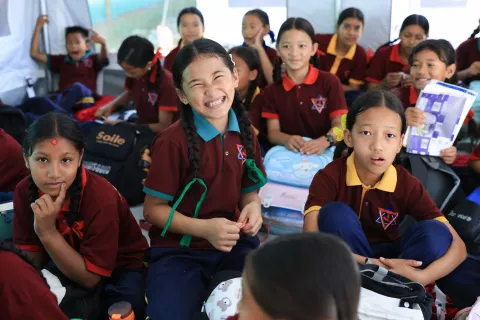
UNICEF facilitates high-level policy dialogue on climate action and risk reduction through education
The Government of Nepal takes step forward in making education a key sector in fighting the climate crisis

The world is breaking records, and not the good kind.
According to NASA, 2024 was the warmest year on record. In 2024, climate events disrupted the education of at least 242 million students worldwide, spanning from pre-primary to upper secondary levels. South Asia was the hardest-hit region, with 128 million students experiencing school closures and interruptions due to climate-related disasters.
In Nepal, precipitation during its monsoon season was 122.0% of the seasonal average with most of the country reporting above average temperatures, according to the Government. A single flood event in October is estimated to have disrupted the education of 250,000 school-aged children. 2024 monsoon season led to devastating floods and landslides, while other climate related events like wildfires, heatwaves, and heavy pollution also threatened lives across the country.
On International Day of Education, UNICEF reflects on how climate change has disrupted the lives and education of children in climate-vulnerable low-income countries like Nepal.

Nepal, ranked the 10th most climate affected country in the world —according to the Climate Risk Index—is situated between two of the world’s largest carbon emitters, making it particularly vulnerable to the effects of climate change, despite having a low contribution to global carbon emissions itself. With a population of 29 million and child population of 40%, it is Nepal’s children who are forced to absorb the burden of the impacts of these changes.
With the current and future generation of children in mind, the government of Nepal has made a strategic choice to integrate education into its national strategy to adapt to and fight the climate crisis. By integrating the education sector into its Nationally Determined Contributions (NDCs) — a national climate pledge under the Paris agreements— it could pave way for a more climate conscious, resilient, sustainable future in Nepal.
Education, which drives generational transformation and fosters the development of climate-smart, resilient human capital, holds the potential to help Nepal combat the impacts of global warming. Schools are where children gain awareness on how to protect themselves, their community, and their planet, but they are also physically vulnerable to climate disasters if they lack adequate infrastructure. This in turn can lead to school closures, disrupting children’s education.
The investment case for integrating education into the climate agenda is strong—it can both build a more resilient education system and equip communities with the skills needed to adapt to a changing world.


Recognizing the critical role of education, UNICEF spearheaded a High-Level National Policy Dialogue on "Strengthening the Role of Climate Action and Risk Reduction through Education in National Climate Policies and Nationally Determined Contributions (NDCs)” on January 16th, 2025. It was the very first time that the Ministry of Education, Science and Technology (MoEST) and key stakeholders came together to discuss climate impacts on education, its integration into NDC 3.0, and strategies to build a climate-smart, resilient education system.
This platform facilitated collaboration among key stakeholders to advocate for school safety, green schools, and education in emergencies. To decrease the education sector’s carbon footprint, the event also called for the promotion of economically sustainable renewable energy sources in all 35,000 schools across Nepal. A key focus was placed on revising Nepal’s curriculum at all levels to include knowledge of climate-induced hazards and risks, along with efforts like greening schools, developing model schools, and children’s climate clubs that could bring transformative changes to education in the context of climate resilience.
Mr. Suman Subedi, Under Secretary at the Ministry of Forest and Environment (MoFE) shared how the government is working collaboratively with stakeholders and cross-sectoral partners in developing the upcoming NDC 3.0. He emphasized the role of the Climate Change Management Division (CCMD) in addressing all aspects of mitigation and adaptation. Similarly, Mr. Manjeet Dhakal, Head of the LDC Support Team and Senior Technical Advisor at MoFE, highlighted the importance of integrating education into adaptation and mitigation plans. There was also a strong call to establish direct access to the Climate Change Management Division (CCMD) under the MoFE, ensuring alignment between education efforts and national and sub-national policies.

UNICEF Nepal Chief of Education, Neven Knezevic, highlighted the government’s efforts by stating, “Policies are building green and resilient schools, but we need to do more.”
Emphasizing the importance of securing climate financing for education, he added, “Nepal has an opportunity to pave a way forward to show other countries how to access climate education funding."
While the integration of education into the NDCs is promising, Nepal must establish a dedicated national fund to address basic climate-induced hazards in the education sector to ensure meaningful, sustainable progress in tackling these challenges.
The education sector in Nepal still has a long way to go before it is financially equipped to create this desired reality and future. Paving the way for climate funding from national and international loss and damage funds are among the key possibilities to filling these gaps.
Nepal has the opportunity to serve as an international model for the integration of education into national climate policies if adequate financing is realized. The stark reality is that even if the national level financing is achieved, Nepal will still face an extreme deficit in meeting requirements put in place to safeguard its children from the effects of climate change.
On World Education Day, UNICEF is calling for increased national and international investments in safe, green, and climate-resilient education infrastructures in Nepal and across the world.
With the Government of Nepal’s leadership, these critical policy dialogues are made possible. Together, UNICEF and partners MoEST, MoFE, UNESCO, GPE, the European Union, the Government of Norway, and The Government of Finland are at the forefront of the mission to prioritize the education and climate agenda to create a safer future for the children of Nepal.