Speaking their language
How multilingual education is changing the way children learn across Nepal

“I see them smile more now. Learning feels less like a burden and more like play,” – Renuka Dahal, teacher
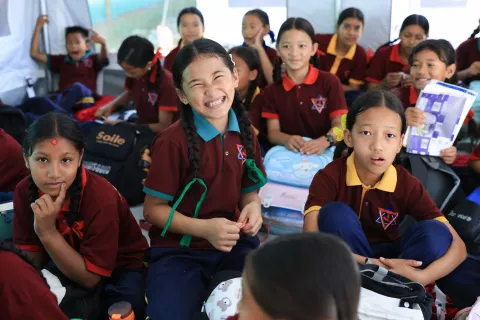
The morning sun pours softly through the windows of a classroom in Judibela, Chandrapur, Rautahat — a quiet town nestled in Nepal’s Terai plains. Outside, life unfolds gently: roosters crow, children’s laughter drifts in the air and leaves rustle in the breeze.
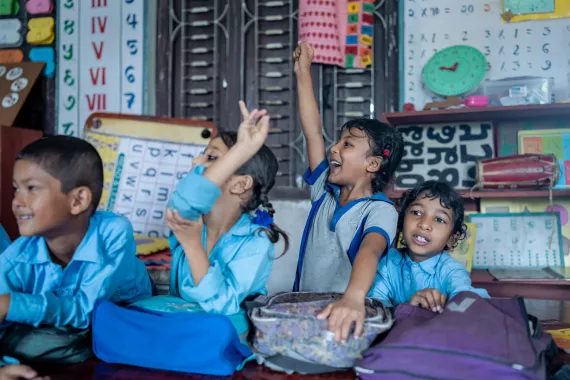
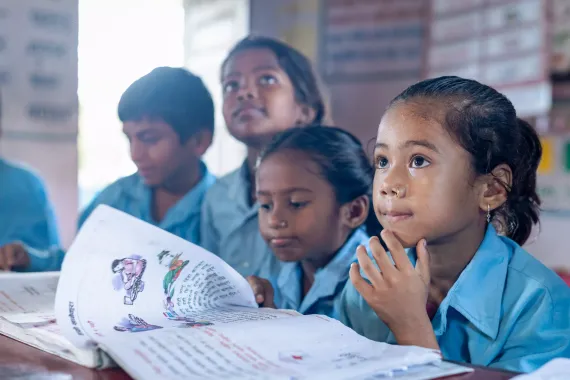
Inside, a group of second graders sit cross-legged on the floor, their eyes wide with curiosity.
Their teacher, Renuka Dahal, holds up a bright picture card of a mango.
“In Nepali, this is aap,” she says with a gentle smile. Then she pauses and asks, “What do you call it at home?”
Immediately, hands shoot up enthusiastically. “Aam!” calls a child in Tharu. “Aam!” echoes another in Maithili. Though the words sound the same, the pride in their voices feels new — like they are finally being seen and heard for who they truly are.

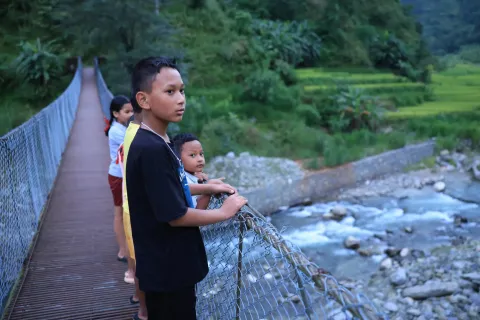
Thousands of kilometers away in western Nepal, in the cool, tree-lined hills of Dandagaun, Narayan Municipality, Dailekh District, a different classroom hums with similar energy. A narrow path winds downhill through fresh trees and rich earth, leading to a school nestled in a clearing, surrounded by lush green hillsides that rise and fall like waves. Here, the sun hits the tin roof just right in the early morning and inside, children gather to learn in a space once shadowed by silence and hesitation.
For years, children in places like Dailekh and Rautahat faced a difficult barrier — their school lessons were taught only in Nepali, a language many did not speak at home.

UNICEF Nepal/2025/RUpadhayay
“We believed that children must be taught in proper, standard Nepali. If children spoke in their own language or dialect, we would correct them. We told them, ‘You should speak Nepali.’”
- Sher Bahadur Rana, principal, Dailekh school.
It was a well-meaning effort to prepare them for the wider world, but it often left children quiet and fearful of speaking up. Parents saw this too.

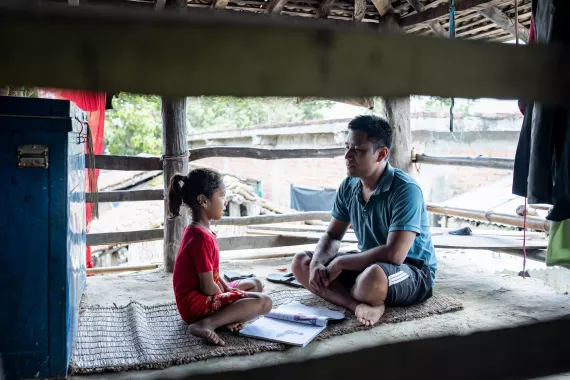
Binay Chaudhary from Rautahat explains that his daughter, who speaks Tharu at home, often understood what was being taught but could not express herself well in Nepali.
“It’s hard for a child to know the answer but not be able to say it,” he says, “and that can make a child lose confidence.”
For many children, the school day was a struggle between understanding lessons and finding their own voice.
In Dailekh, parent Khagendra Jaisi has seen the change first-hand.
“There’s been real progress in learning,” he says.
“Before, she was hesitant to speak — she used to say she didn’t understand what the teachers were teaching at school. But now, she asks questions when she doesn’t understand something. She asks, ‘Sir, what does this mean?’ She even asks at home. This change has been noticeable. Her learning has improved too — now that she understands the lessons, she’s able to progress.”

This story began to change with the introduction of Multilingual Education (MLE) training programmes. Teachers like Rana and Dahal participated in this training, which encouraged them to start education in the mother tongue of the children and gradually introduce Nepali as a second language.
“After the training, we learned that children learn faster and feel more confident when we teach them in the language they speak and understand best,” says Rana.
Dahal agrees warmly, “Now, I ask my students what they call things at home. It makes them feel valued, like their language and identity matter.”
The impact of this approach has been profound. In classrooms across Nepal, the silence that once filled lessons has been replaced by a lively mix of voices. Children teach each other new words in Tharu, Maithili, Khas, Bhojpuri and more. Teachers move fluidly between languages to make sure every child understands.

UNICEF Nepal/2025/RUpadhayay
“Sometimes, children explain lessons to one another in their own language and we learn from them too, it creates a real sense of belonging.”
- Renuka Dahal
This has done more than improve their academic understanding, it has also helped children feel more comfortable with one another. Speaking and learning in a familiar language lowers barriers, making it easier for them to join conversations, learn together and form friendships. The classroom becomes not only a place to study, but also a space where every child feels they belong.

In Chandrapur Municipality, where children from many different ethnic communities come together in a single classroom, the challenge of diverse languages is met with creativity and teamwork.
“If one child explains in Maithili, the others listen and learn,” says Education Officer Dipendra Kumar Mandal.
“Learning becomes a group effort and no one is left behind.”
This cooperation across languages and cultures has changed not just how children learn, but how they relate to each other and their teachers.
The changes stretch beyond the classroom walls. Parents have noticed a shift in their children’s confidence and eagerness to share what they learn. Chaudhary shares that his daughter often comes home excited to tell him new words she’s learned in both Nepali and Tharu.
“She says, ‘Dad, today my teacher taught me this word in Tharu and Nepali,’” he says with a smile. “Before, she was shy to speak. Now, she talks more.”
Local governments are also embracing this approach as part of their education strategies. In Narayan Municipality, Mayor Loman Sharma explains how starting education in the mother tongue has helped children learn faster and strengthened the connection between schools and communities.
“Families feel more involved and teachers are better equipped to meet the children’s needs," he says.
Narayan Municipality has developed curriculum-based learning materials in local languages and trained teachers to deliver lessons accordingly.

UNICEF Nepal/2025/RUpadhayay
“Children who once struggled with lessons now understand better,”
- Mayor Loman Sharma
Chandrapur Municipality is scaling up the Multilingual Education (MLE) programme from 15 schools to all 48, using peer learning to spread knowledge among teachers. The focus is especially on grades one to three—the early years when children build the foundation for their entire schooling.
“When children feel capable and confident early on, they carry that through their education,” Mandal explains.
This multilingual education initiative fits seamlessly into Nepal’s broader commitment to inclusive, quality education. The Constitution of Nepal recognizes the right to education in one’s mother tongue and national policies emphasize reducing barriers for marginalized groups. By teaching children in languages they understand and speak, this programme directly addresses those barriers, creating environments where all children can belong and thrive.


The programme also supports Nepal’s efforts to achieve Sustainable Development Goal 4 (SDG4) — which aims to ensure inclusive and equitable quality education for all children. When children learn in their mother tongue, they are more likely to enroll, stay in school and succeed academically. The multilingual approach helps close the gaps that too often leave children behind — especially those from ethnic minorities, remote areas or low-income families.
Teachers reflect on how the new approach has changed not only the children but also their own roles and perspectives.
“Before, I only spoke Nepali in class,” says Dahal. “Now I ask my students to teach me words in their language. It makes them feel that I care about who they are. They say, ‘Miss, you are one of us now.’ That makes me happy.”
Rana shares similar feelings. “The children are more relaxed, they ask questions, they laugh and they are eager to learn. It feels like a new beginning.”

Inclusive education also means making sure every child feels safe, supported and able to participate fully.
Dahal talks about how she pays close attention to how children arrive at school — whether they are happy or upset — and adjusts her teaching accordingly. She uses games, songs and activities to make learning fun and accessible for all, making sure no child is left out.
“If they’re involved, they learn better,” she says simply.
Education officials like Mandal note the challenges of managing classrooms with so many different languages and cultures. But they also see it as a strength.
“Our motto is ‘unity in diversity.’ Our schools are places where children from many backgrounds learn together. With the right training, teachers can manage these diverse classrooms and help every child grow.”
All of these efforts — training teachers, developing local curriculum materials, involving communities — are part of a long-term plan. Nepal’s municipalities have included multilingual education in their official education strategies, with phased monitoring and expansion plans.
This steady progress promises a future where every child — regardless of where they live or what language they speak — has the chance to succeed.


Back in Dailekh, the hillside school sits quietly beneath the trees, the gentle sounds of children’s voices spilling from the open windows. In Rautahat’s town, the rhythms of daily life mingle with the chatter of students learning and growing together. In classrooms across Nepal, something powerful is happening.
Children who once struggled to be heard are now finding their voices — learning not just words, but confidence, pride and the knowledge that their language — and they themselves — matter.
“The children’s behavior has changed. They are more comfortable, more familiar with their teachers and most importantly — they want to learn. All it took was speaking their language,” says Principal Rana.
As part of Nepal’s School Education Sector Plan (SESP) — with co-funding from the European Union and support from UNICEF and partners — Nepal’s multilingual education programme is more than just a teaching method. It is opening doors for children to learn in ways that respect who they are and help them build a brighter future.