A matter of dignity
In Nepal, UNICEF supports schools in improving their sanitation

Baitadi, Nepal: Narendra Bhatt, head teacher at Siddheshwor Secondary School, remembers feeling ashamed of the sanitation situation in his school. Located in Patan Municipality in Baitadi District in far-western Nepal, the school did have toilets but these were in a poor state.
“The water supply was not regular, and we had no hand-washing stations,” Narendra recalls. “One of our staff would bring in the water manually. It was not ideal.” This was especially hard on the girls, who made up 47 per cent of the student population, according to Narendra. “We knew something had to be done but weren’t sure where to start.”
That starting point came when UNICEF, through the Bhumeshwore Community Development Organization (BCDO), conducted a training in the area for teachers, child clubs and school management committee members on better sanitation in schools. As part of the training, Narendra and his team assessed the situation at Siddheshwor Secondary School as per a star-rating system. The result was grim.
“We came to understand that proper toilets and hand-washing stations are not just essential to the health of students and staff, but a matter of rights and dignity,” Narendra shares.

The school management held discussions on what could be done. Then, with the support of UNICEF, its implementing partner, the Water Supply and Sanitation Division Office (WSSDO) of the Government of Nepal, and the BCDO team, a number of improvements were initiated.
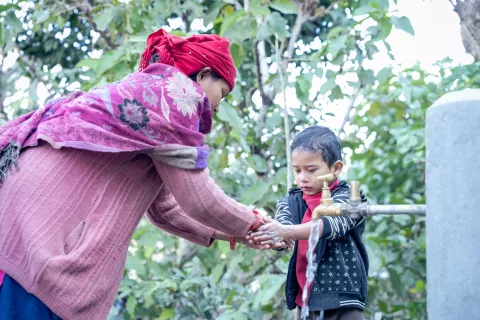
The toilets were foremost remodeled, keeping in mind the needs of children in general, but more specifically girls and students with disability. This included incinerators to dispose of sanitary napkins in the girls’ toilets, and an emergency stock of menstrual hygiene products. A water connection was set up for regular supply and hand-washing stations established in several spots, complete with soap. Moreover, each classroom in the school was equipped with a water filter to provide students with safe drinking water.
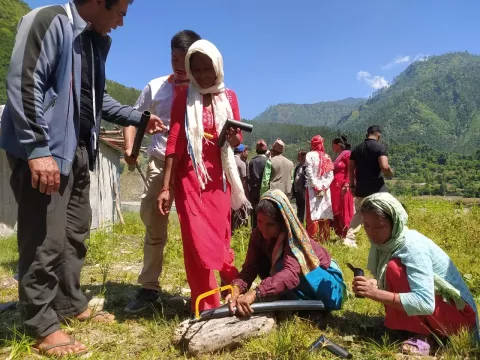
In addition to this, the school was also supported in managing and funding the new facilities. For instance, a focal teacher has now been assigned specifically for looking after water, sanitation and hygiene issues. Child clubs and committees have also been formed to hold orientations and demonstrations in the school and the community.
“A big part of the process is to change attitudes, which is an ongoing effort."
"We knew that unless students and community members really internalized these ideas, it was not going to work,” Narendra says.
An example of this is how the school has declared Tuesdays ‘Sanitation Day’, to be marked with regular demonstrations and other activities to promote good sanitation and hygiene.
Each class is also responsible for cleaning and collecting their own trash and disposing of it in separate biodegradable and non-biodegradable pits. Female students are regularly oriented on menstrual hygiene management and trained to make reusable sanitary napkins.
Ninth-grader Rekha Mahara says that the environment at the school is very different from what it used to be.
“We feel like the management has given much more thought to the students, especially the girls,” she says. “The toilets are so much more comfortable now and suited to our needs.”
Thanks to all these efforts, Siddheshwor Secondary School has received an impressive three-star rating from the School Water Sanitation and Hygiene Coordination Committee and the School Management Committee. Narendra also points out that the upgrades have led to improvement in students’ performance. “There has been a rise in overall grades last year, and we hope that will continue in the coming days,” he says.