Learning safety
How Nepal’s schools are preparing children for disasters

“Children are no longer afraid. They are informed, confident and responsible," says Rikesh Kumar Thakur, teacher

The first light of morning filters gently into the classrooms of Shree Janata Primary School in Hanumannagar Kankalini Municipality, Saptari.
Nestled in Madhesh Province, in the Terai plains of Nepal, the village awakens slowly: the soft rustle of paddy fields, children’s laughter echoing through narrow lanes and the distant crowing of roosters.
Inside, a group of students gather, ready to start the day’s lessons.
But today, the lesson isn’t just about reading or math, it’s about safety.
Rikesh Kumar Thakur, the school’s Comprehensive School Safety (CSS) focal teacher, moves among the children with calm authority.
“If there is an earthquake,” he says, “remember to duck, cover and hold. Then move to the open space outside.”
His voice is firm but gentle and the children respond with practiced movements, covering their heads with their hands as they crouch on the floor. For many of them, these drills are not mere exercises, they are a lesson in survival.

For years, schools like Shree Janata faced frequent threats. Heavy monsoon rains often flooded the sloped areas around the school, making it dangerous to attend classes. Earthquakes loomed as invisible threats, while infrastructure was poorly maintained and unsafe, leaving both children and teachers vulnerable.
“We didn’t have any formal training,” recalls Thakur. “We didn’t know how to keep the children safe or even ourselves.”
That began to change with the introduction of the Comprehensive School Safety Minimum Package (CSSMP). The programme focuses on three key pillars: safe school buildings, disaster management at the school level and safety education for students. Its goal is clear: empower teachers, engage students and build resilient communities.


Thakur’s transformation began with a five-day intensive training. He learned how to conduct mock drills, map safe zones, coordinate with local authorities and prepare the school for floods, earthquakes and heatwaves. Armed with this knowledge, he became a guide for both his colleagues and the children. Teachers began monthly drills and students learned to respond calmly and effectively during emergencies.
The impact spreads beyond the classroom—children take their lessons home, becoming safety ambassadors for their families.

Parwati Kumari Mandal, a seventh grader and president of the school’s Child Club, shares “We practice mock drills every month—ducking, covering, helping injured friends and calling for help if needed. Then we share what we learn with our parents and neighbors.”
Parents have noticed the difference.
Shyam Devi Mandal, whose children attend Shree Janata, shares, “Our children teach us what to do during floods and earthquakes. They tell us to move to higher ground, protect ourselves and help others. Now, when they go to school, we don’t worry as much, because teachers and students are prepared.”
The programme’s impact extends beyond drills. Child clubs have become hubs for leadership and community engagement. Students organize cleaning campaigns, art competitions focused on school safety and discussions on local hazards such as floods, heatwaves and snakes. These clubs teach responsibility and civic engagement while reinforcing safety lessons in playful, memorable ways.

Farther north and west, in the mid-hills of Dailekh District, schools have embraced CSSMP with equal commitment. Kuber Kumar KC, CSS focal teacher at Shree Balbhairav Primary School has been training students from grades 1 to 5 in earthquake safety, ensuring they understand how to protect themselves both at school and at home.


Dhan Bahadur Gurung, CSS focal teacher at Nepal Rastriya Primary School, recalls the 2072 earthquake and the lessons it forced upon them.
“We learned that Nepal is highly prone to earthquakes,” he says
Parents in Dailekh have also felt the change. Guardians who once assumed children would return home safely on their own now actively engage in safety practices, provide contact details to schools and help reinforce safety lessons.

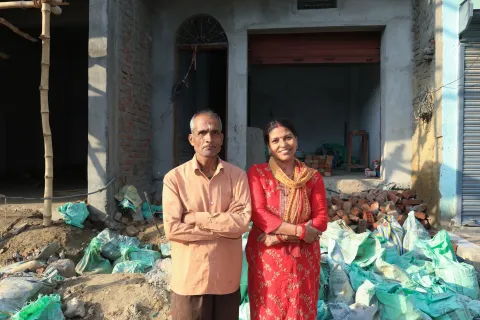
UNICEF Nepal/2025/RUpadhayay
“CSSMP training gave us the knowledge to keep students safe and to guide their families. Now, we map safe zones, teach calm response strategies and coordinate with parents to ensure children are picked up safely if needed,”
- Dhan Bahadur Gurung
Through drills at school, children carry knowledge home, turning their households into safer environments.
The programme’s influence is also tangible in the school grounds.
In Saptari, Shree Janata Primary School raised handpumps above flood level to ensure clean water, built brick fencing around play areas and trimmed trees that could fall during storms.


In Dailekh, schools installed fences and adjusted water faucets to be child friendly. Physical safety now accompanies educational safety, reflecting an understanding that learning thrives in secure environments.
Teachers report a transformation in their own roles and confidence. Thakur describes how coordinating with local organizations, police and the municipality during emergencies has strengthened his ability to guide both students and staff.
“I’ve learned how to protect myself and my students,” he says. “I feel empowered to lead the school safely and share knowledge with my colleagues and community.”
Students, too, feel the impact. Parwati shares that practicing safety drills gives her and her peers a sense of control and responsibility. They learn how to act during earthquakes, how to avoid dangers like flooding rivers and how to help injured classmates or family members.
Education officials recognize the wider benefits of CSSMP. Hari Narayan Sah, Education Officer at Hanumannagar Kankalini Municipality, shares, “This programme doesn’t just improve safety; it enhances teaching and learning. Students attend school regularly, enjoy learning and teachers are motivated to apply new skills. The positive cycle between motivated teachers and engaged students strengthens the entire school community”
Beyond individual schools, CSSMP supports Nepal’s broader policy priorities and development goals. By embedding disaster preparedness into daily learning, the programme advances the government’s commitment to safe and resilient schools, as outlined in national disaster management and education sector plans.

It contributes to Sustainable Development Goal 4, fostering inclusive, equitable, and quality education: children attend school regularly, feel safe and actively participate in learning. CSSMP also strengthens community engagement and local governance, encouraging municipalities, parents and teachers to collaborate on child protection and disaster risk reduction. In this way, the programme safeguards children while advancing Nepal’s vision of resilient, empowered and inclusive communities.
The programme embeds safety into daily life. Focal teachers continue mentoring peers, child clubs pass knowledge among students and families remain engaged. Even after direct support ends, schools maintain safety protocols and infrastructure. Children, parents and teachers are prepared not just to survive disasters, but to thrive despite them.
Across Saptari and Dailekh, the ripple effects are visible. Children arrive at school confident, ready to participate actively in lessons and carry knowledge home. Parents are better informed and prepared, and teachers feel empowered and supported. Schools have become safe havens, capable of withstanding hazards while fostering learning, leadership and community responsibility.

CSSMP demonstrates how education can extend far beyond academics. By combining safety education, infrastructure improvements and community engagement, the programme equips children to navigate their world confidently.
Knowledge moves from classrooms into homes, neighborhoods and entire communities.
Back in Hanumannagar Kankalini Municipality, as the sun rises higher, children gather their books and backpacks, ready for another day. Some will practice mock drills again, others will lead child club activities and many will share lessons learned with their families.
They do so with confidence, pride and a growing understanding of how they can shape their own safety and that of others.
As Thakur reflects, “The programme has changed our school, our students and our community. Children are no longer afraid. They are informed, confident and responsible. That is the real success of CSSMP.”
Through the continued support of the Government of Nepal, the European Union and UNICEF, the CSSMP is more than a safety initiative—it is a doorway to resilient, empowered and engaged communities, where children actively shape a safer future. Across the Terai plains, the hills of Dailekh and beyond, Nepal’s children are learning to keep themselves safe, care for others and thrive in schools where safety and learning go hand in hand.