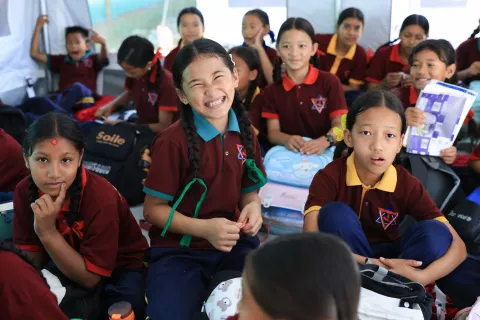
GIEN Strategy: Empowering girls and children with disabilities
In Nepal’s south, a deputy mayor reflects on how a joint initiative of the Girls and Inclusive Education Network has helped her municipality mainstream gender equality and social inclusion in education systems

Rautahat District: Chandrapur Municipality in Rautahat District in southern Nepal, with a population of 72,085 hailing from diverse ethnic backgrounds, faces significant educational challenges, particularly for girls, children with disabilities and people from marginalized communities.
Despite its cultural wealth, only 41.6 per cent of the population is literate, with 54.4 per cent unable to read or write.
However, all set to usher the municipality into a new era is the Deputy Mayor of Chandrapur, Jaymala Kumari Chaudhary – a survivor of child marriage herself.
In collaboration with a joint initiative of the Center for Education and Human Resource Development (CEHRD), UNICEF, the British Council and other members of the Girls and Inclusive Education Network (GIEN), the municipality has begun mainstreaming gender equality and social inclusion in education systems.
Indeed, Jaymala’s personal experiences fuel her commitment to GIEN’s goals, which include influencing policy changes to prioritize inclusive education and addressing barriers faced by girls and children with disabilities.
"My goal is to ensure that every child, regardless of their background, has access to quality education," she says.
GIEN and its related policies also establish mechanisms to monitor and evaluate progress, ensuring accountability and continuous improvement.
The joint initiative in disseminating GIEN's fived-year strategic plan clarified how GIEN's goals align with the Nepal School Education Sector Plan and highlighted the need for such a network to ensure quality and inclusive education.
This strategy is crucial as it clearly sets out the process of developing gender-responsive plans, operational policies and implementation arrangements, ensuring consistency and standard procedures across the country.
Jaymala is a steadfast advocate for the timely allocation of funds to inclusive and quality education programs, emphasizing the importance of inclusive education for individual growth, social equity and the economic prosperity of each municipality.
"As the coordinator for the GIEN in my municipality, I am committed to making it functional at both school and local levels, ensuring resources are in place and budgets are allocated to realise the vision outlined in the GIEN strategy," she asserts.
The dissemination events were part of the wider initiatives under UNICEF’s inclusive education work supported by the European Union, the Embassy of Finland, and the Let Us Learn foundation.
"GIEN serves as a platform for involving families, communities and local governments in promoting inclusive education initiatives," Jaymala explains. "Working together with different organizations is crucial for sustainable impact."