A future dance hall at Indira’s school
The joint EU-UNICEF project has constructed 650 such TLCs across nine earthquake-affected districts of Nepal.

- English
- नेपाली
Sindhuli, Nepal – Indira Shrestha was at her home with her Fupu (aunt) and her younger brother when the earthquake struck Nepal on 25 April 2015. They were taking a nap, Indira in bed and her brother and aunt on the floor. Indira had hardly closed her eyes when everything began shaking. She tried to wake her brother and aunt, but it was only after things started to fall that they awoke. Indira panicked and jumped out of the window onto the barn in the back. Thankfully she survived but with a major sprain that took about a month to heal completely. Her aunt and brother had come out taking the stairs.
Her house sustained some damage, although it was habitable with a few minor repairs. Her school however, had suffered a major blow.
The Sunkoshi Higher Secondary School in Khang Sang is located just above the main highway that winds towards Okhaldhunga District from Sindhuli. Two elongated buildings containing about four classes were badly damaged during the quake. The structures were made of large stones held together with mud.
Indira walks along these ruined structures now and finds it very disquieting.
“This is where we were taught,” she says looking at the blackboard tacked into the wall.
A section in one of the corners has a large gaping hole from where one can see tall hills from far beyond. The school was shut for about two months.
Indira lives nearby, so she could attend school once it opened. But many of her friends from far away could not as they had to walk hours to get to school. They also had to help around home after the quake.

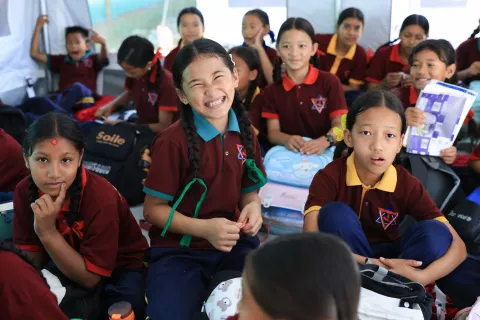
It was quite difficult to accommodate all students, so for a while studies resumed under two large Peepal trees in the school’s compound where extra-curricular activities used to be conducted. Of course, any bad weather meant classes were abandoned. Now Sunkoshi has two Transitional Learning Centres, made as part of the “Restoring Education in post-quake Nepal” project. The joint EU-UNICEF project has constructed 650 such TLCs across nine earthquake-affected districts of Nepal.
Indira praises the spacious TLCs and the amount of light it lets in. In the old buildings, she says, it was darker. The thing she likes most about school however is not the classes themselves, but taking part in “cultural programs", specifically dance competitions. She has been a regular participant at such events ever since she was a kid. Like many schools in rural Nepal, Indira's school doesn’t have a hall for such programs as it lacks resources to facilitate learning that is not included in the syllabus.
One of the benefits of the TLCs is that, as permanent reconstruction catches up and such structures are built in schools across the country, these transitional centres can easily be converted into libraries, halls, meeting rooms and many more venues.
When Indira hears this, she has a mixed reaction. An 11th grader, she will finish school next year and won't have an opportunity to use the TLC as a hall.
“But I will come to see programs in there,” she said.