Holding on to hope
A family soldiers on after the flood in southern Nepal, thanks to support provided by UNICEF a part of the Central Emergency Response Fund – Anticipatory Action

Saptari, Nepal: Over the years, Poonam Mandal and husband Mithu had grown wary of the recurring floods in and around their home in Tilathi Koiladi Rural Municipality in Saptari District in Nepal’s southern lowlands. Frustrated by the constant threat, they decided to tear down their mud house and build a cement one, believing it would offer the family a more secure future — especially keeping in mind their youngest son, Durga, who was born with a disability.
“We made this thinking we would be safer,” shares Poonam.
But the new house came at a heavy price. To afford the construction, the family had to take out a substantial loan — one they would be repaying for years. And despite their efforts, the security they had hoped for proved elusive.
When heavy floods hit Saptari in September 2024, their home remained standing, but the river ravaged their farmland. The experience was especially distressing for Durga.
“He was so scared, he didn’t want to stay in the house. He insisted on going outside,” Poonam recalls.
For families like theirs, pre-existing vulnerabilities make climate disasters even more devastating. The physical, emotional, and financial toll is heavier, adding to the daily struggles they already face. Unforeseen disasters not only disrupt their lives but also push them further into economic hardship.

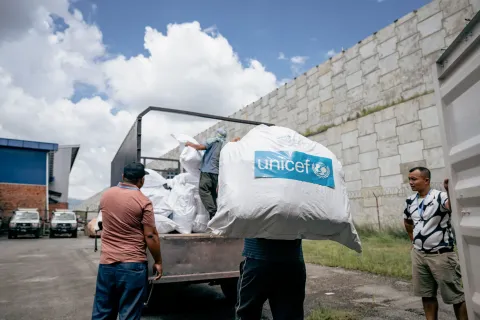
In response, with support from the Central Emergency Response Fund - Anticipatory Action, UNICEF partnered with the local government and organizations to provide timely and effective assistance to vulnerable households living in the Koshi and Karnali river basins.
As part of this initiative, Poonam’s family received NPR 15,000 in Multi-Purpose Cash (MPC).
“Each household has different needs, so by providing cash, families can use it for whatever their immediate priorities are,” explains Bishnu Maya Bhattarai, Social Policy Officer at UNICEF Nepal.
Mithu was taken by surprise when, soon after the flood, he received a message on his mobile informing him that NPR 15,000 had been deposited into his account. He hadn’t realized his family had already been identified as eligible for the assistance. The funds came as an immense relief.
With Durga’s medical needs in mind, the family used the cash to stock up on his medications and essential food items. They also set aside NPR 5,000 in Durga’s bank account — an emergency fund for his son’s future medical care.
In addition to the cash support, the family received essential water, sanitation, and hygiene (WASH) supplies, including aqua tabs, towels, soap, a brush, a comb, a bucket, a mug, a hygiene kit, and a mosquito net. “The water quality was not good, so the tabs came in handy,” shares Poonam, who also participated in a hygiene promotion session after the flood.
Now, the family’s focus is on ensuring Durga’s social and physical rehabilitation. “It doesn't matter what their condition is, you need to take care of your children,” Mithu says, his aspirations for Durga unwavering.
The couple dream of sending Durga to Kathmandu for better education opportunities. If they can raise the funds, they hope to provide their son with the future he deserves.