Building momentum in climate advocacy
Nepal’s youth prepare for COP29

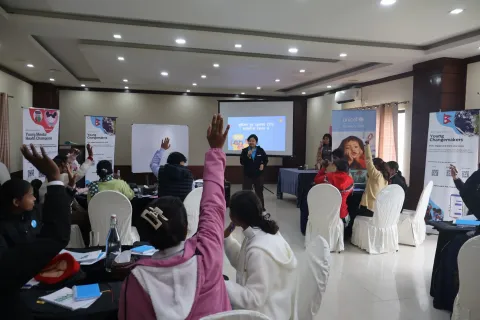
"Let’s make sure our voices aren’t just heard, but respected and reflected on the global stage," Dikshya Baral, Coordinator of Nepalese Youth for Climate Action (NYCA), urged young participants at a climate session held in Lalitpur on 28 October.
Emphasizing evidence-based advocacy and the role of young people in understanding and shaping climate policies, the session aimed to equip young Nepalis with relevant information and insights needed to participate – either virtually or in person – in the upcoming Conference of the Parties of the UNFCCC or COP 29, soon to be held in Baku, Azerbaijan.
Hosted by UNICEF in partnership with Clean Energy Nepal, NYCA, Sustainable Week Kathmandu (SWK), World’s Youth for Climate Justice, Youth Action for Sustainable and Eco-Nepal (YASEN), the event sought to prepare the young advocates to amplify Nepal’s climate issues, effectively represent their communities, and influence global climate discussions.


One of the speakers at the session, Manjeet Dhakal, head of the LDC Support Team and Director at Climate Analytics South Asia and climate change expert advisor to the Minister for Forests and Environment, applauded Nepal’s achievement in expanding its forest cover, a significant feat for a low-emission country with limited resources.
“If Nepal can make progress, why can’t major emitting countries step up?” he urged.
The need to include and elevate the voices of marginalized groups, including indigenous communities, was also echoed by many of the speakers, such as Deepa Oli, Undersecretary of the Ministry of Forests and Environment. Along the same lines, Sabin Lamichhane from Food and Agriculture Organization (FAO) emphasized the importance of using localized, contextual language in climate discussion so as not to exclude indigenous and local communities. Meanwhile, Barsha Lekhi from UNESCO referred to a side event during COP 29 where an Indigenous Pavilion is set to highlight the case of the Thame flood region.

On her part, UNICEF Nepal’s Emergency Specialist Sunita Kayastha explained why UNICEF places a high priority on equipping young people with the tools they need to advocate for change.
Because “The climate crisis is a child rights crisis.”
She also introduced UNICEF’s Youth Advocacy Toolkit, designed to help youth make their voices heard and create a meaningful impact.
The event also included a panel discussion, featuring Ugan Manandhar, Climate and Environment Advisor at the British Embassy in Nepal; Susmita Baidawar, Programme Officer at the Digo Bikas Institute; and Prakash Lama, Programme Coordinator at Clean Energy Nepal.
Panelists shared insights on the COP process, including challenges faced by least-developed countries in meeting climate targets, and the role of social media in raising awareness about the global climate agenda and progress made.

The event concluded with participants being grouped based on their thematic areas of interest for the upcoming COP. Both virtual and physical participants collaborated to form action-oriented teams, aiming to represent Nepal’s climate priorities effectively.
Filled with interactive sessions and practical insights, the event underscored the power of youth voices in global climate action.