On the road with Climate Cinema
Witnessing youth voices and climate realities

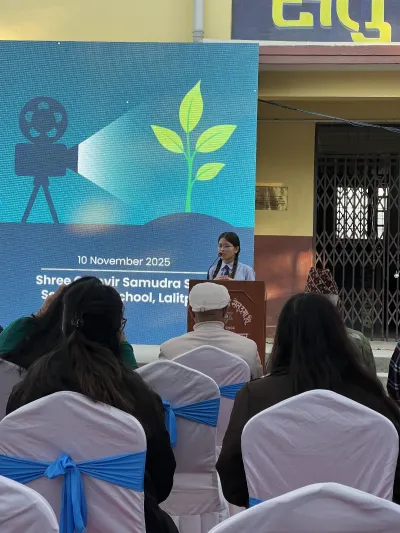
Shree Gamvir Setu Samudra Secondary School has been a longstanding part of Kathmandu’s educational landscape. When I visited, the school grounds were alive with fruit trees students had planted, students dashing around, waste bins neatly placed, and a volleyball court standing tall.
Just weeks earlier, before I set out to join UNICEF Nepal’s Climate Cinema journey, I watched a film about the same school. On my laptop screen, the campus lay submerged in floodwaters. Where students would normally be playing, there were scattered school supplies, a volleyball net, and a quintessential black water tank. The engineering building, named Samundra Bhawan, Sea Building in Nepali, stood half-submerged. This image felt cruelly ironic.
This was the reality Jayanti and her friends had endured when the water levels rose from the river beside her school. In the film, Jayanti documents how this disrupted not just classes, but her right to learn.

This is what Climate Cinema, a UNICEF Nepal initiative, had captured in films co-created with five young people from five provinces across Nepal. Each film highlighted how climate change has impacted their lives and education.
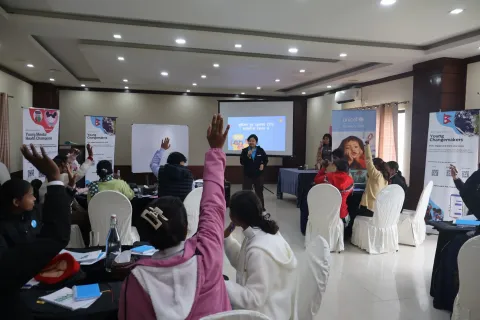
The films were not meant to remain on screen. A few months after filming, they were brought back to the children’s communities, where government representatives and community members were invited to watch and participate in post-screening discussions with students. This mobile cinema journey began in Dhangadhi, Sudurpaschchim Province, and travelled across Nepal to Surkhet, Karnali Province; Bhairahawa, Lumbini Province; Sarlahi, Madhesh Province; and Kathmandu, Bagmati Province. I joined the team for the final three stops.
From screens to reality: Seeing the communities up close
I started my journey from Bhairahawa city, where I met Shiksha, the young person featured in the Lumbini Province film. Her city had recently recovered from urban flooding that disrupted daily life. In her film, Shiksha recorded herself wading through ankle-deep water in her front yard that spills into the city streets.
Further east, in Sarlahi, autumn’s countenance had softened the extremities from seasons past. What I witnessed was gentler than what Pinki had filmed in the Madhesh Province film, but her words reminded me how harsh the earlier months had been. She recalled the relentless heatwaves and droughts.
The Climate Cinema journey culminated on Jayanti's school grounds. The place I had first seen in the film was now back in its “normal” state. Visiting these places in person, I was reminded that climate impacts are not always visible. Sometimes, they fade from view, unless we listen to those who lived through them.
When home is no longer safe
In her film, Jayanti also recounts moving to Kathmandu. She left not only to pursue better education, but to escape the landslide threats in her village in Kalikot.
“I left my village in Kalikot to come to the capital city in hopes of better education, but climate change continued to impact my right to learn.”
Disappointment rang in her voice.
Displacement is no longer exceptional. Across Nepal, people often move to cities seeking opportunities, but now children as young as fifteen are forced to relocate to continue their education or to simply survive.
Similar stories emerge across four other films, from life-altering moves to flooding, droughts, landslides, rising temperatures, and the loss of local flora and fauna.
Young lives shaped by climate change
Spending time with Shiksha and Pinki, it became clear how these experiences have shaped their late teens and early twenties. They were wise beyond their years, driven by a desire to better their communities. Yet as they joked, invited us for tea, and shared stories about their families, I was reminded that they are also simply young people.
As youth climate advocates, they’ve accomplished much, but the very fact that they had to become advocates so young reflects how deeply and unfairly climate change has affected them.


Nepal is among the most climate-vulnerable countries. Despite contributing least to its causes, children and young people bear a disproportionate burden. Climate Cinema captured these realities, and subsequent events created space for students to engage directly with government stakeholders and community members. Students asked pressing questions about COP30, about NDC and how they can be a part of it.
They also demanded accountability, on water usage, better environmental practices, and creating space for youth engagement. “Why are we planting more Eucalyptus trees when they consume excessive water and worsen droughts?” asked Sugandhi Yadhav, a Grade 10 student in Sarlahi. As an active member of her ward’s child club, she had been performing dramas on water scarcity and waste management for her community.


From the get-go, UNICEF Nepal had emphasised that this could not be a one-off initiative. Students echoed that call.
“Involve more schools to expand the campaign,” said Bibek Thapa, a Grade 10 student in Bhairahawa.
The enthusiasm was clear. Students were engaged and eager to contribute. And they called for stronger integration of climate change studies into their curriculum.

Taking action for the present and future
Nepal’s NDC 3.0 now reflects more youth involvement than ever. At the closing event, the Minister for Agriculture and Livestock Development committed to taking their messages to COP30 and received a special report capturing the voices and recommendations of young people from across the country.
These young people are actively shaping their future, but their present remains precarious. Policies must translate into real action to protect both their education and their communities. Actions that lessen displacements and protect communities from climate-induced hazards.
These young advocates are ready for a sustainable future, but the world must act to ensure their present is not lost in the fight against climate change.
Ankita is a UNV Communications Associate with UNICEF's Regional Office for South Asia.