Education Partners commit to continue supporting the education sector in Nepal
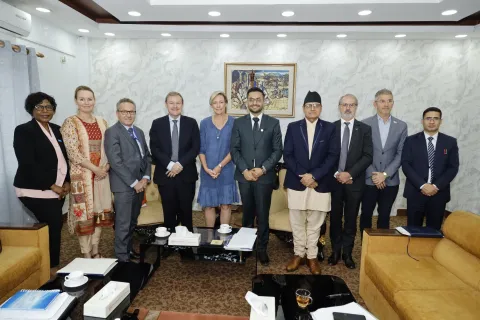
Kathmandu, 25 November 2024 – The Minister of Education Science and Technology Hon. Bidhya Bhattarai met with nine Joint Financing Partners to highlight the challenges facing the education sector in Nepal, as well as opportunities for improvement. Nepal has made good progress in increasing school enrolment, however, a consistent concern is the low learning outcomes, as evidenced by the latest grade ten exams. The Minister appreciated the education partners’ support and requested for continued commitment to improving the quality of education in Nepal. She also explained government priorities that include full implementation of Compulsory and Free Education Act, enhancement of learning achievement of students within the entire school system and utilization of ICT in teaching pedagogy in all schools of Nepal.
The meeting was held as part of the Joint Review Mission (JRM) of the Government of Nepal’s School Education Sector Plan (SESP). The JRM was led by the Ministry of Education, Science and Technology (MoEST) with close engagement of the Asian Development Bank, Embassy of Finland, European Union, Foreign Cooperation and Development Office (UK), Global Partnership for Education, Royal Norwegian Embassy, USAID, UNICEF and the World Bank. Other members of the Local Education Development Partner Group also join the mission. The close collaboration between these education partners is internationally lauded, as it ensures close convergence and coordination between each partner’s responsibilities.
The Joint Review Mission assessed the progress and accomplishments of the Plan's second year of implementation. During the opening session, stakeholders reaffirmed their shared commitment to enhancing learning outcomes for Nepal’s children. While recognizing significant achievements, the session also highlighted the critical need for sustained efforts to address existing gaps.
The Secretary of Education Dr. Dipak Kafle emphasized the need for management, accountability, capacity building and collaboration in the delivery of educational services under SESP through the three-tier governance system.
The education partners appreciated the MoEST's recent achievements, including the approval of the School Midday Meal National Framework, the rollout of the Recovery and Accelerated Learning (REAL) Plan in local governments to ensure learning continuity, advancements in unified local-level planning, and updates to the Teachers Professional Development Framework.
The inclusion of joint inter-ministerial meetings in this Joint Review Meeting (JRM) was celebrated as a significant milestone. These collaborations with key ministries, such as the Ministry of Finance and the Ministry of Federal Affairs and General Administration, particularly in developing capacity for good governance and public financial management, are expected to enhance education delivery nationwide.
On behalf of the Development Partners, Country Director of the Asian Development Bank Mr. Arnauld Cauchois appreciated the progress made over the past two years under the SESP and assured the partners' support to the rest of the programme period in order to achieve the unfinished targets.
As Nepal moves towards graduating from Least Developed Country (LDC) status, focusing on improving learning outcomes becomes increasingly critical for unlocking the nation’s full human capital potential. While the survival rate to Grade 12 has risen to 37.2 per cent, this remains insufficient to drive higher productivity, innovation, and economic participation of Nepal’s young population. Similarly, less than half of Grade 10 students passed the most recent Secondary School Exam, and national student assessments from 2022 revealed stagnation and declines in learning outcomes, exacerbated by the COVID-19 pandemic.
To address these issues, the education partners called for increased investment in quality teaching as well as a focus on both technical and soft skills in schools. Another priority is to make schools resilient to disaster risks, particularly in light of increasing climate challenges.
The JRM will culminate in a set of agreed actions to refine strategies and ensure the continued success of the sector plan, with the ultimate goal of delivering quality education for every child in Nepal.