The red and white packets giving Bendita a chance to recover
UNICEF, with the generous support of the European Union through the NutriNorte programme, is supporting the Government of Mozambique to strengthen nutrition services in Cabo Delgado, Nampula and Zambézia.

Namuno, Cabo Delgado - During the rainy season, the road to Mahurussi becomes too difficult for cars. The only way to reach the community is on foot or by motorbike, along muddy paths that cut through the fields and bush.
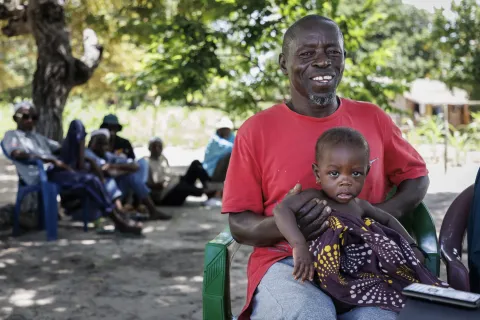
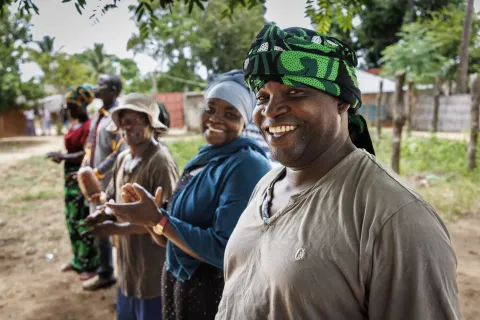
On this day, the mobile health brigade arrives by motorbike and sets up in the shade beneath a cluster of tamarind trees. Mothers gather with their children, waiting for vaccinations, nutrition screening, and other essential health services that would otherwise be several hours away.
This mobile brigade is supported by NutriNorte, a European Union-funded programme launched in 2024 to improve nutrition and well-being among children under five, adolescents and women in districts with high levels of undernutrition in Cabo Delgado, Nampula and Zambézia.
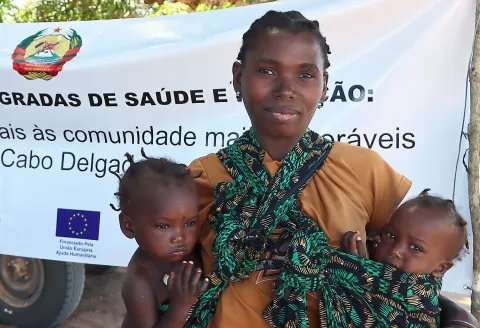
Among the gathered crowd is 23-year-old Claudina Jose, carrying her 18-month-old daughter, Bendita Celeste. Claudina lives in Mahurussi with her husband and four children. Like many families in the community, they depend on farming for food and income.
Neither Bendita nor Claudina’s other young child appeared sick that morning. She had come because she heard the mobile brigade was visiting.
“I brought them to be checked,” Claudina says. “I come as often as I can.”
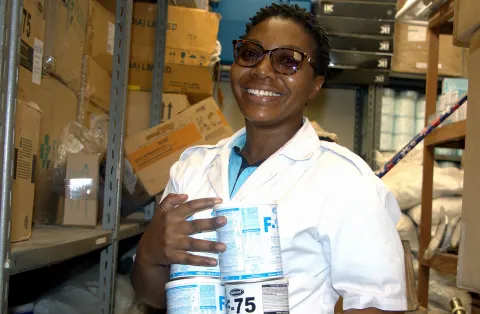
After weighing Bendita and measuring her upper arm, a community health worker tells Claudina that the little girl is underweight and too thin. Bendita is given ready-to-use therapeutic food (RUTF), small red and white packets of a nutrient-dense, peanut-based paste specially formulated to help children with malnutrition gain weight and recover. The packets do not need to be cooked, mixed with water or refrigerated, making them especially useful for children being treated at home in remote communities like Mahurussi.
Bendita rests in her mother’s arms, eating from one of the packets of therapeutic food that Claudina has just received.
“The health worker said Bendita was underweight and too thin,” Claudina says. “He gave me these red and white packets to give to the baby. I have to give her one in the morning and one in the evening for a week, then return to see a community health worker to check Bendita’s progress.”
Bendita had last been checked three months earlier, and the news comes as a shock to Claudina.
“Before today, I did not know my baby was underweight or malnourished,” Claudina says. “I realise now that I waited too long to bring Bendita to the mobile brigade. I will come every month from now on.”
In Mozambique, malnutrition remains a serious threat to children’s health and development.
Around 37 per cent of children under five are stunted, meaning they are too short for their age as a result of chronic undernutrition, while one in six children is malnourished. Stunting can affect a child’s brain development, learning, immunity and future earning potential, with long-term consequences for families, communities and the country’s economic growth. Severe wasting, another form of malnutrition, can become life-threatening if it is not detected and treated quickly.
For families in remote communities such as Mahurussi, distance can make a child’s access to care difficult.
“The nearest hospital is a three-hour walk, so I am thankful that the mobile brigade comes to our community each month,” Claudina says. “The mobile brigade is very close and easy to come to, while the hospital is far away.”
Claudina clutches her yellow health card tightly before placing it into a plastic folder alongside the cards of her other children. For her, the card is a reminder to return, to keep checking, and to act before illness becomes visible.
“It is very important to get a baby weighed and have the arm measured,” she says. “Sometimes you cannot tell if a baby is underweight or not.”
Before leaving the shade of the tamarind trees, Claudina has one message for other mothers in her community.
“Bring your babies to the mobile brigade or to the nearby health facility every month,” she says. “If they do not go, the baby can get sick like my baby Bendita. Don’t make the same mistake as me.”
UNICEF, with the generous support of the European Union through the NutriNorte programme, is supporting the Government of Mozambique to strengthen nutrition services in Cabo Delgado, Nampula and Zambézia, including by helping mobile brigades bring nutrition screening, counselling and treatment for child wasting closer to children and families in remote communities.