When laughter opens the door to healthier habits
UNICEF, with the generous support of the European Union through the NutriNorte programme, supports the Government of Mozambique to strengthen nutrition services in Cabo Delgado, Nampula and Zambézia.
Mahurussi, Cabo Delgado - In Mahurussi community, in Namuno district, a patch of flat ground has become a stage.
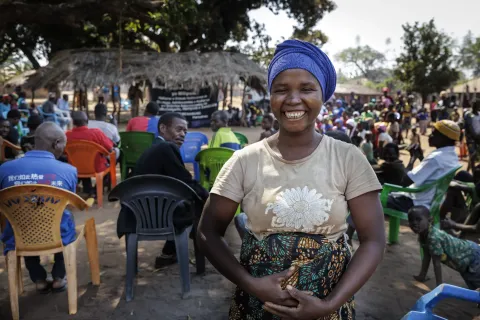
School desks and chairs have been dragged outside and arranged in a circle. Community elders sit at the desks and on a few chairs. Children sit on the ground at the front, looking up at the performers. Others stand behind them, waiting for the show to begin.
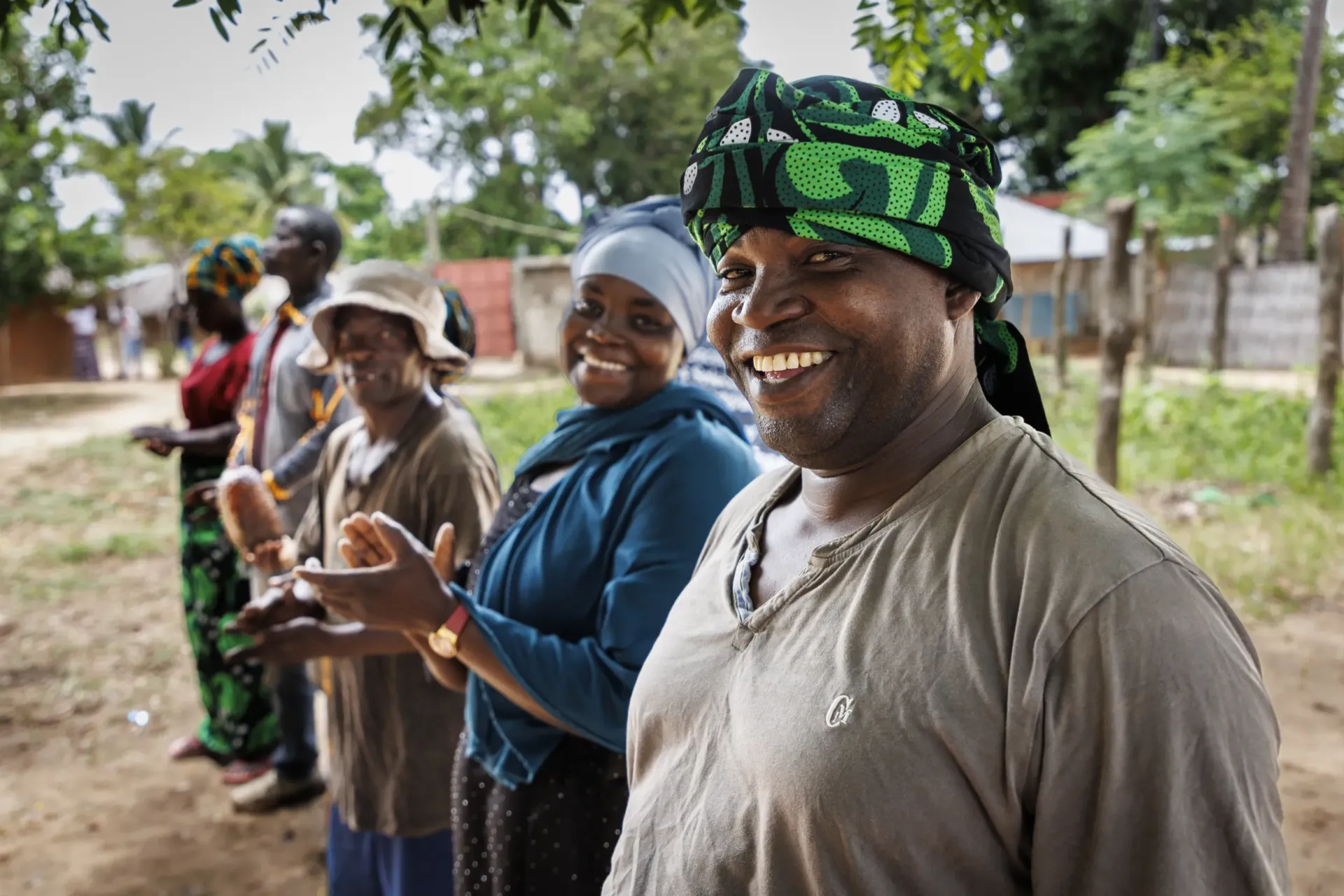
At the centre is Januario João Adriano, 46, the leader of a travelling theatre group. He is not tall, but he fills the space around him with a broad smile, a booming voice and an easy command of the crowd.
Within seconds, the audience is cheering and laughing.
The message is serious, but the delivery is full of humour, music and drama, which makes people reflect about their lives. During the 40-minute performance, Januario and the six other members of the group use songs, dancing, skits, slapstick humour and short speeches to share health and hygiene messages in Makua, the local language.
The approach draws on Theatre of the Oppressed, a participatory methodology developed by Augusto Boal, using performance to spark reflection, dialogue and community-led action.
Today’s performance focuses on the importance of using a latrine and washing hands. These messages are closely linked to nutrition. In Mozambique, almost four in ten children are affected by chronic malnutrition, or stunting, a condition driven by many underlying factors, including poor diets, repeated illness, unsafe water and poor sanitation. When children suffer from diarrhoeal disease, they may not absorb the nutrients they need to grow and stay healthy.
“We have seven people in our theatre group and we cover the Makua-speaking communities across Namuno district,” says Januario. “Each show has different messages, including nutrition, child marriage, hygiene, malaria and the prevention of water-borne diseases.”
The group is made up of people from Namuno district. For Januario, that matters. They know the language, the humour and the realities of the communities they visit. Their work is peer-to-peer communication, carried from one community to another by people who understand the local context.
In Mahurussi, dozens of people arrive early to get a good place to watch. By the time the performance begins, all seats are filled, and many spectators are left standing.
The show moves quickly. In one scene, Januario plays a husband in a domestic setting. In another, he becomes a schoolteacher, turning the crowd into his students. In another, two women chat at a water point. Each sketch brings a familiar situation to life, helping the audience see how everyday choices can affect the health of children and families.
“Theatre is a great way to communicate these messages,” says Januario. “Many people in this community do not know how to read or write. Theatre can catch their attention and help change behaviour and replace unsafe habits.”
In remote areas of Cabo Delgado, access to information can be limited. Written materials do not reach most people, and not all community members are able to read them. Travelling theatre helps bridge that gap by bringing messages directly to families in a way that is accessible, memorable and shared in their own language.
“People come to be entertained and to laugh,” Januario says. “They leave with new ideas and life saving information. They see that the changes are simple, but they can have a big impact on their families.”
Januario says he has already seen changes in how some issues are discussed.
“I have noticed changes in attitudes towards child marriage here,” he says.
UNICEF, with the generous support of the European Union through the NutriNorte programme, supports the Government of Mozambique to strengthen nutrition services in Cabo Delgado, Nampula and Zambézia. Through NutriNorte, UNICEF also helps the travelling theatre group bring key messages to isolated areas like Mahurussi by supporting theatre training and transport.
When the performance ends, the stage returns to being a simple patch of ground. The desks and chairs will be carried back, and the crowd will return home. But thenew learnings and critical thinking will continue to travel through conversations, families and daily routines.
“People are never too old to learn something new and improve their skills,” Januario says.