A new latrine brings safer hygiene to Belinha’s family
"Now I am happy because we have our own latrine. We no longer have to cross the village to use my mother’s."
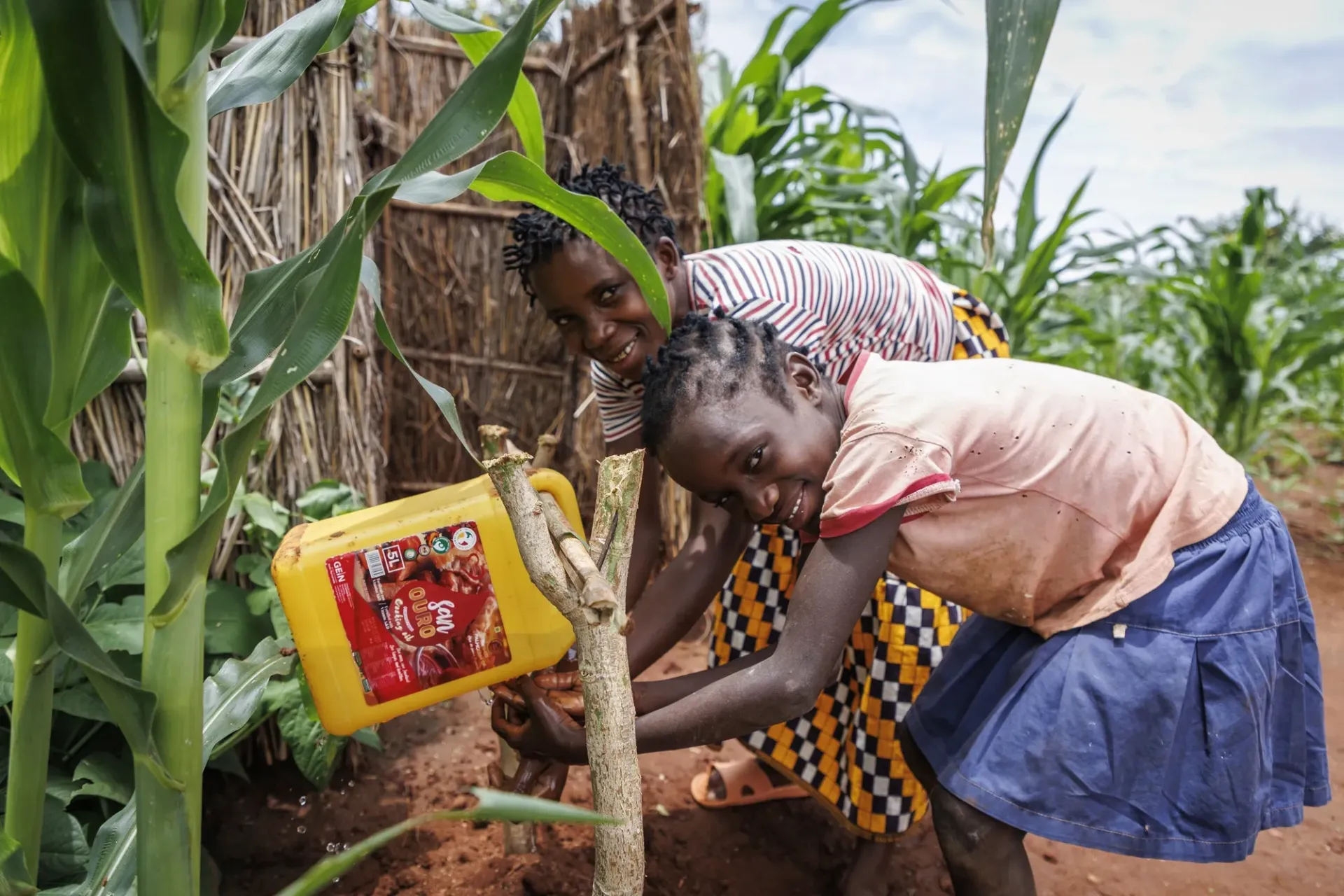
Ocua, Cabo Delgado - Eight-year-old Didacia Faruque steps out of the family’s new latrine and presses her foot against a wooden lever beside it. A five-litre container tips forward, releasing a small stream of water over her hands.
“It is important to wash our hands after using the latrine so that we do not get diarrhoea or cholera,” says Didacia, a Grade 5 pupil. “They teach me these lessons at school, and my mother reminds me every day.”
The simple handwashing device, known as a tippy tap, is made from sticks, string and a reused plastic container. Together with the latrine standing a few metres from their home, it has made daily life safer and easier for Didacia and her mother, 24-year-old Belinha Bonifacio.
Until two months ago, the family did not have a latrine of its own.
“We had to walk to my mother’s house on the other side of the village whenever we needed to use one,” Belinha says. “It was difficult, especially for the children.”
The family had already faced a difficult period after Cyclone Chido struck northern Mozambique in December 2024.
“The cyclone destroyed our house,” Belinha recalls. “It took off the roof and knocked down all the walls.”
As families rebuilt, community workers began sharing information about safer sanitation practices through the WASH component of the NutriNorte programme. The programme is implemented in the community by the district government with support from UNICEF and funded by the European Union.
The process begins with a public meeting where residents discuss the importance of using latrines, washing their hands and preventing illnesses linked to poor sanitation. Members of the community WASH committee and WASH activists then visit households to provide more practical guidance.
“I attended the community meeting and learned why every family should have a latrine,” Belinha says. “I wanted to build one for my family.”
When a WASH activist later visited her home, Belinha learned how to construct a latrine and tippy tap using materials available in the community. The worker returned afterwards to check that both had been built correctly.
The latrine has strong walls made from bricks and clay, with a bamboo roof. The design is intended to be more resilient to the cyclones, floods and heavy rainfall that regularly affect Mozambique. Because the materials can be found locally, families do not need to spend money buying imported materials.
“Now I am happy because we have our own latrine,” Belinha says. “We no longer have to cross the village to use my mother’s.”
Belinha and Didacia live in Mahurunga, a community of 2,182 families. Community leader Pascoal Farjala, 54, is also a member of the local WASH committee. He says combining large public meetings with household visits has helped change people’s habits.
“We first gather the whole community to discuss hygiene and sanitation,” Pascoal says. “Then we go door to door and speak with each family. Together, these two approaches are very effective.”
Mahurunga has eliminated open defecation, while community workers continue encouraging every household to build and maintain its own latrine and handwashing facility.
“The situation has changed greatly,” Pascoal says. “Most families now have a latrine, and we are seeing fewer cases of illnesses such as diarrhoea at the health centre. I am very proud of the progress the community has made.”
For Belinha, the message is simple.
“I hope every family will build and use a latrine so that we can prevent cholera, diarrhoea and other diseases,” she says.
Beside her, Didacia washes her hands once more, repeating a routine that is now part of everyday life at home.