Strengthening local decision-making for a more effective education system in Madagascar
Data Must Speak SCALE
- English
- Français
- DMS SCALE (Strengthen Capacity and Advance Local Evidence Use) aims to empower local actors in the Malagasy education system by providing them with tools and skills to effectively use the data they collect – enabling rapid and context-specific decision-making.
- DMS SCALE builds on the Positive Deviance research, which identified successful behaviours and practices in schools that achieve exceptional results. It promotes a co-creation approach –working with national experts to develop solutions tailored to local realities.
- By strengthening local capacities and improving information exchange between central and local levels, DMS SCALE supports Madagascar's transition towards effective decentralization, making the education system more resilient and capable of responding efficiently– especially during crises or natural disasters.
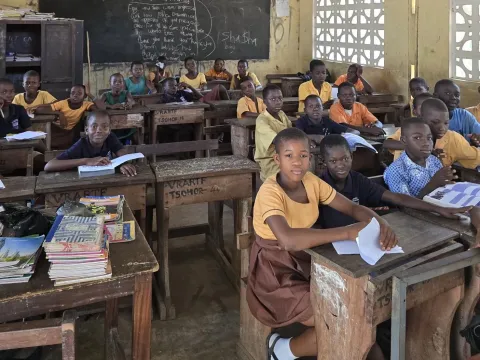
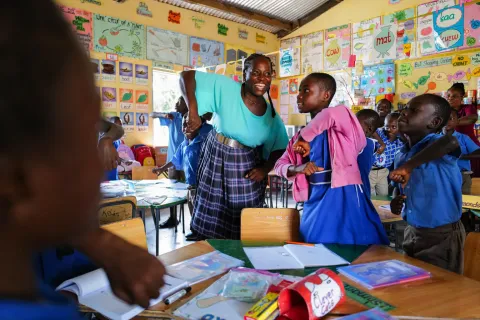
Rasoa is a school principal in a Malagasy village. Every day, she faces numerous challenges: overcrowded classrooms, a shortage of qualified teachers, and insufficient teaching materials. “We collect and send a lot of data on our school’s management, but sometimes we lack the tools, training, or autonomy to use this data in our day-to-day decision making. For example, to know which classes require more attention or where additional teaching support is needed,” she says.
Since 2021, Madagascar Ministry of National Education (MEN) and UNICEF's Data Must Speak (DMS) research team have been collaborating to identify positive deviant schools—schools that achieve better learning and promotion outcomes than others in similar contexts and with equivalent resources. Together, the MEN and UNICEF have managed to identify behaviours and practices that help these schools stand out positively. These schools benefit from more frequent visits and support from local pedagogical advisors, education authorities, and community members – contributing to their exceptional performance.
Building on these findings, the new DMS SCALE research aims to equip actors within the decentralized system and school principals like Rasoa with the skills to use data for rapid, context-appropriate decision-making. By strengthening their capacity to manage and analyze the data they already collect, DMS SCALE aspires to support Madagascar in providing better-quality, more resilient education to all Malagasy communities.

A deconcentrated education system transitioning to decentralization
Madagascar’s education system operates under a deconcentrated structure, with decision-making authority distributed to local representatives of the central government. This structure includes 23 Regional Education Directorates (DREN) which oversee education at the regional level and 114 School Districts (CISCO), responsible for coordinating district-level educational and administrative activities. At the commune level, around 1,848 Administrative and Pedagogical Zones (ZAP), led by ZAP chiefs, provide training and monitoring support to school principals and teachers – ensuring a direct connection to schools.
The push for decentralization—transferring more authority to local governments—is emphasized in strategic documents such as the 2022 Madagascar Emergence Plan, the 2023 National Plan for Emerging Decentralization, and Law No. 2022-018, which outlines the overarching framework for Madagascar’s education system. These policies aim to strengthen local governments’ capacity to make decisions adapted to their communities.
However, despite this policy emphasis on decentralization, decision-making power remains largely centralized. Rivo Nambinina Ramboatiana, a research officer at the Education Statistics Service, explains: “We primarily analyze administrative education data at the central level. The lack of skills, time, and resources makes it difficult for ZAP chiefs or school principals to make decisions that directly improve school outcomes at their level.”

DMS SCALE: Continuing research on positive deviant schools to empower local decision-makers
DMS SCALE builds on the DMS positive deviance research, which identified the behaviours and practices directly linked to better school performance. These findings included the importance of strengthening local education authorities’ capacities to take evidence-based decisions. Moreover, DMS SCALE also encourages a co-creation approach – conducting research collaboratively with national technicians.
“Co-creation allows us to leverage local expertise,” says Voahangy Rahelmanantsoa, Head of Department at the Education Planning Directorate. Solutions are not imposed; they are developed collaboratively with those who know their regions, districts, communes, and schools best.
In Madagascar, DMS SCALE focuses on two key strategies:
- Improving information exchange between local and central levels: better feedback will help decentralized system actors support localised decision-making.
- Strengthening the skills of local education actors: training school principals and DREN, CISCO, and ZAP managers to use data to improve day-to-day management. Activities will be organized to help them access, understand, and utilize data for informed and sustainable decision-making.
What does DMS SCALE mean for principals like Rasoa and local education actors in Madagascar?
For principals like Rasoa, this means they can better utilize the information they collect to improve their schools and provide students with the education they deserve. Additionally, in a country like Madagascar, often struck by natural disasters, DMS SCALE can play a crucial role. By strengthening skills and providing tools to principals and local education authorities, this research aims to support them in making swift and effective decisions in case of emergencies. As Bodo Fandresena Toavinarivelo Nirinalisoa, Head of Department at the Pedagogical Inspection Directorate (DESIP), emphasizes: “In times of crisis, quick and localised decision-making is essential.”
Authors: Solo Mandimbihery Rakotosoa, Director of Education Planning, Madagascar Ministry of National Education; Mamy Andrianarilala, Monitoring and Evaluation Specialist, UNICEF Madagascar; Chandni Jain, Education Researcher, UNICEF Innocenti