Lasting gains
The power of implementation research to improve education in Egypt
In 2025, nearly 185,000 of Egypt’s most vulnerable young learners gained measurable reading skills. Seven months later, they had not lost them. Behind that result is a deliberate approach to evidence: research designed to work inside a real programme, at scale. Egypt’s Ministry of Education and Technical Education (MoETE), supported by UNICEF, launched an ambitious national effort to accelerate foundational literacy. Globally, it is estimated that close to 70 per cent of 10-year-olds cannot read and understand a simple paragraph – Egypt is taking that challenge head on. The National Arabic Literacy Programme (NALP) was rolled out across almost 1,000 schools in 10 governorates, targeting struggling learners with Arabic language teaching, structured lessons, dedicated materials, and additional teaching time over a focused 12-week period.
Big programmes like these come with big questions. Did it work? And just as importantly, why did it work or not work?
To answer these questions, UNICEF Egypt engaged with UNICEF’s Office of Strategy and Evidence – Innocenti, to embed implementation research directly into the programme as it unfolded. The aim was to generate credible analysis fast enough to support decision-making.
What the evidence revealed
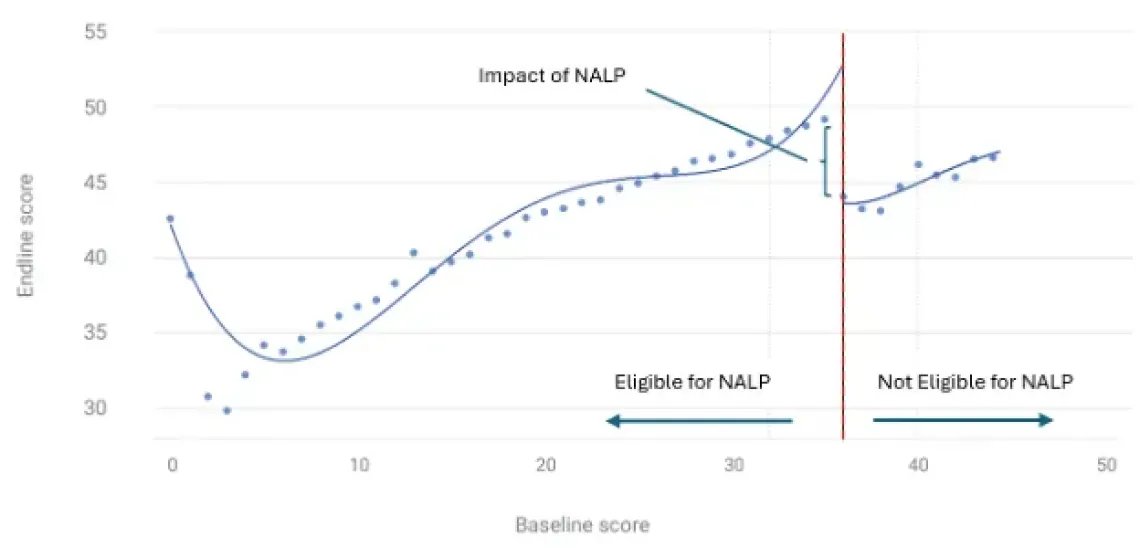
The findings were clear and encouraging. The NALP programme had a strong, positive impact on children’s learning, with measurable improvements in Arabic language skills by 17 percent. Because the research used rigorous quasi-experimental methods, the results were discussed and interpreted with confidence among the research team, government counterparts, and partners.
Figure 1. The impact of the NALP estimated through a Regression Discontinuity Design
Do the learning gains last?
Recent follow-up data provides an encouraging view that these learning gains persisted over time.
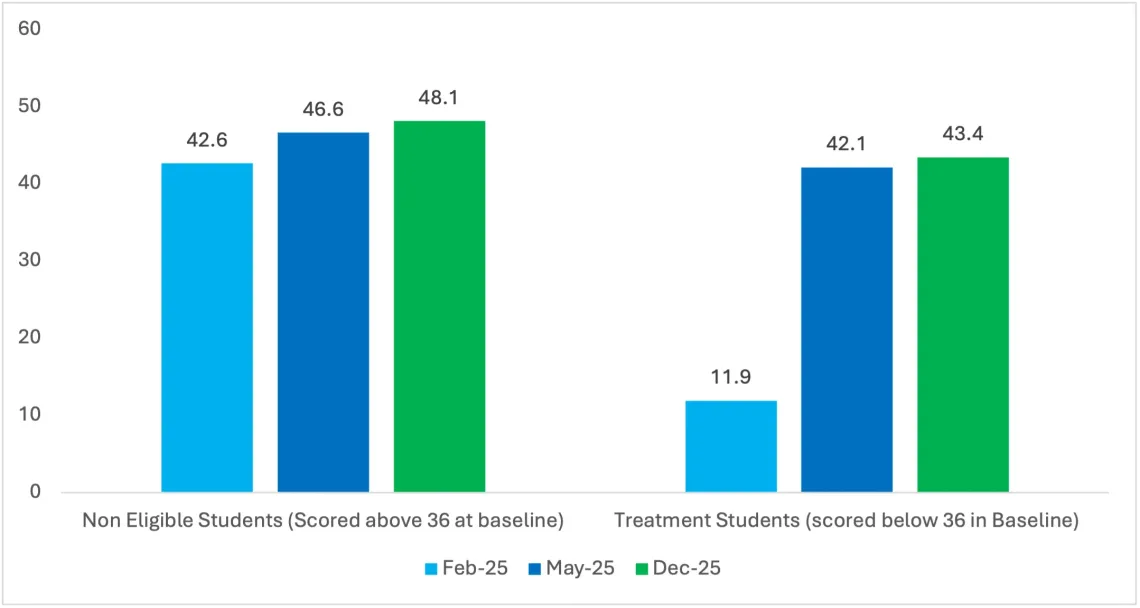
- Initial jump: prior to the NALP treatment students (the most vulnerable learners) started with a baseline mean score of 11.9 out of 60 (conducted in February 2025) and this surged to 42.1 at the endline (conducted May 2025).
- Sustained success: in follow-up assessments conducted 7 months after the programme concluded (December 2025), these same students maintained, and even slightly grew, their skills to a score of 43.4.
The data show that the NALP closed the gap between the most vulnerable and their peers and this progress persisted over time. This result is based on a large, robust sample of 185,697 students, providing an estimate which reflects real life implementation across 1000 schools, a large scale result.
Figure 2. The evolution of Average Literacy Scores over time (NALP participants vs. nonparticipants)
Implementation Research means meeting implementers where they are
To conduct this research within a large-scale programme took coordination, flexibility, trust and communication. Together, the research and implementation teams identified the right methodology for the context.
Schools had been pre-selected for the programme so a randomized trial was not feasible, but the programme’s eligibility cut-off score provided the opportunity for regression discontinuity design. This quasi-experimental design made it possible to produce rigorous impact estimates within the real-world constraints of a large scale rollout.
Close collaboration with the Ministry of Education and Technical Education and the National Center for Examinations and Educational Evaluation (NCEEE) made it possible to leverage rich administrative data already being collected. This allowed the team to assess impact and implementation quality without creating costly, parallel systems.
From evidence to fast action
What stands out in Egypt is the speed of the evidence-to-action cycle. Four months after engaging with the research team at Innocenti, and two months after the programme concluded, findings were presented to the Minister of Education and Technical Education.
The evidence directly informed the government’s decision to scale up the programme to 10 additional governorates. Beyond final scores, insights into how the programme worked across different contexts mattered even more. Qualitative feedback from teachers highlighted where additional support was needed, and implementation findings helped refine training, materials, and delivery approaches for the next round. Evidence was not treated as a retrospective exercise - it became a tool for continuous improvement.
Why this matters
For governments and development partners, the Egypt experience offers a blueprint: evidence is most useful when it is generated inside real programmes, implemented at large scale.
When research adapts to implementation realities, rather than the other way around, it allows leaders to move at the speed of decision-making. In a context where policy windows are short and stakes for children’s future are high, that ability to turn real-time information into decisions can change lives. As the NALP programme expands and evolves research continues to be at the core, stay tuned for what’s next.
The National Arabic Literacy Programme in Egypt is supported by the German Government through KfW Development Bank.
At the time of publishing, Thomas Dreesen holds the position of Education Manager at UNICEF Office of Strategy and Evidence – Innocenti, and Shiraz Chakera is Chief of Education for UNICEF Egypt.