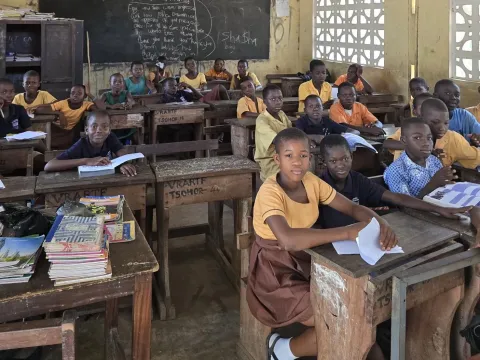
What works in positive deviant schools
Practices of successful schools that improve education outcomes
Picture this: A government primary school in Ethiopia consistently outperforms the school just down the road, despite having the same number of teachers and learning materials, and a similar quality of facilities. For the principal at this school, success lies in teachers that are well-supported and well-trained. The principal specifically pairs less engaged teachers with more active colleagues, while new teachers benefit from dedicated training and mentoring programmes. According to the school principal:

“We facilitate a one-to-five mentoring structure (one highly engaged teacher supporting five other teachers) to foster a collaborative environment focused on teaching and learning tasks. This set-up has significantly reduced the number of issues brought to me and the vice principals.”
This school is not alone. Across 13 education systems spanning Africa, Asia, and Latin America, UNICEF Innocenti’s Data Must Speak (DMS) positive deviance research has identified positive deviant schools – or those schools that achieve better education outcomes compared to their peer schools despite operating in similar contexts and with similar resources.
What are some of the specific practices of positive deviant schools that support children’s success? Here we preview three:
Positive deviant schools leverage local oversight and shared accountability for better teaching practices: In positive deviant schools, supporting effective teaching is not just the responsibility of the school leader. Decentralized education officers overseeing positive deviant schools also play an important role in improving teaching quality. In Chad, pedagogical supervisors provide more meaningful and practical support through interactive simulations and targeted trainings based on classroom visits. And in Ghana, school improvement support officers visit schools, provide targeted training, and help leaders and teachers adjust instruction using exam results and classroom observations.
Positive deviant schools also foster closer collaboration with the broader school community through information meetings with parents and caregivers, encouraging them to take an active role in their children’s learning and gathering feedback from students on their teacher’s performance. One school committee chair in Nepal shares:
“I employ a multifaceted approach to monitor and support our teachers. Firstly, I convene regular meetings with the teaching staff to provide constructive feedback and offer suggestions for improvement […] Additionally, I seek input from students to gauge their perception of their teachers’ performance. This feedback is instrumental in identifying areas of strength and potential areas for growth.”
Teachers in positive deviant schools differentiate their instruction and foster cooperative learning to support students’ diverse needs: Pedagogical approaches in positive deviant schools position teachers as key facilitators of learning, while students take an active role in their own learning and guiding and supporting each other.
Teachers in positive deviant schools use differentiated instruction, adapting their teaching methods for students’ different learning levels. In Chad, Madagascar, Mainland Tanzania, and Zanzibar, teachers use formative assessments to identify students who need additional support with foundational skills. These teachers then provide targeted support sessions during or after school to help these students catch up. In other cases, teachers organize students into flexible learning groups and adjust lesson pacing to ensure that no one is left behind.
Cooperative learning is also central in positive deviant school classrooms. Teachers specifically create small-group discussions and collaborative projects that give students opportunities to work together. For instance, in Côte d’Ivoire, students are asked to explain concepts to each other before moving on to new topics. In Lao People’s Democratic Republic, teachers establish reading circles, where students take turns reading aloud and discussing texts. Teachers leverage cooperative learning strategies not only to reinforce academic content but also to strengthen communication, teamwork, and leadership skills among students.
By combining differentiated instruction with cooperative learning strategies, these schools create inclusive environments where all learners are supported.Positive deviant schools amplify students’ voices and agency: Positive deviant schools amplify students’ voices, creating space for them to speak up and contribute to school life.
For example, in Mainland Tanzania, Nepal, and Zambia, positive deviant schools have anonymous feedback boxes for students, creating avenues for them to voice their safety and well-being concerns without fear of retribution. In Togo, positive deviant schools give students a more active role in school governance. Some schools appoint students as “presidents” or “ministers” to solve challenges and include student perspectives in extracurricular activities, giving them a voice in school life and boosting their engagement.
The DMS research also found that amplifying students’ voices through school clubs fosters a culture of inclusion, safety, and shared accountability. A school principal in Ethiopia describes:
“For example, in the past, when female students experienced their menstrual cycle, they would face challenges and keep it to themselves without telling anyone. However, with the establishment of the women's club, they have gained awareness [… which] has empowered them to openly discuss it with others. … This increased awareness and open communication have greatly improved the students' overall performance and well-being.”
Positive deviant schools thrive not on special resources, but on the collective practices of their communities. These schools also demonstrate that locally rooted practices are already driving meaningful improvements in learning outcomes.
Let’s listen, learn, and amplify these locally led practices. Because when we do, we don’t just improve education outcomes for children, we empower schools and the students and communities they serve.
The full report, with the list of practices and behaviours of positive deviant schools, is accessible here.
The Data Must Speak (DMS) positive deviance research aims to mitigate the learning crisis by using existing data to understand the behaviours and practices of positive deviant schools – or schools that outperform their peer schools despite operating in similar contexts and with similar resources. It is co-created and co-implemented with Ministries of Education, partners, and key stakeholders. The DMS research relies on mixed methods and innovative approaches (i.e., positive deviance, behavioural sciences, implementation research, and scaling science) to generate knowledge and practical lessons about ‘what works,’ ‘why,’ and ‘how’ to scale grassroots solutions for national policymakers and the broader international community of education stakeholders.
The DMS research is implemented in 15 countries: Brazil, Burkina Faso, Chad, Cote d'Ivoire, Ethiopia, Ghana, the Lao People’s Democratic Republic, Madagascar, Mali, Nepal, Niger, the United Republic of Tanzania, Togo, Viet Nam, and Zambia. It is made possible through a coalition of donors: Global Partnership for Education Knowledge and Innovation Exchange, a joint endeavour with the International Development Research Centre (IDRC), Hewlett Foundation, Jacobs Foundation, Norwegian Agency for Development Cooperation (Norad), Schools2030 initiative (Aga Khan Foundation), and UNICEF internal resources.