Somalia Appeal
Humanitarian Action for Children
UNICEF’s Humanitarian Action for Children appeal helps support the agency’s work as it provides conflict- and disaster-affected children with access to water, sanitation, nutrition, education, health and protection services. Return to main appeal page.
Somalia snapshot
Appeal highlights
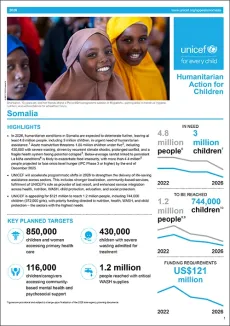
- In 2026, humanitarian conditions in Somalia are expected to deteriorate further, leaving at least 4.8 million people, including 3 million children, in urgent need of humanitarian assistance. Acute malnutrition threatens 1.85 million children under five, including 430,000 with severe wasting, driven by recurrent climate shocks, prolonged conflict, and a fragile health system facing potential collapse. Below-average rainfall linked to persistent La Niña conditions is likely to exacerbate food insecurity, with more than 4.4 million 5 people projected to face crisis-level hunger (IPC Phase 3 or higher) by the end of December 2025.
- UNICEF will accelerate programmatic shifts in 2026 to strengthen the delivery of life-saving assistance across sectors. This includes stronger localization, community-based services, fulfillment of UNICEF's role as provider of last resort, and enhanced service integration across health, nutrition, WASH, child protection, education, and social protection.
- UNICEF is appealing for US$121 million to reach 1.2 million people, including 744,000 children (372,000 girls), with priority funding directed to nutrition, health, WASH, and child protection – the sectors with the highest needs.

Key planned targets

850,000 children and women accessing primary health care

430,000 children with severe wasting admitted for treatment

116,000 children/ caregivers accessing community-based mental health and psychosocial support

1.2 million people reached with critical WASH supplies
Funding requirements for 2026
Country needs and strategy
Accordion
Somalia continues to face overlapping humanitarian crises driven by recurrent climatic shocks, sustained conflict and public health threats. In 2026, the situation is expected to worsen as drought, localized flooding and a fragile security and political environment, coupled with a decline in humanitarian funding, continue to weaken livelihoods, limit access to essential services, and deepen gender disparities. About 4.8 million people, including 3 million children, are projected to need humanitarian assistance.
By late 2025, an estimated 4.4 million people face crisis levels of food insecurity or worse (IPC Phase 3 or above) – about 1 million more than the beginning of the year, reflecting rising food insecurity and deepening vulnerability. Through mid-2026, a projected 1.85 million children under five will suffer from wasting, including 430,000 children with severe wasting. This represents a 12 per cent rise in global acute malnutrition and a 5 per cent rise in severe wasting compared with 2025. The forecast for below-average 2025 Deyr (October–December) rains could deplete water sources, reduce crop yields, and worsen livestock conditions. These climatic stresses, alongside elevated food prices, prolonged conflict, and shrinking livelihoods, will likely push more households into crisis. The expected unprecedented funding reductions in 2026 will exacerbate existing vulnerabilities.
Conflict, insecurity and fragility remain major drivers of displacement. An estimated 3.5 million people are internally displaced, with violence escalating sharply in 2025. More than 7,700 conflict fatalities were recorded in the first nine months of 2025, up from 5,554 fatalities in 2024. Inter-clan clashes, political violence, military operations against non-state armed groups, and transition to the African Union Support and Stabilization Mission in Somalia continue to constrain humanitarian access and expose more children and women to grave protection risks, including recruitment by armed groups and gender-based violence. Access to mental health and psychosocial support remains severely limited.
Low vaccination coverage, poor WASH conditions, and gender barriers to healthcare have driven epidemics and communicable diseases across Somalia. Outbreaks of cholera, acute watery diarrhoea, measles, and diphtheria remain widespread. By September 2025, more than 7,900 cholera cases and 2,700 diphtheria cases were reported, alongside a surge in measles infections. The health system, already fragile, will likely see a reduction of at least 35 per cent in the number of functioning facilities by mid-2026. There is little government fiscal capacity to fill gaps.
Many Somali children have limited access to education, healthcare, and safe water, exposing them to multiple overlapping risks that threaten their survival and development. With two-thirds of children out of school and limited government investment in social services, the combined pressures of conflict, climate, and funding constraints mean that high levels of humanitarian need are likely throughout 2026.
In Somalia, UNICEF collaborates with federal and state governments, civil society, the private sector and United Nations agencies to maximize the reach and impact of humanitarian assistance and protection to the most vulnerable children, women and adolescents. Through strategic partnerships, UNICEF delivers essential services and protection for vulnerable children, strengthens local systems and ensures an integrated response aligned with the Humanitarian Needs and Response Plan (HNRP) for Somalia.
UNICEF leads the coordination of core clusters for nutrition, WASH and education, while remaining a key partner in health, protection and cross-sectoral coordination. Under the cluster simplification and localization approach, UNICEF will place greater emphasis on strengthening area-based coordination structures at subnational levels to enhance coherence, local capacity and responsiveness to community priorities. UNICEF will strengthen humanitarian coordination support, emphasizing nationalization and stronger locally led locally structures under the Humanitarian Reset agenda. Dedicated support will ensure child protection and gender-based violence mitigation and response remain priorities in the new consolidated protection cluster.
Through a decentralized field presence, UNICEF delivers integrated programming that brings essential services closer to children and families most at risk. Core interventions include treating and preventing acute malnutrition among children and pregnant and lactating women; expanding access to primary healthcare; and improving availability of safe water, sanitation and hygiene services. Education in emergencies through creation of safe and inclusive learning spaces remains a life-saving intervention: it protects children, reduces negative coping mechanisms, and connects children to core services. Education also helps create a better bridge to longer-term recovery efforts. Child protection interventions focus on case management, mental health and psychosocial support, gender-based violence prevention and response and reintegration of children formerly associated with armed groups. Humanitarian cash transfers are linked to key sectors, including nutrition, WASH and health.
UNICEF continues to expand community engagement through digital feedback platforms (e.g., U-Report) and community consultations that amplify the voices of children, women, and minority and marginalized groups. UNICEF will scale up prevention of aid diversion through digitization of the nutrition register and supplies, which strengthens traceability of essential services and supplies, and by enhancing inclusion of minority and marginalized groups. UNICEF will also strengthen preparedness and anticipatory action to enhance early response capacity and reduce the impact of shocks.
In line with the Humanitarian Reset and the 2026 HNRP, UNICEF will prioritize targeted life-saving interventions for the most vulnerable children and women in areas with the highest needs and limited access.
Programme targets
Find out more about UNICEF's work
Highlights
Humanitarian Action is at the core of UNICEF’s mandate to realize the rights of every child. This edition of Humanitarian Action for Children – UNICEF’s annual humanitarian fundraising appeal – describes the ongoing crises affecting children in Somalia; the strategies that we are using to respond to these situations; and the donor support that is essential in this response.