Neither women nor children, where do Angola’s adolescent girls stand?
Girls in Angola, and around the world, need sexual and reproductive health education and services.

- Portuguese
- English
Aged 17, Teresa found herself homeless. She was 7 months pregnant. Her family had disowned her months ago when they learned of the pregnancy. Running out of options, Teresa went to her boyfriend’s home but was later expelled by his family. She slept in their garden for two weeks before a concerned neighbour told her about a new homeless shelter that had opened recently. There was one problem, though: the centre was only for girls aged up to 15 years old.
Teresa found herself hitting a brick wall. Like so many adolescent girls in their late teens, she felt invisible to the social protection systems in Angola.
“This is something that is happening in many countries. Support gets interrupted for adolescent girls when they reach the legal age of adulthood, around 18 years old. It may seem like society is doing a lot for women or for children, but adolescent girls are considered neither. They are falling through the cracks in alarmingly large numbers because there are very few policies that actually protect them or meet their needs,” explains Ana Patricia, Child Protection Officer.
The shelter, recognizing Teresa’s vulnerability, made an exception and took her in. Traumatized by her ordeal, Teresa spent the next three months unable to speak. Her baby was born and slowly, with the support of social workers at the a local center supported by Dom Bosco, a religious NGO programming for children and adolescents in vulnerable situations, Teresa found the strength to rebuild her life.
“I have never felt more lonely than when I delivered my baby as I did not have any relatives around me, but having gone through that, I now know that I am ready to tackle any obstacle life throws my way. I am a survivor and I want to support other girls like me,” said Teresa.
Angolan girls face multiple disadvantages and vulnerabilities. Almost 1 in 3 girls between 5-17 years old has never attended school, and less than half of girls compared to boys enter secondary school. Angola also has one of the highest rates of teenage pregnancy worldwide, while physical and sexual violence tend to be widespread.
Teresa believes the most important support Angolan girls need is access to quality information, echoing a key priority in UNICEF’s Adolescent Girls Strategy. With 1 in 4 Angolan girls sexually active at age 15 and 1.3% only using birth control pills, adolescent pregnancy is a real risk.
“Girls in Angola, and around the world, need sexual and reproductive health education and services. We need relationships built on trust with our doctors and most importantly, our parents, so we are not misled by information and practices that are harmful to us. We should also not be excluded from school if we get pregnant. This does not help anyone,” explains Teresa.
Teresa, now aged 21, has come a long way. She has her own home and a fulfilling job. Determined to give back to her community, she invited a young girl, Maria*, who used to live in the same homeless shelter, to live with her. Teresa supports Maria in her studies and has also mediated between Maria and her parents.
“We might be teenagers but in a few short years, we will be adults and we are the future of this country. For those of us who learned the hard way, we cannot keep our stories to ourselves. We have to share it to the world so other girls like us can benefit,” says Teresa.
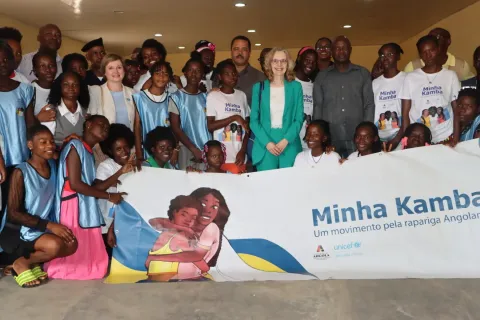
Girls like Teresa and Maria are at the centre of UNICEF's programming, which employs a gender-transformative strategy to amplify their voices and provide gender-responsive services. Building on this programme and other existing initiatives in Angola, such as the HPV vaccine acceptance campaign, the National Programme on Teenage Pregnancy and Child Marriage and the Minha Kamba (girl-to-girl) approach, our vision is that by 2027 at least 2.5 million adolescent girls receive supportive quality health and protection services that are child-centered and girl-friendly, such as quality sexual and reproductive health information, mental health support, and childcare assistance including parenting and caregiver guidance and young mother-to-mother support groups.