Listening, Doing, Reading and Writing, a new methodology trains Teachers.
With a more precise and personalized monitoring of each child, the methodology seeks to stimulate different modes of learning.

- Portuguese
- English
In sub-Saharan Africa, according to 2023 UNESCO data, only 1 in 10 children can read and understand a simple text by the age of 10. This educational inequality directly affects children's individual development and their ability to adapt to a constantly developing society.
To achieve the objectives of the approach, the Ministry of Education, with the technical support of UNICEF and the methodological guidance of the TaRL Africa organization, trained about 500 teachers to implement this educational methodology of school reinforcement for the acquisition and consolidation of basic skills in the subjects of Portuguese Language and Mathematics.
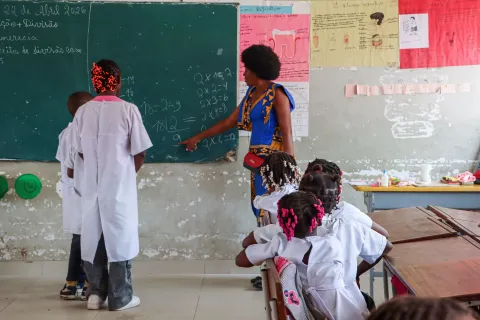
Suzana Paulo was one of more than 500 teachers who had the opportunity to be part of the experimental phase of Learning at the Right Age – AIC.
In the province of Huila, in the municipalities of Lubango and Humpata, 18 schools were selected to be part of the experimental phase of the methodology. One of these schools is school No. 60 in Lubango, where teacher Suzana Inácio Paulo has been teaching for more than 30 years.
"When I entered the training I was very happy because it was very similar to what I already applied and with the training I learned methods of how to improve and apply this new way of teaching students with more difficulties." Said Suzana Paulo.
The experienced teacher says that she began her career as a volunteer adult teacher in the municipality of Humpata, where the focus was on literacy for peasants. So it was not difficult for her to switch to primary school when the opportunity arose, as she was already teaching vowels to adults.
"My students for me are my sons and daughters. Before starting my classes, let them tell a story and then I also tell a story to create a more cheerful atmosphere in the classroom."

The experienced teacher says that she began her career as a volunteer adult teacher in the municipality of Humpata, where the focus was on literacy for peasants. So it was not difficult for her to switch to primary school when the opportunity arose, as she was already teaching vowels to adults.
"My students for me are my sons and daughters. Before starting my classes, let them tell a story and then I also tell a story to create a more cheerful atmosphere in the classroom."
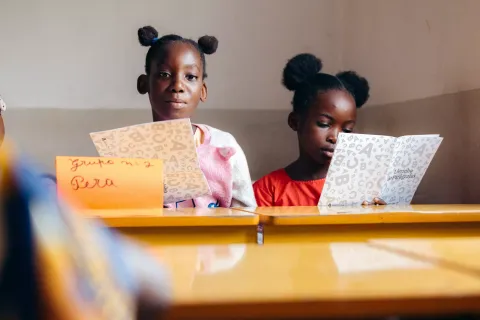
The AIC presents an adaptive and student-centered approach and can be a model to be expanded on a national scale. Thus ensuring a more accurate and personalized monitoring of each child's learning. The methodology seeks to stimulate different modes of learning, with activities that vary between listening, saying, doing, reading, and writing.
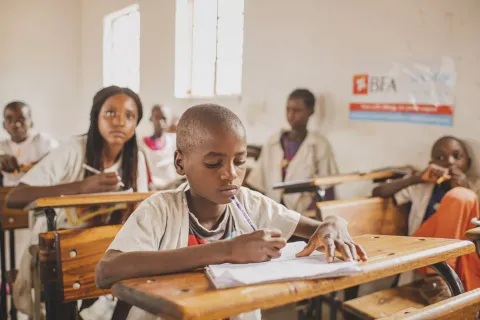
In this innovative method, instead of grouping children by class, they are organized by levels of competence in reading and mathematical calculation, allowing them to advance quickly from one group to another as they progress.
According to teacher Suzana Paulo, in the first classes of the AIC application, the students did not feel much difference because they did not know they were being diagnosed, for them they continued to have a normal class. I just created a cheerful atmosphere with positive and encouraging words when they read and counted the numbers.
"In a few classes my students have already mastered all the games and activities that we carry out in the classroom. They were excited and brought materials from home to contribute to the activities. In my house I also apply these methodologies and my son has already mastered the exercises in a short time. In two weeks he stopped having difficulties reading on paper and started reading everything his eyes can see."

One of the great difficulties in ensuring improvements in the learning levels of our students, reported by teacher Suzana and other teachers at school No. 60, is the lack of responsibility and support from parents.
Parents must assume that their participation in the life of the school is a right and a duty. In addition to being a civic duty, the active participation of parents in school structures (parents' associations and other pedagogical groups) is seen by sons and daughters as a demonstration of commitment and interest.
The Learning at the Right Age intervention lasts for eighteen months and should reach about 65 schools and approximately 22,000 students, enabling teachers to implement this educational methodology of school reinforcement for the acquisition and consolidation of basic skills in the subjects of Portuguese Language and Mathematics. The AIC will contribute to the improvement of learning outcomes in Angola.
Previous results in other countries, such as Zambia, a pioneer country for the implementation of this methodology in Africa, indicate substantial improvements in reading and basic calculation skills and a significant reduction in the number of students at the lowest levels of learning.
For teacher Suzana, who will enter the reform in 2025, the formation of the AIC should come a long time. As a teacher, I always looked for ways not to leave even students behind, so I started to separate them based on their abilities, those who already knew how to read, those who could count, those who already knew how to interpret, and those who already know how to do calculations. I also separated those who had the most difficulties and began to call this exercise a small explanation.
I worked with them separately and my goal was that they were all at the same level in terms of basic reading and calculations.
"I participated in the Girls' Empowerment and Learning for All program called PAT. But AIC completed my ideas in the classroom. Before the AIC, I always tried to recover the students who had the most difficulties", says Suzana Paulo.

In Angola, UNICEF supports the Ministry of Education in implementing the approach with technical support from TaRL Africa and funding from Banco de Fomento Angola, the Government of Austria, and The Church of Jesus Christ of Latter-day Saints. Initially, it is being implemented in approximately 65 schools in the provinces of Benguela, Cunene, Huíla, and Luanda, from January to June 2024.
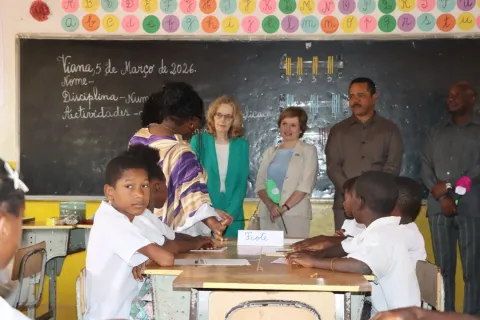
Consultative processes were carried out with Provincial Offices, Municipal Directorates, school directors, and teachers, and an implementation model adapted to the context of the Angolan education system was designed. The schedule of activities includes consultations, training of teachers and supervisors, sensitization of school managers, and associations of parents and guardians. In November 2023, the first regional trainings were held in Huíla and Luanda, training 75 senior trainers and mentors.