

Protecting children with disabilities during armed conflict
What we all need to know, and how you can take action with us.
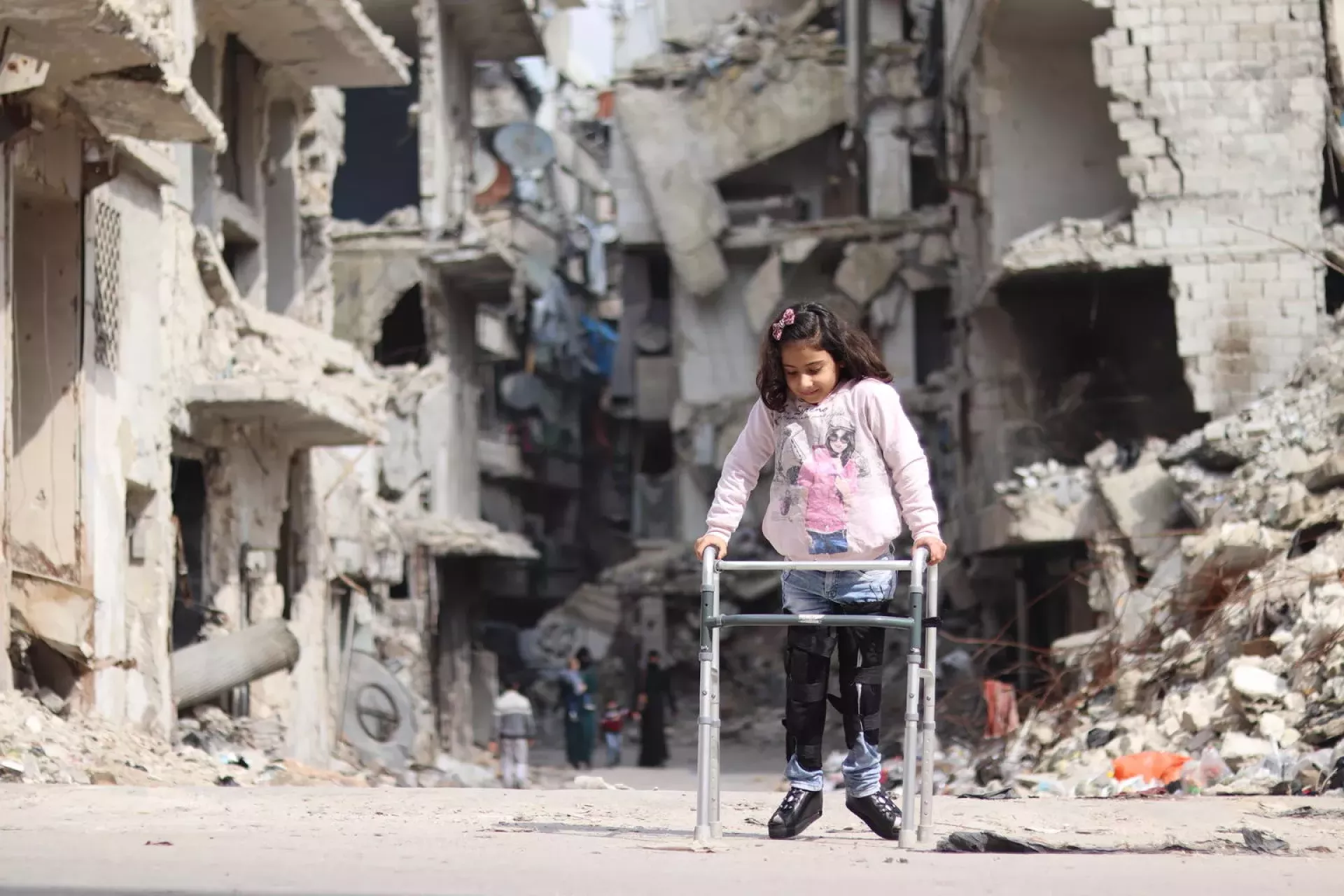
Few are more vulnerable during humanitarian crisis than children: This is something nearly every country in the world agrees on.
In the most widely ratified rights treaty on the planet, Governments united in their commitment to protect children through times of peace and times of war.
But those who bear no responsibility for conflict are still among the first to come into peril. Children with disabilities face exceptional forms of neglect and disregard when violence breaks out.
How many children caught in conflict have a disability?
UNICEF estimates that nearly 240 million children – one in ten worldwide – have a disability. In situations of armed conflict, this proportion is likely to surge.
The horrific impact of armed conflict on children – unthinkable violence compounded by loss of medical care, food and water – heightens a child’s risk of long-term impairments, both physical and mental. Active fighting, together with a breakdown in the delivery of critical services, results in many children acquiring new or secondary impairments. Worldwide, the number of children with disabilities who are caught in conflict is difficult to approximate.
Why are data so difficult to obtain?
Various challenges complicate our efforts to collect data on children with disabilities, even in times of stability.
The way countries define and measure disability varies considerably across the globe – as do methods for data collection. Source reliability may further limit the quality of data we do have.
What’s more, in places where persons with disabilities face discrimination or violence, disclosure rates remain low. Many parents choose not to register their children with government authorities for fear of stigma, or due to general misunderstanding of disability in children. During armed conflict, this leaves those most at risk largely invisible to the humanitarian actors attempting to reach them.
What additional risks do children with disabilities face during conflict?
In situations of armed conflict, children with disabilities tend to be disproportionately exposed to violence and rights violations.
They’re more likely to be abandoned or separated from their caregivers, especially during an attack or sudden displacement. This is of particular concern for children living in residential care. Evacuation procedures often neglect the needs of children with disabilities: Routes may be inaccessible to those with mobility impairments. Warning systems, like broadcasts or sirens, are imperceptible to those with vision and hearing impairments. If unable to flee without assistance, these children face higher risks of death and serious injury.
Unaccompanied children are also more vulnerable to abduction. In situations of armed conflict, children may be taken during raids on villages, attacks on schools or hospitals, and ambushes on displacement camps. Many are further abused – subjected to sexual violence, trafficking or recruitment into armed groups. Armed groups have been known to use children with disabilities as human shields and for trafficking weapons. They may also deliberately target children with intellectual disabilities to carry out suicide attacks.
Especially for girls, the threat of rape and other forms of sexual violence soars during armed conflict. Many are increasingly vulnerable due to specific care needs or reliance on others for communication. UNICEF estimates that children with intellectual disabilities, in particular, are nearly five times more likely to be subjected to sexual violence than others their age. Like all survivors, these children face severe physical wounds and psychological trauma. Yet the barriers they encounter accessing support services are tremendous.
Are children with disabilities protected under international law?
Yes. International human rights and humanitarian law calls for the protection of children with disabilities during armed conflict.
In international human rights law, both the Convention on the Rights of the Child – the most widely ratified rights treaty on the planet – and the Convention on the Rights of Persons with Disabilities set out obligations for governments to protect and fulfill the rights of children with disabilities. These treaties include specific provisions for situations of armed conflict.
In international humanitarian law, children with disabilities are protected as members of the civilian population and as particularly at-risk individuals, according to the Geneva Conventions and their Additional Protocols.
The United Nations Security Council has also passed numerous resolutions to strengthen the international legal framework for the protection of children during armed conflict, including one that urges Member States to provide “timely, appropriate inclusive and accessible assistance to children with disabilities who are affected by armed conflict, including reintegration, rehabilitation, and psychosocial support.”
What support do humanitarian organizations need to protect the rights of children with disabilities?
Above all, organizations like UNICEF need swift, safe access to children caught in conflict – regardless of who they are or where they live.
For children with disabilities, the denial of humanitarian access by parties to conflict leads to pronounced suffering.
Many of these children lose critical care when violence breaks out, including medical treatments, rehabilitation, and assistive technology accessible only through community services, health facilities and schools. These are places often deliberately targeted by warring parties. Where blockades cut civilians off from power sources, children who rely on essential devices for respiratory support, or on assistive technology for mobility, face compounding hardships.
Humanitarian organizations also need reliable data disaggregated by disability. Data on the number of children with disabilities, as well as the nature of the barriers they face, are crucial for shaping humanitarian interventions that reach and support all children. Tailored training for frontline workers is also critical to turn disability inclusion into an integral part – and not simply a supplement – of emergency assessments and response plans.
What is UNICEF doing to provide support for children with disabilities caught in conflict?
UNICEF operates across sectors to make humanitarian action inclusive, helping to ensure emergency response plans account for children with various forms of disability. We work together with local organizations of persons with disabilities (OPDs), especially so that children with disabilities have opportunities to participate in assessments and planning for humanitarian response. Their knowledge is crucial to address the barriers that they alone face when cut off from support.
In the State of Palestine, for example, UNICEF partnered with OPDs to provide children with assistive devices like hearing aids, wheelchairs and prosthetics, as well as cash assistance to help them meet their most fundamental needs. In Syria – where 30% of the population is now estimated to have a disability – UNICEF’s cash transfer programmes have improved access to food, health care and education for thousands of children with disabilities. And in Ukraine, UNICEF established mobile response teams to provide psychosocial support to children with disabilities, thanks to our existing partnership with OPDs.
UNICEF also works to improve the disaggregation of data by disability, so that we can better plan for – and measure progress towards – inclusive humanitarian action. Lack of data must not be used as an excuse for lack of support. UNICEF will continue to ensure that children with disabilities are represented in humanitarian decision-making, and that families affected by conflict have opportunities to participate in emergency response, recovery and rebuilding.
What can others do to support children with disabilities caught in conflict?
You don’t have to work for a humanitarian group to help protect the rights of children with disabilities caught in conflict. Activists play a vital role in mobilizing support.
Consider reaching out to organizations of persons with disabilities (OPDs) to understand how you can best support in your local context. Many OPDs are indispensable partners to organizations like UNICEF. These groups are often the first responders in an emergency and have the best understanding of the cultural context, and immediate needs, of children in crisis.
You can also help raise awareness of the rights violations these children face during conflict. Sharing stories and information on social media and other platforms can lead to increased resources for organizations already making a difference.
Finally, advocate for emergency relief efforts that account for the priorities of children with disabilities. You can even organize campaigns to contact local or national representatives, urging them to speak up for these issues in domestic and international forums.