UNICEF Executive Director Catherine Russell remarks at the Annual Session of the UNICEF Executive Board
As delivered
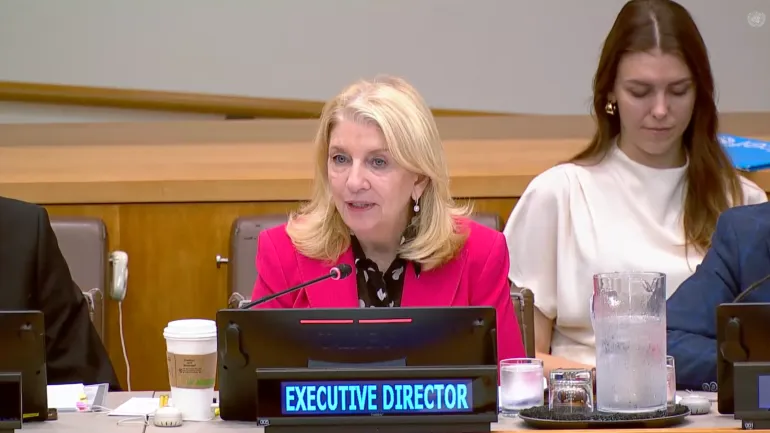
NEW YORK, 16 June 2026 – “Excellencies, distinguished delegates, colleagues, thank you for joining us for this annual session of the UNICEF Executive Board.
“I would like to thank the President of the Executive Board, the members of the Bureau, and all Board members for your continued partnership and support.
“Once again, we have a full agenda, with many important topics for discussion. These include presentations of the Annual Report of the Executive Director for 2025, the annual report on Humanitarian Action, as well as updates on repositioning the UN development system, and the UN80 Initiative.
“Excellencies,
“We come together at a consequential moment for children. Across all regions, children are confronting a convergence of crises that threaten hard-won gains in survival, learning, protection, and development.
“At the same time, new and different challenges are emerging. Children are learning to navigate a rapidly evolving digital environment. They are interacting with advanced technologies that present both extraordinary opportunities and significant risks.
“But this is more than a story of crises.
“It is also a story about choices. Choices about whether upholding the rights of children is something we do, not just something we say and choices about whether investments in children are protected when budgets come under pressure.
“Here, I’d like to highlight an issue that has deeply concerning implications for whether children can realize their right to essential services and care – the fiscal burden of servicing huge and unsustainable debt.
“Today, nearly 400 million children live in countries where debt burdens are outpacing investment in health, education, and nutrition. In 37 countries, home to approximately 1.1 billion children, governments now spend more servicing debt than they do on health. This means less available resources for children’s vaccines, medicine, and primary health care.
“The consequences are profound. These countries account for an estimated 3.2 million under-five deaths, and 96 million stunted children each year.
“In other words, children are suffering and dying because their governments are spending increasingly high levels of their revenue to service their debts – resources that could otherwise be used on essential services.
“How the world responds to this debt crisis is one of the most consequential questions for children everywhere. The choices made now – on debt restructuring, on fiscal space, on what gets protected, and what gets cut – will shape the trajectory of an entire generation.
“Three decades ago, we saw some success in debt reduction. Debt relief initiatives helped create fiscal space for investments in child survival, education, and development. This created a fresh start for some fragile states. However, many countries eventually experienced a return to the high risk of debt distress due to global commodity price drops, climate shocks, and new borrowing.
“Debt sustainability is often discussed in financial terms. But for children, it is ultimately about whether schools remain open, whether health workers are paid, whether nutrition programmes continue, and whether governments can invest in the next generation.
“In this sense, debt is not only a financial issue. It is a child-rights issue. And protecting children's rights requires protecting investments in children.
“UNICEF will continue to work with governments, international financial institutions, development banks, and partners – including the Vatican – to ensure that children remain at the center of the conversation on debt restructuring, fiscal policy, and development financing.
“Excellencies,
“Despite these challenges, progress for children remains possible.
“Over the course of the previous Strategic Plan, UNICEF invested nearly $32 billion dollars in programme delivery for children and communities around the world, strengthening systems to ensure scale and sustainability.
“In 2025 alone, UNICEF and our partners supported nearly 39 million births in health facilities. We reached 51.9 million children with services for the integrated management of neonatal and childhood illnesses. As a top priority, we trained 4.8 million health workers. And through our supply operations, we delivered 3.2 billion vaccine doses to 103 countries.
“UNICEF reached 27.8 million out-of-school children with access to education. We helped protect nearly 10.4 million adolescent girls at risk of child marriage. And we expanded climate and environmental programming to 129 countries and territories.
“These are not simply statistics.
“They represent children who survived, learned, were protected, and were given a better chance to reach their potential. And every one of these results reflects UNICEF's enduring commitment to upholding the rights of children.
“The Strategic Plan that concluded in 2025 demonstrated that even amid conflict, economic uncertainty, and shrinking resources, we can deliver for children.
“Our current Strategic Plan provides a framework for the next phase of this work. It focuses our efforts on helping children survive and thrive, learn and acquire new skills, live free from poverty, be protected from violence, and build resilience to climate and environmental risks.
“Excellencies,
“The need for this work has rarely been greater.
“In 2025, UNICEF responded to 414 emergencies across 101 countries and territories. And every day, we continue our lifesaving programmes in even the most challenging humanitarian contexts.
“In Gaza, where children face the deadly consequences of conflict, deprivation, and the collapse of essential services; in Sudan, where millions of children remain displaced and at risk of violence, child recruitment, disease, and hunger; and in the Democratic Republic of the Congo, where conflict, sexual violence, and an outbreak of the Ebola virus continue to threaten children's lives, UNICEF is working to reach children with lifesaving assistance and protection.
“But in these and other crises around the world, humanitarian needs continue to outpace available resources.
“Last year, for example, UNICEF received only 31 per cent of the funding required under our humanitarian appeal.
“As part of OCHA’s global humanitarian appeal for 2026, UNICEF has requested $7.7 billion dollars to reach 73 million children with humanitarian assistance. In addition, funding for our critical long-term development work is similarly constrained.
“And this has real, human consequences. It means fewer children reached, fewer services delivered, and more children left without support.
“In practical terms, this can mean reducing the frequency of nutrition treatment, scaling back protection services, or limiting access to safe learning spaces.
“For children, these are not marginal adjustments. They are the difference between recovery and relapse. Between protection and exposure. Between hope and despair.
“Despite these challenges, UNICEF is adapting.
“We are strengthening partnerships with governments and local actors. We are investing more in preparedness and anticipatory action. And we are working to make every dollar go further.
“However, cuts in development assistance – almost across the board – are having an impact and there are limits to how much efficiency can compensate for declining resources.
“Excellencies,
“We all know that crises do not respect borders. conflict in one region can cause largescale migration to another. An Ebola outbreak in one country can quickly spread to its neighbors and beyond.
“In addition, ongoing geopolitical tensions clearly demonstrate how interconnected today's challenges have become.
“Disruptions to key global transport routes and rising fuel costs have increased the cost of delivering life-saving supplies around the world. Vaccines, nutrition commodities, medical supplies, and educational materials are taking longer and costing more to reach the communities that need them.
“Every additional dollar spent on transportation is a dollar that cannot be spent directly on children.
“These pressures reinforce the importance of resilient supply chains, flexible funding, and sustained investment.
“A sufficient blend of quality financing, including flexible resources, allows UNICEF and our partners to act early, respond quickly, and direct support to where needs are greatest.
“In 2025, UNICEF's Emergency Programme Fund, funded by core resources, issued nearly $70 million in loans to 35 countries and regional offices, getting resources to children within 48 hours of the onset of a crisis.
“This ability to move quickly saves lives. And it demonstrates why predictable, flexible funding remains one of the most effective investments Member States can make in safeguarding the rights of all children.
“Here, I would like to recognize the important work of our National Committees – both in generating significant regular resource contributions and in their impactful advocacy and engagement for children’s rights around the world.
“Excellencies,
“Protecting children's rights also means helping shape the environments in which children grow up.
“Children consistently tell us that they do not experience a clear divide between their online and offline lives. For them, these worlds are interconnected. Their rights must be protected in both.
“Artificial intelligence offers enormous opportunities to expand access to learning, information, and services. But it also presents significant risks. We have already seen the emergence of AI-generated deepfakes that exploit and sexualize children, demonstrating how quickly new technologies can create new forms of harm.
“The choices governments, technology companies, and societies make today will help determine whether these technologies advance children's development or place them at greater risk.
“UNICEF is working with governments, industry, and partners to ensure that children's rights, safety, and well-being are built into these systems from the outset.
“Earlier this month, UNICEF contributed to discussions that helped inform the first common G7 principles for the online safety of children. We welcome this important step forward, and we stand ready to support implementation.
“UNICEF is also actively engaged in the first Global Dialogue on AI Governance. As children account for one third of internet users worldwide and are adopting AI-enabled technologies faster than adults, their interests and perspectives must be reflected in the rules and safeguards that will shape their future.
“Just as we advocate for children in humanitarian action, public finance and climate policy, we must also ensure that children's rights are protected in the digital age.
“Excellencies,
“To succeed in these efforts, UNICEF continues to strengthen effectiveness, efficiency, and accountability across the organization and beyond.
“At a time when Member States are rightly focused on the future of the multilateral system, UNICEF remains fully engaged in efforts to strengthen how the United Nations delivers.
“We support reform not as an abstract exercise, but because better coordination, stronger collaboration, and greater efficiency translate into better outcomes for children.
“Across the UN80 agenda and broader reform efforts, UNICEF is contributing expertise, leadership, and operational experience. From data and evidence to supply chains, shared services, and country-level cooperation, UNICEF has long been a constructive and committed partner in efforts to make the United Nations more effective.
“We have been helping to advance practical reforms for many years. And we will continue to engage actively and positively in efforts to strengthen the UN system.
“Because if the United Nations delivers better, children will be served better.
“These reforms are not an end in themselves. They help ensure that every possible resource reaches children.
“Excellencies,
“At a time of growing needs, and increasing pressure on public resources, accountability matters more than ever.
“Member States, partners, and the public rightly expect UNICEF to demonstrate not only results, but also integrity, transparency, and responsible stewardship.
“UNICEF remains committed to strong governance and independent oversight. We continue to strengthen evaluation, audit, ethics, investigations, risk management, and safeguarding systems across the organization. Protection from sexual exploitation and abuse remains a top priority, supported by continued investments in prevention, reporting mechanisms, survivor-centered approaches, and accountability.
“Strong oversight is fundamental to our mission.
“It is fundamental to maintaining trust, improving performance, and ensuring that resources achieve the greatest possible impact for children.
“Before closing, I would like to highlight that later this year, UNICEF will mark its eightieth anniversary.
“For eight decades, UNICEF has worked alongside governments, communities, partners, and children themselves to advance children's rights and improve children's lives.
“But the challenges facing children today are not the same as those UNICEF confronted in 1946. And the challenges they will face tomorrow will be different again.
“Alongside conflict, poverty, disease, and climate shocks, children are increasingly confronting mental health challenges, online harms, and the opportunities and risks created by rapidly advancing technologies.
“For eighty years, UNICEF has adapted to meet the changing needs of children.
“We must continue to do so … and we will because our commitment to children’s rights is ironclad. We will move forward together, every day, until every child has the opportunity to survive, thrive, and reach their full potential. That is why we do this work. That is UNICEF’s mission.
“Thank you.”
#####
Media contacts
About UNICEF
UNICEF, the United Nations agency for children, works to protect the rights of every child, everywhere, especially the most disadvantaged children and in the toughest places to reach. Across more than 190 countries and territories, we do whatever it takes to help children survive, thrive, and fulfil their potential.
Follow UNICEF on X, Facebook, Instagram and YouTube