

UNICEF and partners call to prioritize children in climate action and financing at COP29
UNICEF at COP29
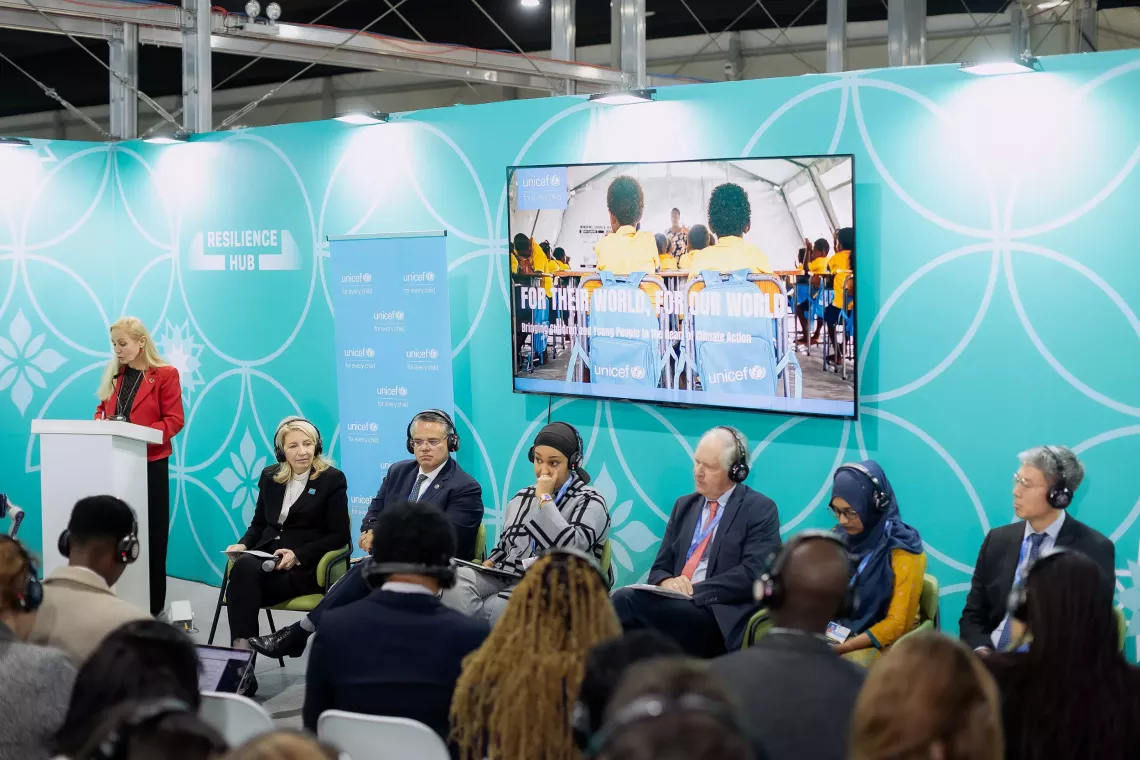
BAKU, 21 November 2024 - At the UN Climate Change Summit (COP 29) in Baku, Azerbaijan, UNICEF called on global leaders to recognize the climate crisis as a child rights crisis, urging action to safeguard children’s futures.
At the event For Their World, For Our World last week, UNICEF and partners including the Green Climate (GCF) and the World Bank, alongside the government of the Republic of Korea and the government of Somalia, joined young people in advocating for children and youth to be prioritized and engaged in national climate policies and plans.
According to UNICEF’s Children’s Climate Risk Index, more than one billion children are living in areas classified as "extremely high-risk” from climate hazards.
However, essential social services for children - including health, social protection, and education - continue to receive minimal financing for climate adaptation and resilience. Between 2006 and 2023, only 2.4 percent of climate finance from major multilateral climate funds was allocated in a child-responsive manner.
"We must do better by increasing support for these vital systems. It’s not just the right thing to do; it makes economic sense," said UNICEF Executive Director Catherine Russell. "Every dollar invested in climate adaptation and resilience can yield up to ten dollars in net economic gains, benefiting both current and future generations."
UNICEF works to ensure that children’s needs are prioritized in climate action globally, fostering partnerships to drive meaningful, lasting climate solutions for all children. In this movement, the voices of young people are critical. As UNICEF Youth Advocate Farzana Faruk Jhumu said, “When we are all talking about children, we need to make sure we create this environment for them.”
In a recent milestone, the Green Climate Fund approved UNICEF as an Accredited Entity, enabling UNICEF to lead and join significant adaptation and mitigation partnerships with support from GCF.
“We are delighted to welcome UNICEF as an Accredited Entity, “said GCF Chief Investment Officer Henry Gonzalez. “We look forward to not only doing a lot more in providing children with the social services they need and protecting them from the worst impacts of climate change, but also bringing the best of both institutions to truly shape the future. We have a lot of work ahead of us and are keen to collaborate with quality partners such as UNICEF.”
The World Bank, represented at the event by Vice President for the Planet Vice Presidency, Juergen Voegele, reiterated the urgency of accelerating and amplifying climate action. “Institutions working in development must ensure that our efforts directly benefit the next generation,” Voegele said. “Climate change is no longer a distant issue; it's affecting everyone, everywhere, every day. This isn’t just one of many priorities—it has to be a top priority moving forward. You have our commitment to maintain this focus."
In another major step, UNICEF, and the Korea International Cooperation Agency (KOICA) recently signed a US$39 million multi-country partnership to reduce climate vulnerability among children in Small Island Developing States and Africa.
During the panel discussion, Keeyong Chung, Ambassador and Deputy Minister for Climate Change of the Republic of Korea, emphasized Korea’s commitment to bridging the development gap between developing and developed nations, playing the role of a “green ladder” in climate action. Republic of Korea is eager to continue this role in partnership with reliable multilateral organizations and bilateral partners to advance this important work.
“Her Excellency Ambassador Khadija Mohamed Al-Makhzoumi, Somalia’s Minister of Environment and Climate Change, underscored the critical need to prioritize Somali children in climate action. Speaking to COP29 participants, she emphasized, “Somalia’s children are at the heart of our climate response. Ranked among the most vulnerable, they face severe risks from droughts, floods, and health crises. It is our duty, in partnership with UNICEF and global allies, to ensure a resilient future—one where our youth can thrive, protected from the impacts of climate change.”
Looking to the future, UNICEF is inspired by GCF’s ambitious plan to manage US$50 billion in climate investments by 2030, focusing on the most vulnerable populations. In alignment, UNICEF’s Sustainability and Climate Change Action Plan (SCAP) aims to drive a global movement for children by setting ambitious climate targets with both public and private sector.
“Today’s young people and children will inherit a world shaped by our actions. With nearly 4.2 billion children projected to be born over the next 30 years, we must prepare them for the climate realities they will face,” added Russell. “Fostering resilient communities where children can thrive requires each of our partners to stand ready and committed to drive this mission forward.”
About UNICEF
UNICEF, the United Nations agency for children, works to protect the rights of every child, especially the most disadvantaged and those hardest to reach. Across more than 190 countries and territories, we do whatever it takes to help children survive, thrive, and fulfil their potential.
About GCF
The Green Climate Fund (GCF) is the world’s largest dedicated climate fund. GCF’s mandate is to foster a paradigm shift towards low-emission, climate-resilient development pathways in developing countries. GCF has a portfolio of projects and programmes across more than 100 countries. It also has a readiness support programme to build capacity and help countries develop long-term plans to fight climate change.
GCF pays particular attention to the needs of societies that are highly vulnerable to the effects of climate change, to limit or reduce their greenhouse gas emissions (mitigation) and adapt to climate change (adaptation). GCF aims to allocate a minimum of 50 percent of the fund to particularly vulnerable countries, including Least Developed Countries (LDCs), Small Island Developing States (SIDS), and African states. GCF’s activities are aligned with the priorities of countries through the principle of country ownership and has established a direct access modality so that national and sub-national organizations can receive funding directly, rather than only via international or regional entities.
For further information, please contact:
David Evans, Senior Advisor, Public-Private Partnerships, [email protected]
Maria Dumpert, Climate Partnerships Manager, [email protected]