A home, two businesses, one flood
In flood-affected Dhading, Sushila lost her home and livelihood; and while UNICEF cash support provided immediate relief, her needs continue
Dhading, Nepal: On the morning of 26 August, Sushila Khadka had done what she did every day. She cooked, fed her three children and sent them off to school. She took breakfast to her eldest, who has tuition at 6 am, and was heading home with groceries when she learnt that a flood was coming. Much to her relief, children were already safe. Their teachers had taken them to higher ground.
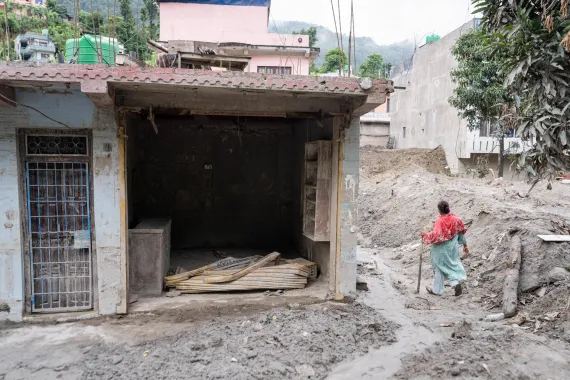
Her husband, Jivan, was not. He was inside the family’s house in Galchhi in Dhading. Jivan is completely deaf and cannot hear even loud sounds. “No one had told him,” Sushila says. She dropped her bags and went to find him. Together they ran uphill, and when they looked back, their house was being swept away.
They had heard the warnings. Miking had told people to evacuate, and armed police came to the door. One tugged at Sushila’s arm as she locked up. But the Trishuli had never reached them before, even in the heaviest monsoons, so they closed their doors and took nothing.
“We didn’t think it would be this big,” she says. They had climbed only a little higher when the water hit, five or seven houses below them. “If we had been just five minutes late in running away, we wouldn’t have made it.”
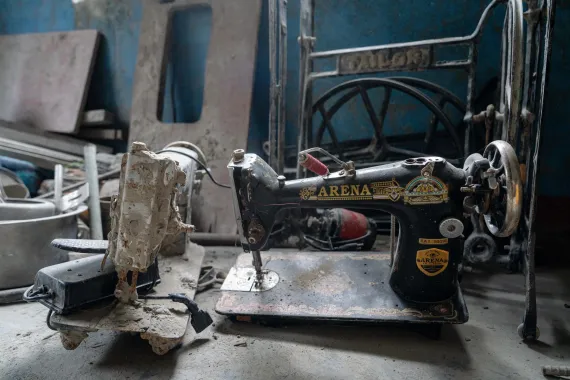
The house was more than a home. It was where the family earned a living. For 18 years Sushila has been a tailor, and before opening her own shop she spent seven years as a trainer, teaching more than 500 students. Alongside the tailoring, she and Jivan ran a small tea shop and grocery. They sold tea and snacks in the mornings and evenings, and in the afternoons, when Sushila cut the cloth, Jivan helped her sew.
“We had no other ways to earn, no farms, no agriculture,” she says. “It was through the businesses that we were supporting our children and our family.”
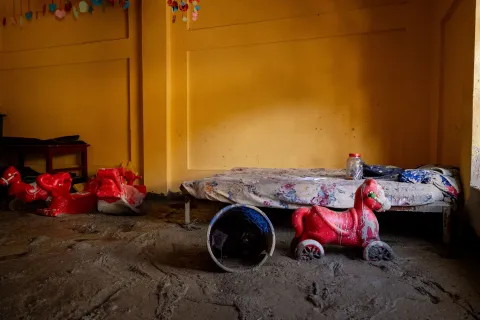
The family escaped with nothing. Their documents and jewelry were left behind. Their sewing machines are rusted and jammed, beyond repair. The home is too damaged to live in, and they are now renting a place. “We had nothing – we had run out with the clothes on our backs,” Sushila says. For a few days, they did not know where to stay, what to eat or how to look after their children.
Then the family received cash assistance from UNICEF, giving them something to start with.
“It was a great relief at a time when we had nothing,” Sushila says.
Her children had no clothes, notebooks or pencils. With the cash, she could decide for herself what the family needed most. She bought those things for them, along with some basic essentials.

But the needs have not ended. Sushila has a prosthetic leg below the knee. It has cracked and is difficult to walk on, and fixing it will cost at least 70,000 to 80,000 rupees. “We don’t have that money right now, and I’m struggling to walk,” she says. Jivan can help at home, but finding work outside is hard for him. “I myself cannot go here and there, and my husband too, struggles to communicate,” she says.
“My biggest concern is not having an income.”
Her children’s education weighs on her most. They are 15, 12 and 4. A child in ninth grade should not be moved to another school in the middle of the course, she says, and she cannot let any of them drop out. The children feel the strain too. “They’re feeling like our mother isn’t able to buy us these things, how will we study?” Sushila says. Sometimes they suggest changing schools. “So I tell them, just keep studying, we’ll find a way.” She carries her own worries as well.

UNICEF Nepal/2026/RUpadhayay
“I still have a lot of fear and trauma in my heart."
Sushila does not think life can go back to how it was. “But if we got some support in educating our children, or in making some living arrangements here, I would restart my business and work like I used to and raise my children,” she says. A place with two rooms, one for tailoring and one to live in, would be a start.
“I could go back to taking care of my children – that is my hope right now.”