Just a Few Minutes from Health: Natalia’s Story
“If we did not have the mobile brigade, we would have to go to the hospital which is more than 30 kilometres away,” says Natalia.

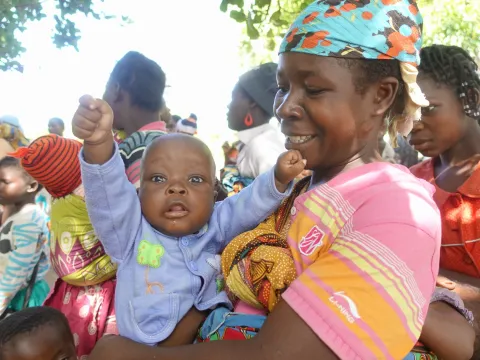
Impire, Cabo Delgado. In the midday sun, 18-year-old Natalia Adriana waits patiently in the shade, her six-month-old daughter Rabia Malike resting in her arms. Rabia’s hair is decorated with colourful ties, and Natalia holds the yellow vaccination card tightly. It is Rabia’s health record, and Natalia never leaves it behind.
“The mobile brigade is very good for the community because it gives us useful information and medicine for our babies and keeps them healthy,”
Natalia lives in Impire with her husband. Together, they work in their fields to support their young family. Rabia is their first child. Every month, when the mobile brigade comes to the village, Natalia is there.
“I have been coming to visit the mobile brigade since a year ago, when I was pregnant,” she says. “All the pregnant women and the mothers with babies in the community come to use the services of the mobile brigade.”
Today, Rabia was weighed and measured, received vitamin A supplements, the polio vaccine, and micronutrient powers to be mixed into her food.
“The health workers said Rabia is a healthy baby, no problems,” says Natalia.
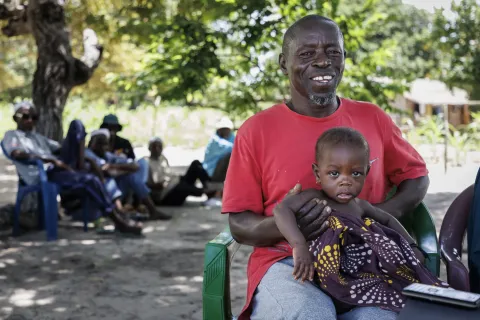
For many families in Impire, the mobile brigade is the only accessible way to receive health and nutrition services. “If we did not have the mobile brigade, we would have to go to the hospital which is more than 30 kilometres away,” says Natalia. “We don’t have the money to go there. I am very happy that the mobile brigade comes to the village because it is easy to visit and keep my baby healthy. It is only a few minutes from our house so I can walk here.”
Natalia has learned a great deal from the health workers who visit each month. “I learned about exclusive breastfeeding here at the mobile brigade,” she says. “The baby is 6 months old now, so I have just started giving her solid food like porridge. The community health workers taught us how to make enriched porridge by adding peanuts, moringa leaves, and other ingredients from our fields.”
“When I was pregnant I heard about the colostrum, the first milk for the baby,” she adds. “It is very important not to throw this out, but to feed it to the baby.”
In 2024, UNICEF supported 1,860 integrated mobile brigades across Mozambique. These reached more than 92,000 children under five and over 21,000 pregnant women with essential health services. The first five years of life are crucial for a child’s growth and development, and the mobile brigades help make sure children receive the care, nutrition and vaccinations they need to thrive.
In Cabo Delgado, Nampula, Zambezia and Sofala provinces, mobile brigades have been equipped, supplied and trained by UNICEF with support from the Government of Japan, the Government of Germany through KfW development bank, the European Union, ECHO, and the Central Emergency Response Fund.
Back in Impire, Natalia is preparing to head home with her daughter. She smiles as she tucks away Rabia’s vaccination card. “I can walk here easily,” she says. “That means I can always come and take care of my baby and of my health.”