Clean water brings new strength to Marietta’s family in Nacaca
For years, access to safe water was one of the biggest challenges in Nacaca. In 2025, a new solar-powered water system was installed.

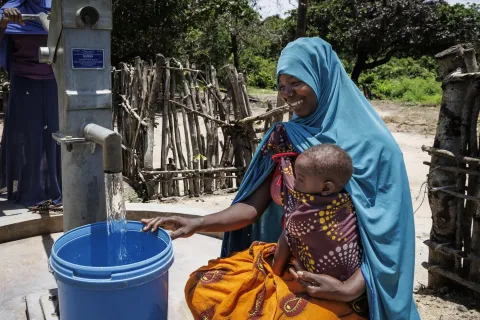
Montepuez, Cabo Delgado - Each day, Marietta Paulina walks from her home to a nearby water point in Nacaca resettlement camp, carrying a white bucket in her hand.
The journey now takes only a few minutes. For Marietta, a 52-year-old grandmother caring for four grandchildren, that short walk has changed the rhythm of daily life.
“In the past, the water was very far away and it was not clean,” she says. “I would get up at four in the morning to go to the traditional water hole and return home at nine. My neck would hurt from carrying the water home.”
Marietta arrived in Nacaca in 2020, after fleeing violence in the north of the province. Today, she lives with her grandchildren in a house with a thatched roof, bamboo walls and reddish clay. Around the camp, families have built homes, planted fields and enrolled their children in school.
Marietta grows cassava, maize and beans in a field near the camp. At home, she cooks, washes, cleans and cares for her grandchildren. Water is essential to almost everything she does.
For years, access to safe water was one of the biggest challenges in Nacaca. Families relied on traditional water holes or tried to draw water manually from underground sources. During the hot season, water was often difficult to find. When it was available, it was not always safe to drink.
“The water that came from the traditional hole was not clean and it was salty,” says Antumane Joao Baptista, 34, a community leader in Nacaca. “It was not good for people’s health. The water now is clean and tastes good.”
For Marietta’s family, the old water source brought worry as well as physical strain.
“I had a pain in my belly from drinking the water and my grandchildren would regularly have diarrhoea,” she says. “Now we drink the fresh water from the new system and we don’t have pains in our belly anymore. The whole family is healthy at the moment.”
In 2025, a new solar-powered water system was installed in Nacaca. The system uses solar energy to pump water from deep underground into storage tanks on a water tower with a total capacity of 40,000 litres, which then supplies six water points around the camp. In this area, water is found at around 60 to 80 metres underground, making it extremely difficult for families to access safely without a proper system.
For Marietta, the nearest water point is now just 30 metres from her home.
“The water point is close now,” she says. “I don’t need to carry a big bucket any more, so my neck doesn’t hurt.”
The change has also given her back time. Instead of spending long hours collecting water, Marietta can cook, care for her grandchildren and work in her field.
Across Nacaca, around 3,000 people have settled since fleeing violence in northern Cabo Delgado in 2020. For families who arrived with few belongings and began rebuilding their lives in the camp, access to safe water is helping make the community more stable and secure.
“I am grateful for this water system as our community came here with nothing,” Marietta says. “Water is very important for our new lives here in Nacaca.”
The system is part of wider efforts to help families displaced by conflict rebuild their lives with access to basic services.
UNICEF supported the installation of the solar-powered water system in Nacaca resettlement camp with generous funding from the World Bank through the Northern Crisis Recovery Project, coordinated by UNOPS.