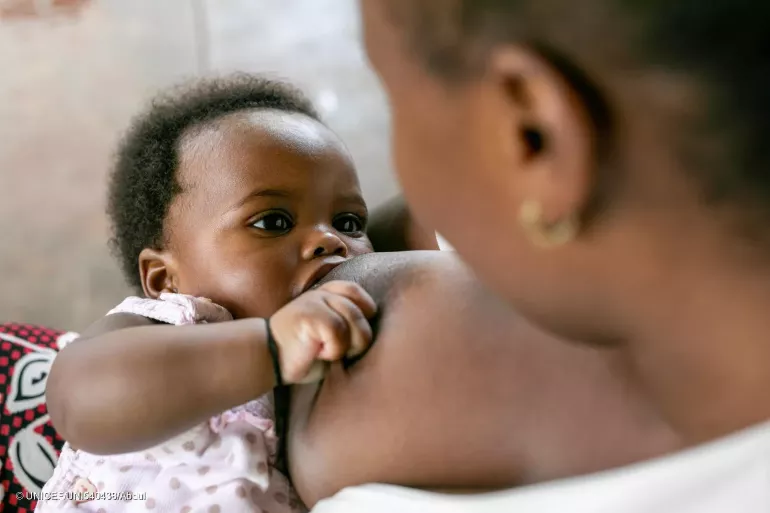
Mozambique boosts exclusive breastfeeding by 14.5 per cent since 2013
Mozambique has achieved a 14.5 per cent increase in exclusive breastfeeding rates since 2013, the second largest increase in the Eastern and Southern Africa region, and ninth largest globally.
- Português
- English
Maputo, Mozambique – Mozambique has achieved a 14.5 per cent increase in exclusive breastfeeding rates since 2013, the second largest increase in the Eastern and Southern Africa region, and ninth largest globally. Mozambique’s exclusive breastfeeding rate now stands at 56 per cent, running ahead of the WHO’s target of 50% by 2025.
Key to this success has been strong commitment from Government and partners including UNICEF, and investment in community-level interventions, supported by awareness raising activities. Despite this progress, additional efforts are needed to further boost rates of exclusive breastfeeding if we are to achieve the WHO’s target of 70% by 2030.
Coinciding with start of World Breastfeeding Week, held in the first week of August every year to generate public awareness and support for breastfeeding, the data showing this increase was issued today by UNICEF.
The global theme for World Breastfeeding Week 2024 is “Closing the Gap: Breastfeeding Support for All”, a theme which aims to focus on progress made in increasing breastfeeding rates, while identifying areas where further support will be needed to achieve WHO targets by 2025. These global targets seek to increase the rate of exclusive breastfeeding in the first 6 months to at least 50 per cent and contribute to reducing childhood wasting to less than 5 per cent and achieving a 40 per cent reduction in the number of children under-five who are stunted.
Since 2017, with support from UNICEF and partners like the European Union, World Bank, USAID, the Mozambique Ministry of Health has implemented a ‘Nutrition Intervention Package’. This initiative trains community health workers to counsel caregivers on exclusive breastfeeding, complementary feeding, and hygiene. Community health workers give cooking demonstrations on how to use local ingredients to prepare healthy and nutritious foods, utilizing ingredients like papaya, peanuts, pumpkin, and local vegetables. This is key to improving the nutrition status of children in Mozambique, where only 14 per cent of children aged 6–23 months currently receive a minimum standard of dietary diversity.
The package of interventions also includes vitamin A and micronutrient supplementation, deworming, and growth monitoring promotion for children under 2 years of age. This has been accompanied by robust investment at the community level, and intensification of communication around breastfeeding through radio, television, community theatre, and social media.
While the 14.5% increase is positive, exclusive breastfeeding rates must rise further if Mozambique is to cut rates of newborn and child mortality and malnutrition, which remain high. Shockingly, 24 out of every 1000 children die during the first 28 days of life and almost 1 in 3 children under five experience stunting. The next objective is to meet the UNICEF and WHO’s target rate of 70% exclusive breastfeeding by 2030.
Key to success will be ongoing efforts to reinforce overall delivery of maternal and newborn care services, including nutrition counselling and screening at community level, combined with efforts to address misinformation and promote positive hygiene practices. These are areas where UNICEF, with support from partners, is actively supporting the Government of Mozambique. Across the country, over 3.9 million caregivers of children under the age of 2 received counselling on exclusive breastfeeding at community level.
Media contacts
Sobre o UNICEF
O UNICEF trabalha em alguns dos lugares mais difíceis do mundo, para chegar às crianças mais desfavorecidas. Para salvar as suas vidas. Para defender os seus direitos. Para ajudá-las a alcançar o seu verdadeiro potencial. Presentes em 190 países e territórios trabalhamos para cada criança, em qualquer parte, todos os dias, para construirmos um mundo melhor para todos. E nunca desistimos. Para mais informação sobre o UNICEF e seu trabalho para cada criança, visite www.unicef.org.mz
Siga as actividades do UNICEF no Twitter e Facebook