Learning locked away?
Promoting the use of teaching and learning materials in Ghana’s classrooms
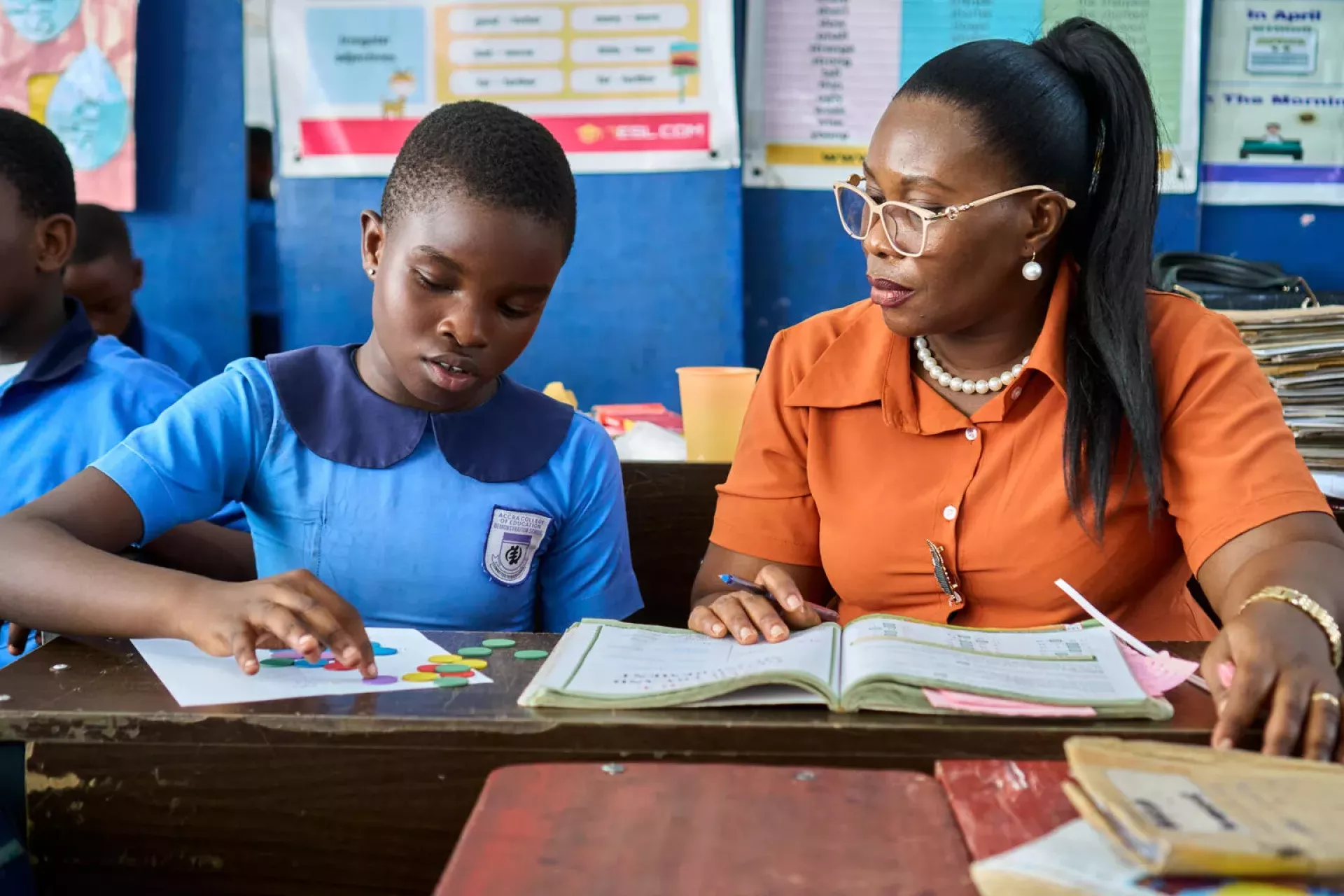
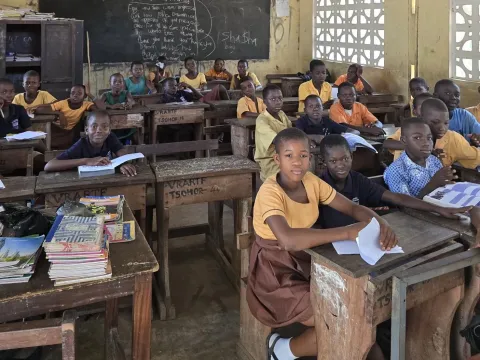
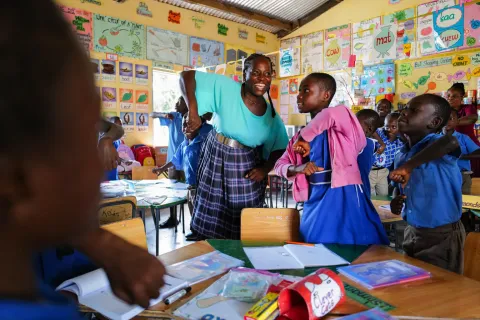
Meet Nana, a third-grade teacher in Ghana. At the start of the school year, Nana eagerly watched as boxes of textbooks and workbooks arrived at her school. Hoping to use them to improve her instruction, she looked forward to facilitating new lesson plans and introducing more practice problems to her students using these resources. However, upon scanning through them, Nana was confused by their structure and content. She was surprised to see that these new materials looked so different from the materials she had previously and was unsure how to use them. The materials have been locked away in Nana's classroom cupboard ever since.
Since 2021, the Ghana’s Ministry of Education (MoE) has partnered with UNICEF’s Data Must Speak (DMS) research to identify positive deviant schools – primary schools that are outperforming their peers even though they have similar resources and contexts. UNICEF, in partnership with the Ghana MoE, visited these positive deviant schools in 2023 to better understand the practices and behaviors that positively influence learning and which can help teachers, like Nana, when scaled across the country. To be expanded upon in our forthcoming report, DMS discovered that positive deviant schools in Ghana tended to:
- Offer more frequent and tailored opportunities for teacher professional development;
- Engage community stakeholders in school planning and monitoring processes;
- Support teachers with lesson preparation, such as through teacher co-planning; and
- Provide students with out-of-class remedial learning opportunities.
Positive deviant schools in Ghana also had greater access to educational materials. Ghana has made substantial investments towards supporting classroom instruction through the development of high-quality teaching and learning materials (TLMs), such as teacher guides and student workbooks. However, the average student only has access to half of their required subject textbooks (Ghana MoE, 2019). This issue has been exacerbated by Ghana’s transition to a new national curriculum and a declining national education budget for goods and services (UNICEF Ghana, 2023). However, as evidenced through classroom observations, classes in positive deviant schools were 10 percentage points more likely to contain teacher manuals and 10 percentage points more likely to contain student textbooks/workbooks (UNICEF Innocenti – Office of Research and Foresight et al., forthcoming). DMS has found that the greater availability of TLMs in positive deviant schools is due – at least partially – to headteachers being proactive and resourceful in procuring and managing educational materials.
However, the use of TLMs in Ghana does not differ between positive deviant schools and average schools, despite the former having greater access.
Why are teachers in Ghana not utilizing TLMs in the classroom despite having access to them, and how can these challenges be overcome? Ghana is not an anomaly; many other countries are asking similar questions.
Education systems globally are attempting to enhance the quality of teaching by providing teachers with a package of comprehensive educational materials, but implementation issues persist. Known as structured pedagogy, these packages integrate student materials, teacher guides, lesson plans, training, and ongoing support in efforts to bolster learning in the classroom. They can facilitate evidence-based instructional approaches like differentiated learning and formative assessment. Recognized as cost-effective interventions for improving foundational learning, structured pedagogy programs show promise when implemented effectively (GEEAP, 2023). However, implementation issues with structured pedagogy issues are prevalent.
A recent report by ideas42, which was informed by the work undertaken by cohort of organizations using behavioural science to change teacher practices and funded by the Bill and Melinda Gates Foundation (BMGF), found results similar to those of Ghana. Despite having access to new, quality teaching materials or methods, teachers often struggled to integrate the new materials and methods into their daily classroom practices (Flaschen et al., 2024). Such evidence suggests that the experience of teachers like Nana is not unique to Ghana, but a much more common problem for education systems globally – and one that should be considered deeply.1
When efforts that seek to increase access to educational materials fail to also increase their use in the classroom, students miss out on the improved teaching and learning that could have come along with them. To achieve the ultimate goal of improved learner outcomes, access to new TLMs needs to translate into sustained usage.
Insights from behavioral science -- the study of human decision making and behavior -- can provide Ghana, and other countries facing similar challenges, a suite of tools to better promote the use of educational materials in the classroom. While the MoE in Ghana and its partners have made significant strides in enhancing access to and utilization of TLMs in classrooms, including in their own structured pedagogy program (Beg et al., 2020), global evidence suggests additional steps the country can take to maximize the impact of these resources on learning. Ideas42’s synthesis of behavioral science and foundational literacy and numeracy projects undertaken by cohort members2 in Botswana, India, Senegal, South Africa, and Zambia identified 8 barriers to successful program uptake by teachers and provides recommendations to overcome them based on behavioral science insights. Below, we highlight three of these recommendations that are particularly relevant to the Ghanian context:
- Reduce information overload by simplifying materials provided to teachers, such by limiting text, using visuals, and highlighting the most important information;
- Develop new classroom habits by creating reminders to use new practices and materials using channels teachers already pay attention to, such as lesson plans and WhatsApp groups; and
- Build appetite for change by demonstrating the concrete value of new practices and materials to teachers clearly, such as their linkage to gains in learning outcomes (Flaschen et al., 2024).
As the MoE and UNICEF advance the Data Must Speak research and attempt to scale positive deviant practices to more schools, behavioural science can help better understand and address the unique barriers that Ghana’s teachers, like Nana, face in leveraging high-quality educational materials.
UNICEF Innocenti and Ghana MoE thank ideas42 for their contributions to this article.
Footnotes
1 See additional examples from: Jordan: USAID. 2019. Early Grade Reading and Mathematics Initiative (RAMP): 2019 Endline Survey Report. USAID; Liberia: USAID. 2022. USAID/Liberia Read Liberia Impact Evaluation: Classroom Practices Report: 2021-22. USAID; Nepal: King, S. J. (2020). Fidelity of implementation: contextualizing measurement for sub-Saharan Africa education systems. Prepared for presentation at annual meeting of the Comparative and International Education Society (CIES); virtual only; South Africa: Funda Wande. 2022. Funda Wande (Literacy) Qualitative Study: 2021 Implementation. Funda Wande.
2 BMGF behavioural science cohort members include Associates in Research and Education for Development, Busara Center for Behavioral Economics, Central Square Foundation, Centre for Social and Behaviour Change, Funda Wande, idea42, TaRL Africa, VVOB, and Youth Impact.
References
Beg, S., Fitzpatrick, A., Lucas, A., Tsinigo, E., & Atimone, H. 2020. Strengthening Teacher Accountability to Reach All Students (STARS). Milestone 4: Impact Anaysis Report. Innovations for Poverty Action.
Flaschen, K., Amjad, Z., Better, C., and Rinehart-Smit, K. 2024. Improving Teacher Uptake of Pedagogical Best Practices for Foundational Literacy and Numeracy: Key behavioral barriers and tips to address them. Washington, DC: ideas42.
Funda Wande. 2022. Funda Wande (Literacy) Qualitative Study: 2021 Implementation. Funda Wande.
Global Education Evidence Advisory Panel. 2023. Cost-Effective Approaches to Improve Global Learning. World Bank: Washington, DC.
Ghana, Ministry of Education, Education Sector Analysis 2018, Ghana, Ministry of Education, Accra, 2019
King, S. J. (2020). Fidelity of implementation: contextualizing measurement for sub-Saharan Africa education systems. Prepared for presentation at annual meeting of the Comparative and International Education Society (CIES); virtual only.
UNICEF Ghana. 2023. Education Budget Brief 2023. UNICEF Ghana.
UNICEF Innocenti – Global Office of Research and Foresight, Ministry of Education Ghana and UNICEF Ghana (2023). Data Must Speak: Schools inspiring change: Research on the practices and behaviours of positive deviant schools in Ghana, Innocenti Research Report, UNICEF Innocenti – Global Office of Research and Foresight.
USAID. 2019. Early Grade Reading and Mathematics Initiative (RAMP): 2019 Endline Survey Report. USAID
USAID. 2022. USAID/Liberia Read Liberia Impact Evaluation: Classroom Practices Report: 2021-22. USAID
World Bank. 2023. Making Teacher Policy Work. © Washington, DC: World Bank. http://hdl.handle.net/10986/40579 License: CC BY 3.0 IGO.