Bridging continents: How UNICEF Egypt and UNICEF Innocenti foster youth leadership
A personal look at how UNICEF encourages the leaders of tomorrow
In the summer of 2023, Rawan ElBendary, a 23-year-old Egyptian graduate of Economics and Management, was scrolling through LinkedIn, looking for opportunities. One that caught her attention was the UNICEF Innocenti Youth Foresight Fellowship – just three days before the application deadline. Rawan was hesitant and unsure if she would make it through the first round of selection. To her surprise, she was chosen for the fellowship, joining 11 other fellows from across the globe.
The UNICEF Innocenti Youth Foresight Fellowship equips young people with the skills to think critically about the future, to understand global issues and to collaborate with UNICEF offices to lead foresight projects in their own countries.
The Fellows spend the first part of the programme honing their foresight skills, learning to think about the future and becoming agents of change. They then collaborate with UNICEF's country offices to design and lead foresight projects that inform various programme areas. Rawan connected with Ghada Nadi, Knowledge Management Officer, at UNICEF's Egypt office, and explored the nation’s priorities to choose a topic for her project. A clear focus emerged: the future of work.
According to a 2022 UNICEF report, Understanding Youth Aspirations in Egypt, young Egyptians, especially those in Lower and Upper Egypt, face challenges finding good jobs. This leads them to seek further training to improve their qualifications. The report identified that the most important factors for young people when searching for a job are salary, location and work hours; women prioritize location and work hours more than men. There's a desire for change, especially among those within the lower wealth quantiles, the report found.
Youth unemployment in Egypt is a pressing issue, with high rates of unemployment among educated youth and among women. Unemployment rates among young Egyptian women are nearly 2.5 times higher than those of young men, leaving many skilled and motivated women without jobs.
“The Youth Foresight Fellowship is an innovative way of meaningfully engaging youth in analyzing emerging issues that would possibly shape their future,” said Nadi. “With the support of UNICEF ECO’s partner, the Information and Decision Support Center (IDSC) of the Egyptian Cabinet Ministers, Rawan applied the tools she learned at the Fellowship to create a space for the participating youth to analyze potential future scenarios regarding the future of work. It was quite eye-opening to hear how they see the future and what really matters to them, providing insights for programming and research.”
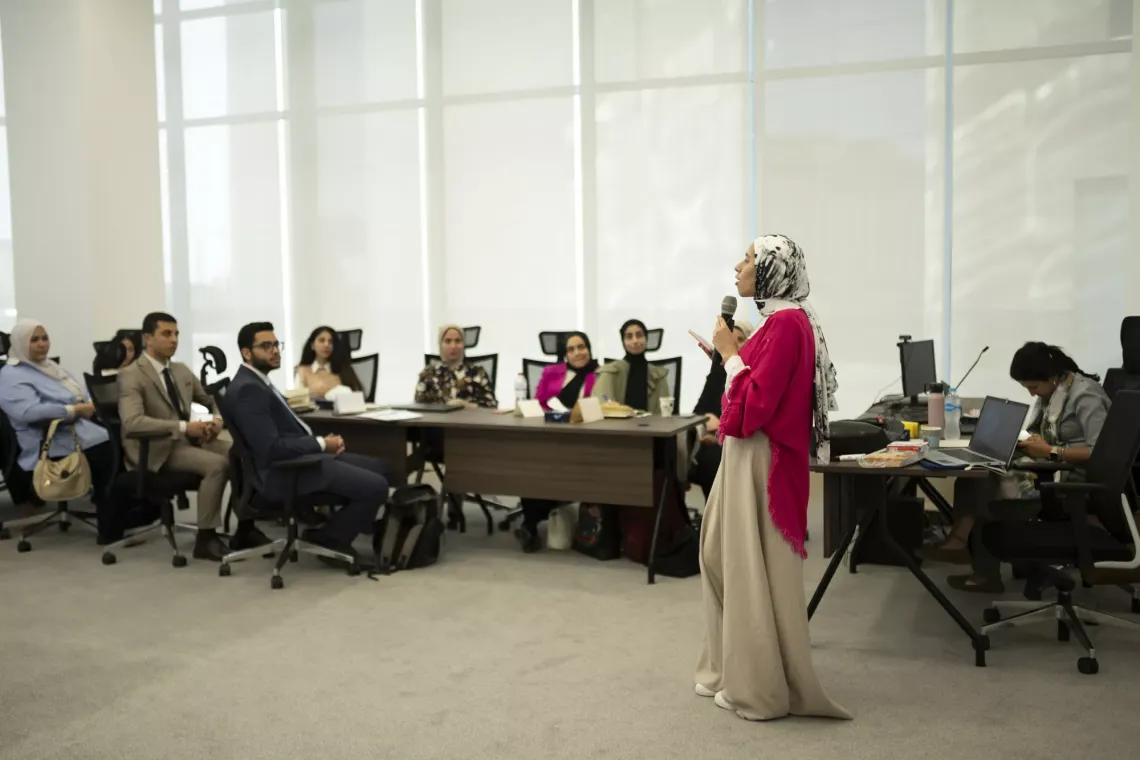
This laid the groundwork for an ambitious foresight workshop at the IDSC of the Egyptian Cabinet. Twenty-five young, bright Egyptian researchers gathered for a two-day workshop led by Rawan to explore the contours of future job-seeking. The workshop was a fusion of ideas, as participants navigated through a structured foresight process.
"One of the things that kept me up at night was exposing a group of young people to foresight for the first time. Will they be interested? Will they be convinced by someone their age being their facilitator?"
“If you ask me, was it easy? I will say yes and no," Rawan said. "One of the things that kept me up at night was exposing a group of young people to foresight for the first time. Will they be interested? Will they be convinced by someone their age being their facilitator?”
Highlighting an aspect of the workshop she appreciated, one participant said: “I loved the fact that my facilitator was my age.”
Throughout her journey, Rawan realized that “young people have a great appetite to learn from each other”.
Rawan explained that all workshop participants shared their ideas freely and without fear of being judged. They wanted workplaces that were fair, helpful and modern. They hoped for jobs that encouraged new ideas and respected everyone's rights. They also envisioned school curriculums that develop students’ interpersonal skills to prepare them for the workplace early on and foster critical thinking.
Abdallah Mohamed, a 24-year-old participant from Sohag in southern Egypt, offered his perspective: "I work in a future studies office. Many jobs, like customer service, will be automated but fields like medicine face ethical challenges to be completely automated. There's potential for a powerful combination of humans and artificial intelligence. I see my role in using artificial intelligence to build predictive models for more accurate forecasts."
The journey continues, with the insights gathered from the foresight workshop informing future interventions and policies.
This story is a testament to the impact that UNICEF programme collaborations, even if continents separate them, can have on young people's lives. Let us continue to invest in empowering young people like Rawan to become active agents of change and build a more resilient and equitable world.
What does the future hold for children’s rights?
How do children and young people envision the future of their education, health, work, privacy, security, technology and the environment?