A new tool to change how the world imagines the future
Creating the future child persona playbook
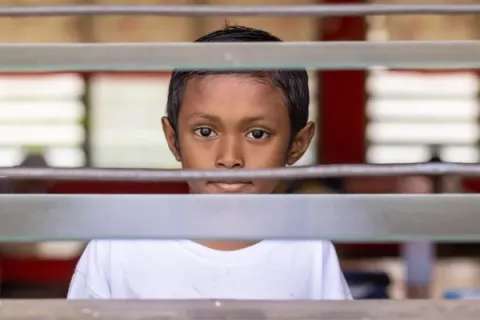
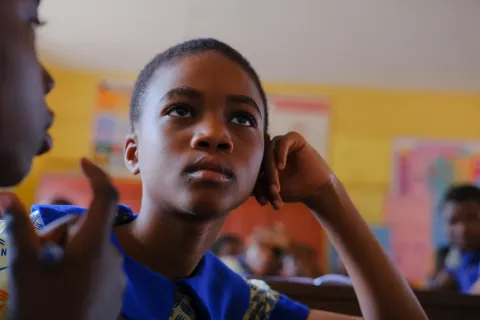
“School feels like a lab, but not just for science, for ideas,” says 14-year-old Kwabena, from Ghana.
“We work with Artificial Intelligence, but we don't just copy what it says. Our teachers encourage us to argue with it, to add our creativity, to make something new.”
Kwabena lives in 2040, and is a symbol of a world where children are curious, empowered and connected. A future persona that represents what tomorrow could look like for millions around the world.

This young Ghanaian, along with five other personas representing different regions of the world, was co-created by UNICEF Youth Foresight Fellows, who explored how children’s lives, learning, and play might evolve by 2050, ensuring futures are built with young people, not just for them.
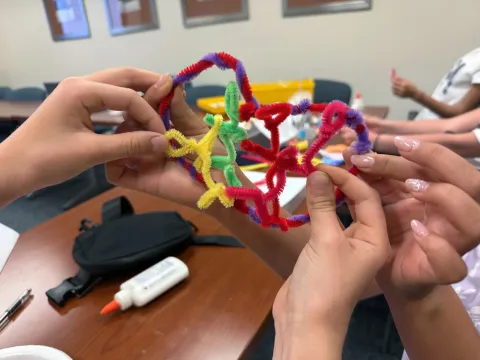
Participatory workshops around the world led by the fellows engaged over 800 children and young people to explore how they envision trends and emerging issues unfolding in the future.
Like Kwabena and Bakyt, a 10-year-old girl from rural Kazakhstan with a visual impairment who studies in an inclusive school, these personas bring the future down from something ‘abstract’ to something very tangible that has an emotional impact on people, building empathy for future generations, and heightening the critical importance of our decision making today.
Now UNICEF is showcasing how child rights and futures thinking can shape more inclusive and just societies through the launch of the Future Child Persona Development Toolkit — a new methodology to co-create personas that help policymakers, practitioners, and young people imagine futures with children, not just for them.
A toolkit to imagine a better future
Developed in collaboration with the Dubai Future Foundation and the Artefact Group, the toolkit builds on the experience and insights gained from last year’s Future Child Persona Exhibit, first presented on World Children’s Day 2024 at the Museum of the Future in Dubai.
This same methodology evolved in 2025 through a partnership with AI storytellers at Tomorrow in Focus. Together, they brought new "future imaginings" to life via an immersive exhibit on the Children’s floor at the 2025 Dubai Future Forum, creating the future worlds you see here.
The toolkit helps individuals and organisations. Particularly anyone working on the child rights agenda – whether they are policymakers, funders, programme designers, child rights advocates, youth leaders, or educators, to embed child rights into long-term strategy and decision-making through a practical, case study-based toolkit.
The toolkit harnesses the power of human-centered design and experiential futures to make complex future scenarios tangible, human, and child-centered.
“When people think about the future, they often gravitate toward abstractions: utopias, dystopias, and extremes,” warns Shai Naides, Chief of Youth Engagement and Strategy at UNICEF Innocenti.
“But children and young people remind us that the future is not just a thought experiment; it is lived and felt. The goal with this toolkit was to create a methodology that honours their perspectives by anchoring foresight in tangible, everyday realities – family, friendship, learning, play, and survival.”
The intention was to push these personas beyond binaries of good and bad, deliberately steering away from damage-centred language in order to reflect the complex granular reality of the human experience – where opportunities and challenges, pain and joy, coexist.
Making the future tangible
Too often, children’s rights are reduced to checklists.
This risks taking away children’s agency and personhood by using data points to define them – further alienating those already on the margins, and ignoring that they are the ones who will inherit the very real consequences of the decisions made today.
The same is true when it comes to long-term decision making that will impact future generations. We take today’s data points and assume they will be true in decades to come.
While this linear thinking works for a predictable world, it leaves us vulnerable in a rapidly evolving one. We need a more anticipatory mindset—one that proactively explores how emerging shifts will transform the world and, by extension, the experience of childhood itself.
This toolkit provides a response to that challenge. It outlines how young people – as active participants and leaders – can build out representations of future children that are tangible, enabling empathy in audiences while also giving workshop participants the space to draw from their own rich and diverse lived experiences.
Policymakers, funders, programme designers, child rights advocates, youth leaders, or educators, can use it too as a tool in workshops or as an activity in classrooms or workspaces.
The playbook includes resources to build scenarios and factsheets for the future child personas, developing day-in-the-life narratives and even imagine what each child would pack in their bag as they leave home in the morning.
The idea is to capture nuanced insights about the life that this child lives, while also making the future tangible through physical artefacts – drawing from the experiential futures framework.
In the future, Kwabena attends innovation hubs at school, where he designs projects that mix technology with Ghanaian culture, like AI helping him study traditional drumming patterns or local languages. “It feels like our creativity is being protected and nurtured, and that is powerful.”
In an increasingly fractured world, the Future Child Persona Development Toolkit is a call to action: imagine, create, and champion future children that reflect the aspirations of your communities, like schools where students’ creativity can be protected and nurtured in a world increasingly impacted by technology.
Rather than seeing children as passive observers in policy and decision-making processes, this playbook positions them as central figures whose stories and perspectives shape the futures we invest in today.
It turns foresight into human-centred stories rooted in empathy and justice, shifting the question from “What might the world look like?” to “What might childhood feel like?”
Download the playbook here. https://www.dubaifuture.ae/wp-content/uploads/2025/11/DFF-UNICEF-Publication.pdf