Women in Learning Leadership: Chad
What does women’s school leadership look like in Chad?
- English
- Français
Highlights
Report 1: What does women’s school leadership look like in Chad?
Effective school leaders are indispensable for driving school and student learning improvements. Inspired by emerging literature highlighting a positive correlation between female school leaders and learning outcomes, and due to the underrepresentation of women in school leadership, the Women in Learning Leadership project in Chad adopts a gender lens to examine school leadership in the country.
This research highlights the significant underrepresentation of women in the education sector in Chad. Only one out of five teachers (20 per cent) and 1 out of 20 school leaders – a mere 5 per cent – are women. The report (in French, with an English Executive Summary) presents the granular and sub-national distribution of women leaders and the multifaceted reasons for their underrepresentation in the Chadian education ecosystem. It also explores the differential education outcomes in schools led by female and male school leaders.
The findings demonstrate that Chad remains a profoundly unequal society, and several barriers at different levels of the education system prevent women from rising into leadership positions. Recommendations targeting the identified barriers are highlighted to enhance female representation at the leadership levels.
Suggested citation: Gouëdard, P., C. Ramos, et B. Tameza. Women in Learning Leadership (WiLL) - Le leadership des femmes dans les apprentissages au Tchad. Innocenti Research Report, UNICEF Innocenti, Novembre 2023.
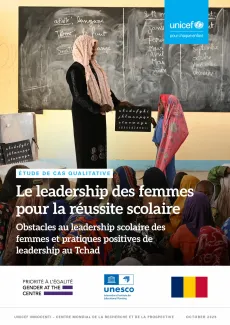
Report 2: Barriers to women’s school leadership and positive leadership practices in Chad – A Qualitative Case Study
Report 1 of the WiLL research in Chad analysed structural, individual and school-based challenges to women’s school leadership, and identified differentiating factors between schools led by women and schools led by men at national level. Building on these insights, this second report further explores two areas: positive practices implemented by men and women school leaders, including any gender differences therein; and barriers and enablers to women’s school leadership. The research found that, while women face individual, school-level and systemic barriers to school leadership, once they are in positions of leadership they can contribute to a positive learning environment. In particular, highlighted women school leaders’ important role in supporting girls’ education by being role models and providing targeted support, especially as concerns menstrual and sexual and reproductive health.
This report is based on an analysis of qualitative data, collected in 22 schools across five provinces of Chad (Ouaddaï, Chari-Baguirmi, N’Djaména, Moyen-Chari, and Mandoul). The research sample includes 11 rural and 11 urban schools, half of them led by women. Data was collected with 260 respondents, including school leaders, teachers, inspectors, pedagogical facilitators and caregivers.
This report explores the policies, practices and conditions that can support or hinder women’s school leadership in Chad. It aims to generate evidence that can foster a more equitable and positive learning environment.
Suggested citation: Di Paolo, I, Charpentier, A., et Tameza, B. (2025). Women in learning leadership – Barriers to women’s school leadership and positive leadership practices in Chad: Qualitative case study. UNICEF Innocenti, October 2025.