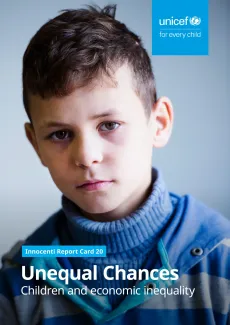
Unequal Chances: Children and economic inequality
Innocenti Report Card 20
Living in a wealthy country does not guarantee that all children are equally happy, healthy and have the same level of academic and social skills. The latest edition of the UNICEF Innocenti Report Card series explores how economic inequalities impact children’s well-being.
The report considers this question in the context of 44 countries that are classified as high-income and/or are members of the Organisation for Economic Co-operation and Development (OECD).
Examining the relationship between child well-being and income inequality, the report asks:
- Even amidst wealth, why is it that some children fare better than others?
- How does inequality shape children’s well-being?
- How do children perceive inequality?
- What can be done to create equal opportunities for all children?
Overall child well-being in wealthy countries
Each edition of the Innocenti Report Card series ranks countries on how they are doing on key aspects of child well-being. The league table of Report Card 20 ranks 37 countries, where data are available, on three dimensions: mental health, physical health, and academic and social skills. The league table shows areas of strength and weakness across this group of countries.
For example, the Kingdom of the Netherlands, Denmark and France are on top of the league table across all three dimensions of child well-being. But most countries show uneven performance, doing much better in some areas than others.
Persistent poverty in a world of plenty
The wealthiest countries in the world continue to get richer. But despite this increasing prosperity, large inequalities persist within these countries. Even in the most equal countries, people in the top fifth of the income distribution have 3.5 times as much income as people in the bottom fifth. In the most unequal countries people in the top fifth have income more than 7 times than people in the bottom fifth.
Why does this matter for children? The report shows that a wider gap between the rich and the poor in a country is linked, on average, to poorer physical health, mental well-being and skills for children.
Additionally, child poverty – a sign of inequality at the lower range of incomes – remains stubbornly high. It affects at least 1 in 10 children in every country studied, with rates ranging from around 10 per cent in Denmark to around 37 per cent in Colombia and Costa Rica.
How economic inequality shapes children’s lives
Economic inequality has a clear relationship with how healthy children are, how happy they are and the academic and social skills that they develop.
Physical health
Children (between ages 5 to 14) are more likely to die in childhood if they live in unequal societies and they are more likely to be overweight. While these mortality rates have fallen substantially in general, there are signs that they are increasing in some countries. The five countries with the highest levels of economic inequality have child mortality rates, on average, 2.4 times those in the five most equal countries.
Children in unequal societies are at a higher risk of overweight and obesity. A child’s food and nutrition are influenced by the quality of foods their family can buy and prepare. Lower income families find it difficult to afford healthier food options and rely on energy-dense foods putting the children at risk of overweight and obesity. The share of children who are overweight is 1.7 times higher in the most unequal countries than in the most equal countries.
In fact, economic inequalities shape children’s overall level of health. In the European Union, only 58 per cent of children in families with the lowest fifth of income are in very good health, compared with 73 per cent among the top fifth.
Mental well-being
Economic inequalities are also linked to inequalities in mental well-being. Around 77 per cent of children living in the most advantaged families report high life satisfaction compared to only 67 per cent in the most disadvantaged families.
Children’s skills
Income inequality also holds back children’s academic performance and social skills. There are notable gaps in academic achievements among 15-year-olds living in this group of countries. On average, children in wealthier families are almost twice as likely (83 per cent) to have basic academic proficiency in reading and mathematics by age 15 than children in poorer families (42 per cent).
How do economic inequalities affect children?
The report traces the many pathways through which economic inequalities translate into poorer outcomes for disadvantaged children. Economic inequalities shape inequalities in the world around the child (household, neighbourhood and school resources) and in the world of the child (relationships and activities).
Children living in economically disadvantaged contexts tend, on average, to have access to fewer and poorer quality resources at home, in their neighbourhood and at school. This includes, for example, poorer quality housing, greater food insecurity, poorer quality local services including schools, and higher levels of environmental problems such as pollution.
And there are tangible differences in their daily lives, including poorer-quality diets, lower levels of physical exercise, and a higher likelihood of engaging in paid work rather than school studies.
This network of influences can ultimately lead to inequalities in children’s physical health, mental well‑being, and academic and social skills.
How do children experience and understand inequality?
Research undertaken with children in six countries showed children’s strong awareness and understanding of inequalities.
“If you’re poor and your friends invite you out, you might get left out if you don’t have any money to go with them”.
Child in Colombia.
Children discussed and identified several aspects of inequalities including economic factors, differences and discriminations experienced because of gender, disability, race, ethnicity and migration status, as well as physical aspects such as appearance.
“There are schools that when a girl is Roma, as they are accustomed that [sic] Roma girls don’t study, they place them in support classes even if they get good grades.”
Child in Spain.
As well as identifying these inequalities, children also named the different range of systems and contexts in which inequalities are rooted, including the education system, government and public policies. They also proposed solutions to tackle these inequalities:
“Give children the right to vote and more money for social aid for children.”
Child in Switzerland.
What can countries do to minimize the harm done by inequalities?
Beyond material resources, economic inequalities can affect child well-being through other pathways. Economically disadvantaged children, and their families, often face greater levels of stress, stigmatization, and discrimination in various aspects of their lives. Governments and stakeholders can act in several policy areas to minimize the impact of inequality on children’s well-being, particularly by reducing child poverty.
Actions can include:
- Improve safety nets, (including family and child benefits and minimum wages), so that no child grows up in poverty.
- Improve local environments and services with subsidized housing, improvements to infrastructure in disadvantaged neighbourhoods, and investment in public facilities like green spaces and leisure facilities.
- Address inequalities in education by minimizing socioeconomic segregation in schools; ensuring that schools are appropriately staffed and equipped regardless of students’ economic backgrounds; and by providing children with healthy and nutritious school meals.
- Engage with children to better understand their perspectives on how inequality affects them and their families and to develop solutions that promote their well-being.
- Improve data and monitoring. Even in countries with substantial resources, data is still lacking on many aspects of well-being. Data also needs to be improved so that it is disaggregated by different sub-groups in the population to enable an exploration of how economic inequalities intersect with other types of social inequalities.
Highlights
The latest UNICEF Innocenti Report Card 20 Unequal Chances: Children and economic inequality examines how economic inequality shapes children’s lives across 44 countries that are classified as high-income and/or are members of the Organisation for Economic Co-operation and Development (OECD). The wealthiest countries in the world continue to get richer, yet large inequalities persist within these countries – and these gaps have serious consequences for children’s physical health, mental well‑being and skills.
The report updates UNICEF Innocenti’s league table of child well‑being and shows that countries with lower levels of income inequality and child poverty tend to achieve better outcomes for children overall. At the same time, stark inequalities within countries mean that children from poorer families consistently face higher risks of ill health, lower life satisfaction and weaker educational outcomes.
The report concludes with clear policy directions, calling on governments to reduce child poverty, promote fair access to resources and services, and work with children themselves to create more equitable societies because reducing inequality is essential to ensuring that every child has a fair chance to thrive.
Suggested citation: UNICEF Office of Strategy and Evidence – Innocenti, Unequal chances: Children and economic inequality, Innocenti Report Card 20, UNICEF Innocenti, Florence, May 2026.
The working papers on child participation and the statistical analysis accompanying this report card are forthcoming. This publication is part of the UNICEF Innocenti Report Card series.