Building Better Healthcare for Children in Banyumas
Improving the Quality and Supply of Water and Energy in Health Centres
- English
- Bahasa Indonesia
A healthcare facility should be a sanctuary, a place of healing and safety. Yet, for many children across the province of Central Java, the very buildings meant to protect them harbour a grave public health risk: a lack of basic water, sanitation and hygiene (WASH) services.
According to 2020 Ministry of Health data, one in ten primary healthcare centers (Puskesmas) in Central Java lacks access to water services that meet standard safety protocols. Most Puskesmas have handwashing facilities with soap and running water located either near delivery areas or close to toilets, but not in both locations.
Deep in the Sokaraja District of Banyumas in Central Java, Puskesmas Sokaraja II faced a major challenge. Although the taps ran, the water was unsafe. Laboratory tests revealed the supply was contaminated with E. coli and high levels of iron – a danger for a facility providing maternity care and serving thousands of patients, including children.
In 2024 alone, over 8,000 children passed through the doors of Puskesmas Sokajara II for everything – from routine immunization to dental work.

Today, children no longer face the risk of water contamination at Puskesmas Sokaraja II, one of 40 Puskemas in Banyumas to benefit from comprehensive WASH service improvements using WASH FIT (Water and Sanitation for Health Facility Improvement Tool).
WASH FIT is an assessment tool that helps health facilities improve water, sanitation, hygiene, environmental cleaning services and waste management. UNICEF introduced WASH FIT to Puskesmas in Banyumas and supported some of these centres to make improvements based on the assessment and action plan. This collaboration is made possible with the support of the local government, Ministry of Health, and funding from the Government of Korea.
At Puskesmas Sokajara II, the assessment highlighted the peril of the water quality. The solution was precise: the installation of a water filtration system and an additional elevated water tank to ensure the supply of clean water.
“This intervention is vital,” says Dr. Cahyanita Sayekti, the Head of Puskesmas Sokaraja II, affectionately known as Dr. Nita. “The water quality at Puskesmas Sokaraja II has transformed. Our latest laboratory checks show no traces of E. coli. Since we provide maternity services that require absolute hygiene, this is a game-changer.”
The improvements extend beyond clean water. The Puskesmas also received industrial laundry machines, ensuring that bedding and linens used for pregnant women and sick children are sterilized effectively. Some of the facility improvements recommended by the risk assessment were partially funded by the Puskesmas. As a BLUD (Badan Layanan Umum Daerah), the Puskesmas operates under a special entity status that provides flexibility in managing its own income and resources.
“We hope the Puskesmas is now more resilient against future shocks,” Dr. Nita says.
We are prepared with better hygiene and sanitation. Our assessment score using the WASHFIT tool increased from 88 percent to 95 percent, indicating a tangible rise in the quality of care.
Miles away, Puskesmas Banyumas faced a different risk: scarcity of water supply.
Housed in a striking cultural heritage building, a former Dutch bank (Banjoemasche Bank) constructed in 1775, the facility is a fixture of local history. It is also a bustling hub, designated as a child-friendly Puskesmas, with visits by over 9,000 children per year.
“Our primary water source comes from the local private water supply company (PDAM),” explains Dr. Kuntoro, the Head of Puskesmas Banyumas. “There were times when the water simply stopped. We had to call PDAM and beg for a tank of water just to keep our operations running.”
Responding to WASH FIT findings, the facility now uses new boreholes – deep wells that draw water from underground sources. This upgrade doubled the health centre’s water reserves. “I feel more secure now,” says Dr. Kuntoro, sounding relieved. “We no longer live in fear of needing emergency water tanks.”
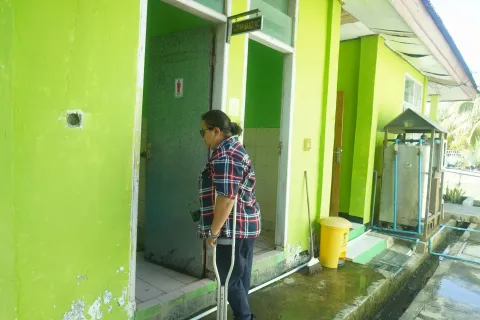
The renovation at the heritage site went further than water supply. The facility now boasts clean, secure, disability-friendly and gender-separated toilets, equipped with mirrors and menstrual hygiene kits, alongside a new wastewater treatment plant, modernizing a centuries-old building to meet current standards of dignity and care.
WASH FIT’s risk assessments can identify triggers and provide early warning signs for Puskesmas management. Coupled with the PERIKSA tool (Perangkat Penilaian Risiko Iklim Sanitasi dan Air Minum) – developed by UNICEF together with Bappenas – Puskesmas can also identify ways to design more climate resilient water and sanitation systems.
This combination was critical for Puskesmas Baturraden II. Situated in the shadow of Mount Slamet, the facility is vulnerable to the mountain’s volatile weather. Heavy rains and lightning strikes frequently severed the power grid, plunging the centre into darkness. Blackouts can be catastrophic – particularly for a refrigerator full of temperature-sensitive vaccine and medicine.
“There was a time when we had to evacuate our vaccines because the electricity was gone for a day,” recalls Head of Puskesmas Baturraden II, Fajar Tri Asih,S.Kep.,Ns.,M.M.,M.Kep.

After the assessment, the Puskesmas identified a solution: harness the energy above them through an 8.5 kWh off-grid hybrid solar system. Capable of powering the clinic for up to 36 hours without sunlight, it ensures the facility remains operational even when the grid fails.
“After being installed, we can save on electricity bills up to 30 percent,” Fajar notes. But the true value isn’t just in the savings, it is in the security of knowing the lights and the vaccine fridges will stay on.”

From water contamination in Sokaraja, scarcity in the heritage halls of Puskemas Banyumas and blackouts at the foot of Mount Slamet, these three Puskesmas are proof that local solutions, guided by key assessment tools, can transform vulnerable facilities and ensure that every patient – especially every child – has access to the safe WASH services they deserve.