Six provinces, 104 million lives: The push to end open defecation in Indonesia
Nationwide efforts to protect child health and dignity

- English
- Bahasa Indonesia
In the village of Lumajang, a small community in East Java, Indonesia, a mother of three recalls the hardships her family faced not too long ago. "We had no toilet at home," Hanifah explains. "We had to defecate in the rice fields, even at night, using a flashlight. It was dangerous, especially during the rainy season when the paths were slippery."
Lumajang was declared open defecation-free (ODF) in 2021. Three years later, in October 2024, Sumenep became the final district in East Java to achieve ODF status, marking the entire province as free from open defecation. With this achievement, East Java joined four other provinces – Jogjakarta, West Nusa Tenggara, South Sulawesi and Central Java. In 2025, Aceh became the sixth province to earn ODF status.
Achieving ODF status is no small feat. The journey requires the certification of every household, village and district within a province. A single household practicing open defecation can prevent an entire province from being recognized as ODF.
Through relentless national and local efforts by the Government of Indonesia, with support from UNICEF and other stakeholders, the open defecation rate in Indonesia has plummeted from 35.46 per cent in 2010 to just 3.2 per cent in 2024. Today, over 104 million people live in defecation-free environments across six ODF provinces.
For communities like Hanifah's, the end of open defecation means far more than convenience—it is a crucial step for improving child health and development. Open defecation exposes communities – especially children – to deadly diseases such as diarrhea, and contributes to stunting, a pressing challenge in Indonesia that affects one in five children.

The Indonesian government has committed to ending open defecation by 2030. The 'Roadmap for ODF 2022-2030', developed with UNICEF’s technical assistance, has been pivotal in guiding these efforts. It includes a national monitoring system to track progress at the household level.
Innovative financing has also played an important role. In 2017, in West Nusa Tenggara, the National Board of Zakat (BAZNAS) collaborated with UNICEF to launch a model using Zakat funds – mandatory charitable giving by Muslims – to help families build toilets. BAZNAS has expanded this model to other provinces, including Aceh, East Java, South Sulawesi and Papua.
“Lack of access to clean water and sanitation is a major issue related to poverty in Indonesia,” says Nana Mintarti, a commissioner at BAZNAS. “Poor water quality and inadequate sanitation lead to various diseases that significantly affect impoverished communities. BAZNAS is committed to enhancing support for improving access to water and sanitation hygiene.”
UNICEF has also supported loan initiatives in partnership with community-based enterprises, making it easier for families to build toilets with manageable repayment terms, alleviating financial burdens.
"Between 2021 and 2025, 136 new districts/cities across Indonesia became open defecation-free, benefiting approximately 95 million residents," says Kannan Nadar, UNICEF Indonesia’s Chief of the Water, Sanitation and Hygiene Programme.
"By the end of 2025, we expect that 37 new districts/cities will be ODF, benefiting close to 27 million people. Our collective efforts have shown what works. Now, we are focused on maintaining this status while we double down to ensure that every child lives in an open defecation free environment.”
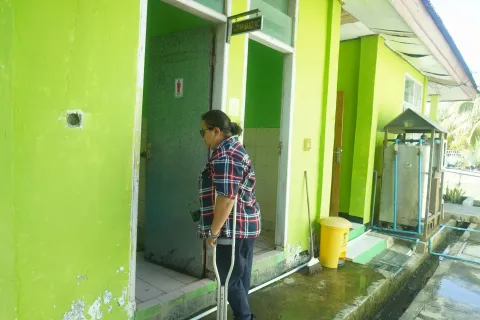
UNICEF continues to work with the national government and local authorities to ensure that sanitation facilities are resilient to climate hazards and inclusive of all, especially girls, women and persons with disabilities. With every new district that declares ODF status, Indonesia moves closer to a future where no child has to face the dangers and indignities of open defecation.