Margaretha's journey to recovery
When RUTF and family support came at the right time

- English
- Bahasa Indonesia
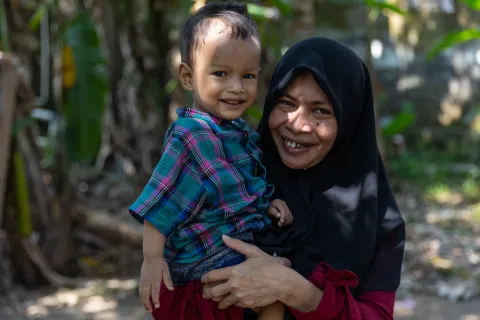
Small laughter from Margaretha Theresia (24 months) can now be heard in the yard of her modest home in Kampung Sidomulyo, Merauke district, South Papua province. Margaretha now takes little runs around the house and asks for food when she is hungry. For her mother, Maria Baraka, this simple scene feels like a miracle. Only a few months earlier, Margaretha looked weak, had difficulty eating, and was not yet as active as children her age. Maria remembers worrying as her daughter’s weight did not increase and her appetite continued to decline. Every day, she tried different ways to encourage Margaretha to eat, but her condition did not improve much.
"She usually did not want to eat. She was listless, weak, and just slept. Now she has changed for the better. She is talking more ... now she is chatty, playing. When she wants to eat, she asks for food and keeps talking. The change has been very good," Maria said.
Margaretha lives with her family of four. Her father works in construction. To access health services, the family walks to the Posyandu (community health post) or Puskesmas (community health-care centre) because they do not have a private vehicle, and public transport is not easily available. In this context, having services close to the community, along with the role of community health volunteers and home visits, is critical to ensure that children receive timely identification and care from wasting, one of the most severe forms of undernutrition among children under five.
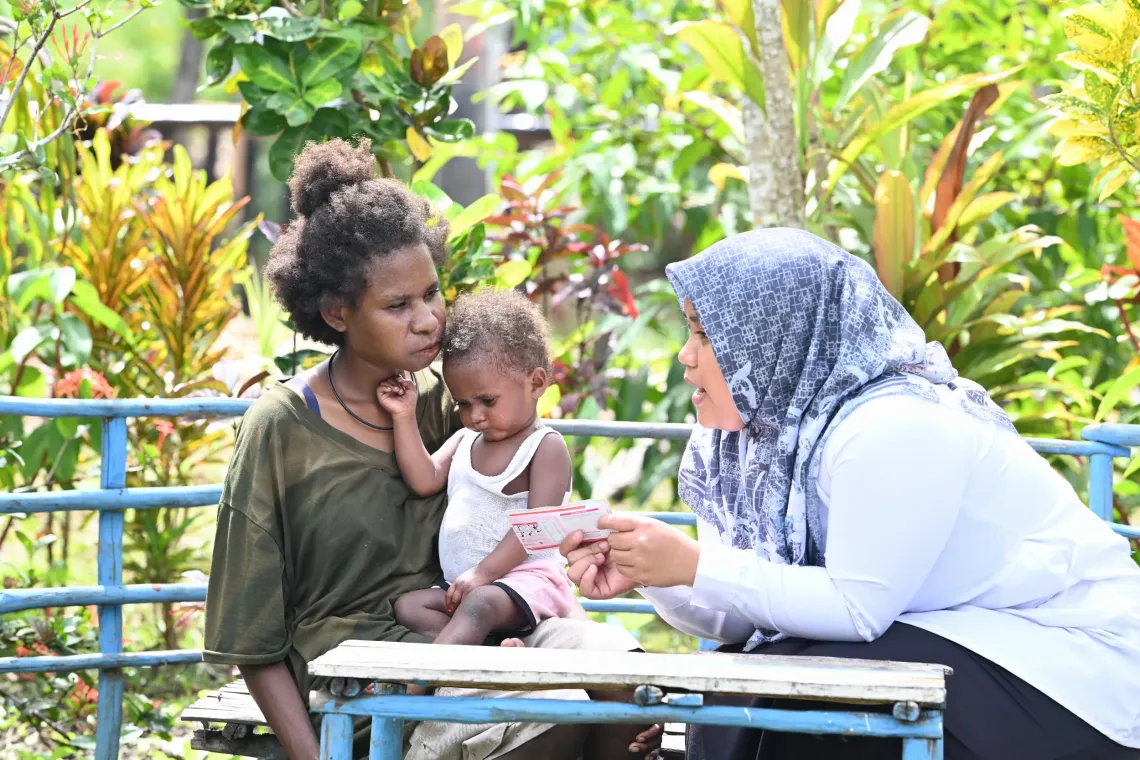
Margaretha's recovery journey began when she was identified through the Posyandu. During the monthly growth and development monitoring there, Margaretha showed signs of severe wasting. Her weight was far below her age, at 5.5kg, and her MUAC was 10cm. Based on this condition, Margaretha was referred to Puskesmas Kuprik for further confirmation by trained health workers.
“The diagnosis was frightening, but it also brought clarity. It meant that Margaretha’s condition had been identified, and that help was available close to home,” Maria recalled.
Based on the confirmation in Puskesmas Kuprik, Margaretha was diagnosed with severe wasting and met the criteria to be treated at the outpatient care by providing RUTF, a therapeutic food designed specifically for children with severe wasting, which can be consumed directly at the community setting without required hospitalization. RUTF does not need to be cooked and is easy to give at home. Using RUFT, Maria made sure her daughter received the treatment regularly, and attended routine follow-up visits at the Puskesmas. Through the provision of RUTF and essential medicines, routine monitoring by health workers and community health volunteers, and family support, Margaretha gradually began to recover.
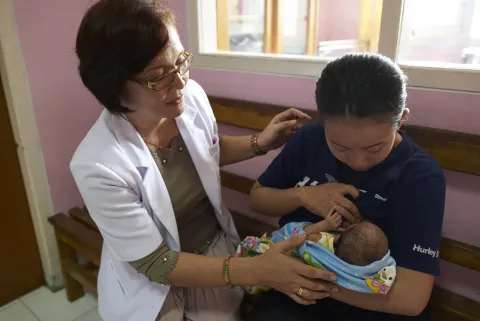
In outpatient care, Margaretha not only received RUTF. Her family was also educated on how to give RUTF and practice clean and healthy lifestyles, with the little girl given routine monitoring of growth and development at the Posyandu. Furthermore, community health volunteers and health workers conducted regular visits every one to two weeks to monitor her progress.
"At first she was weak and did not want to eat. But after receiving RUTF, she started to eat again and her condition slowly improved," Maria recalled.

For Maria, one of the things that helped was that RUTF was practical and easy to give. It did not need to be cooked or mixed with water, and could be consumed directly by the child, according to the dose instructed by health workers.
"It tastes good, so she likes it. Giving it is also simple -- she can eat it directly. It does not need to be mixed or cooked. The important thing is to keep it clean," Maria said.
Sukma, the nutritionist at Puskesmas Kuprik, sees Margaretha's progress as the result of early detection, referral, case management, and continuous support from health workers and community health volunteers. The experience of Puskesmas Kuprik shows that successful outpatient care does not depend only on the availability of RUTF. Challenges such as families moving to different locations, children not returning for weekly follow up according to schedule, and family concerns about treatment can still cause children to be lost to follow-up. In these situations, community health volunteers play an important role in linking families with the Puskesmas.
According to Sukma, before starting therapy, the Puskesmas health team conducted a comprehensive assessment of Margaretha's nutritional status and health condition. The examination showed that she met the criteria for outpatient management of severe wasting with RUTF.
Within a few weeks, Margaretha's weight increased from around 5.5kg to 7.5kg, while her MUAC increased from 10cm to 13cm. Gradually, changes began to show. Margaretha, who had previously been weak, started walking. She became interested in playing again and often asked her mother for food. For the family, however, the most meaningful changes were not limited to the numbers on the scale or the MUAC tape. Margaretha is now more active, walking, playing, and showing a better appetite.

Behind Margaretha's renewed cheerfulness and ability to play is a story of how connected
services -- from the Posyandu and family, community health volunteers, and the Puskesmas to the availability of RUTF -- can help children with severe wasting receive timely and continuous care.
"The role of community health volunteers is very important. They are, in many ways, our front line. They are more aware of the community and better able to reach people, so they are more easily accepted," said Sukma.
Today, Margaretha's journey carries a simple but powerful message: early detection at the Posyandu, appropriate referral, outpatient care, RUTF, family counselling, and support from community health volunteers can help children with severe wasting recover. For Maria, the message to other families is clear.
"I would advise families to go to the Puskesmas so their children can receive good services," she said.
Margaretha’s story reflects a wider challenge faced by many children in Indonesia. Wasting, or acute malnutrition, occurs when a child becomes too thin for their height. It weakens the immune system and increases the risk of illness and death. In Indonesia, around one in fourteen children under five is estimated to be wasted, equivalent to more than 1.7 million children, in which over 260,000 affected by severe wasting. Children with severe waste face a much higher risk of dying than well-nourished children, yet many can recover if they are identified early and receive appropriate treatment.
The challenge is especially urgent in eastern Indonesia, where geography, service access and other barriers can make it harder for families to reach care on time. In South Papua, UNICEF support has focused on strengthening community and facility-based detection, including Family MUAC, caregivers-led screening and early referral, so that children with wasting can be identified and treated before their condition worsens.
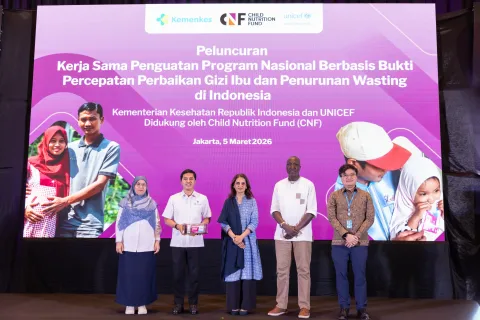
Since 2025, UNICEF, together with the Child Nutrition Fund (CNF), has supported the Government of Indonesia, including South Papua province, to strengthen services for the management of severe wasting among children under 5, through the IMAM programme. This support includes ensuring the availability of RUTF, strengthening the capacity of health workers and community health volunteers, and supporting service implementation. It helps strengthen the health system’s ability to detect, refer, and manage children who need care, so more children have the opportunity to recover and grow optimally, like Margaretha.