Nikita’s inspiring journey at Palika Divyang Bhavan Foundation
As Pimpri-Chinchwad continues to grow as an urban centre, Nikita’s story reminds us of what truly inclusive governance looks like

- English
- हिंदी
Pune, Maharashtra- In the heart of Tuljai Nagar, Pimpri-Chinchwad, 19-year-old Nikita Sanjay Dhas begins her day with a gesture that speaks volumes, a clap.
Living with an intellectual disability, clapping has become her way to express hunger, excitement, or the simple desire to go outside. For her mother, Geeta Dhas, it’s a language of love, routine, and unwavering care.

At birth, nothing appeared out of the ordinary. But by age three-and-a-half years, subtle signs emerged. Nikita remained seated for long hours, not showing the expected developmental pace for her age. That marked the beginning of a journey filled with challenges, adaptations, and breakthroughs.
Geeta, a full-time caregiver, explains, "I cannot leave her alone for even a moment. I have to be with her always." Yet, she is far from alone in this journey.
Four days a week, the mother-daughter duo travels to the Pimpri Chinchwad Mahanagar Palika Divyang Bhavan Foundation ( PCMC-DBF) -a first-of-its-kind, disability-inclusive support centre established by the Pimpri Chinchwad Municipal Corporation (PCMC). For Nikita, DBF has become a second home.
“She used to cry in the beginning,” Geeta recalls. “But now, she looks forward to it and insists we go. There’s music, dance, therapy, games — and most importantly, other children like her. She feels seen.”

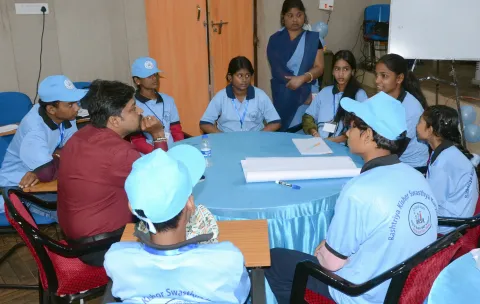
In one session, Nikita colours under the gentle guidance of art teacher Mrunal Mahajan. In another, speech therapist Priyanka Solanki helps her build confidence through sound repetition. Dance sessions led by Maithili Divekar bring rhythm to her movements, strengthening both body and spirit.
Geeta also supports her learning at home by using digital aids, such as a smart TV, to reinforce speech and recognition routines. As a mother, she has become not just a caregiver, but Nikita’s constant therapist, teacher, and advocate.

In recognition of her needs, PCMC provides ₹3,000 per month towards her care a small but meaningful support that underlines the role of local governance in inclusive development.
PCMC-DBF was launched on February 1, 2024. With the commencement of therapies from August 2024, PCMC-DBF has impacted over 750 persons with disabilities, offering disability assessments, counselling, vocational training, assistive devices, and special education. It has a staff of 41 individuals, eight of whom live with disabilities, like Sankalp himself.

In January 2025, PCMC-DBF partnered with UNICEF, adding a strategic layer to its mission. The collaboration produced a Disability-Inclusive Programming Strategy, launched at the Purple Jallosh in March.
This strategy integrates disability into five focus areas: health, WASH, education, child protection, and inclusive data systems. What makes PCMC-DBF special is not just the services it offers, but also how it delivers them, with a staff of 41, including eight individuals with disabilities, who uphold inclusive hiring practices.
For families like the Dhas household, PCMC-DBF is not just a therapy centre it is a space of acceptance, dignity, and hope.
“There are others like her here,” Geeta says, watching Nikita laugh with a group during music time. “She is not left behind.”
As Pimpri-Chinchwad continues to grow as an urban centre, Nikita’s story reminds us of what truly inclusive governance looks like: when services are rooted in local government, delivered by trained professionals, and sustained by empathy and equity.
In Nikita’s claps, we hear not just a request, but a call for a more inclusive future. And PCMC-DBF is answering.