Advocate for Child Rights, Already
Even as early as 5 a.m. the area bustles with activity, visitors try and snag a fish, youngsters click a round of selfies and men and women take a stroll.

- English
- हिंदी
“As you walk down my area, you will see fishermen hauling in fresh catch, children playing, youth singing gaana songs, fish being fried, waves rippling, youngsters playing carrom on streets. The ship-building yard, sea coastline and boats make for a perfect picture”, says 19-year-old Kowsalya from North Chennai.
Almost everyone knows this small, fragile girl who is pursuing her 1st year in Economics at Government Arts and Science College, Tondiarpet, Chennai.
Even as early as 5 am, the area bustles with activity, visitors try to snag a fish, youngsters click a round of selfies and men and women take a stroll. One can hear the shrill voices of fisherwomen enticing customers with descriptions of the varieties of fish on sale.
The fishing villages located in and around Ennore have for many years depended on the creek as a source of livelihood and sustenance. Between the high seas and a highway, this Chennai fishing hamlet’s story is one of struggle for survival, and so is Kowsalya’s.

“My mother and father died when I was young. My father was a heartbroken rickshaw puller who died a few years after my mother. I don’t even remember my parents’ faces. I always wondered if my life would be any different if they were around.”
Kowsalya now lives with her paternal aunt and uncle. She and her two siblings moved to their aunt’s house in the neighbourhood. Her aunt and uncle had five children and had little means of living, but they did have a warm heart.
Even so, Kowsalya’s uncle is an alcoholic. The mammoth responsibility of supporting the needs of the big family was on Kowsalya’s Aunt. Just to barely survive, she started a small food stall in front of the house. “After college or during the holidays, I support my aunty to manage the stall; she has done everything for my siblings and me”, says an emotional Kowsalya.

Since childhood, Kowsalya has been bold and vocal about her rights. She further gained strength and knowledge by attending meetings organized by Arunodhaya’s Children’s Sangam (club).
Arunodhaya Centre for Street and Working Children is an NGO working in this area towards the elimination of child labour in all forms, the protection of child workers and street children who have been victims of abuse and the assistance in strengthening the support of their families.
“I gained knowledge through these meetings on various child rights issues, including child marriage and child labour.”
“I was already aware of these issues through meetings, and moreover, we have witnessed the first-hand experience of what could happen when a child gets married early, such as in my cousin’s case.
Revathi, my aunt’s daughter, eloped and married when she was just 15 years old. The next year, she became a mother. Now, with three children, the 24-year-old cousin bitterly regrets having married young and feels helpless that she is left with few choices in life,” says Kowsalya.
Given their situation, the family wanted to marry off Kowsalya’s sister, Sangeeta, when she was just 16 years old. “My cousin’s plight struck a deep cord in me. I knew my sister did not have to go through the same traumatic experience as Revathi.
I gathered the courage to stand up and speak up for myself and my sister. I was scared that the same thing would also happen to me soon after. I reasoned and argued with my aunt and uncle, explaining why it was wrong to get married young.
The girl is still a child and is physically at risk if she becomes pregnant early. The risk of complications in pregnancy or childbirth is higher. Moreover, the young girl has no control over many decisions in her life and is very vulnerable to domestic violence. Also, such girls drop out of school after marriage.”
Kowsalya’s arguments worked with her family, and they decided to postpone her sister’s wedding. Sangeeta had already dropped out of school after Grade 8 but learnt tailoring to earn a living. She is now 21 years old and married a month ago and also supports her aunt’s food stall.
Kowsalya and her friends from the children’s group thwarted another child marriage in the community by first trying to reason with the girl’s parents and, when that did not work, threatened to call the police and the Childline helpline!
Pushing for children’s rights has made Kowsalya a household name in her community. She is easily recognizable now, whenever there are issues related to child rights, peers, and community people come to Kowsalya for advice.
Kowsalya shares another instance - “I came to know that a 15-year-old girl got married to a boy in my area and came to live in my neighbourhood. I spoke to the girl and found out that she had been pressured into the marriage, and she wanted to study. With the help of Arunodaya, we went to the police and got the marriage annulled.”
“Advocating as part of a group is far more effective than working individually. When we voice as a group, people tend to take our issues more seriously; this is one such instance. Children’s Sangam (club) has got a lot of recognition this way.”
“Since the club has been formed, the children in my area have been able to control child labour. Being a club president has made me more assertive and confident; over time, my skills in both interpersonal relations and communication have improved.
Through my work, I have earned the respect not only of my peers, but of adults and community leaders”, says the proud young confident Kowsalya Kowsalya, who is now a volunteer with Arunodaya, is active on other issues as well. The girl is passionate about bringing change.

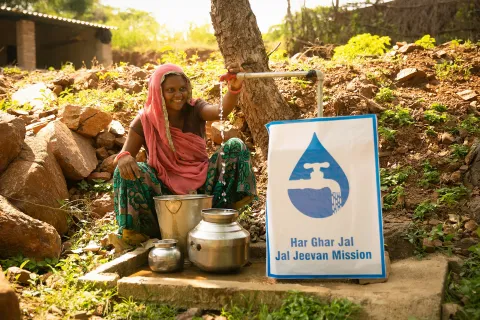
One such issue is water scarcity, which is not new to Chennai. Residents are forced to hunt for water tankers, pay bribes and spend hours, even at night, waiting for trucks to dispense some water.
As the water tanker arrives, women, men, and children rush with coloured plastic pots. This has resulted in many girls staying at home and not going to school or college. This troubled Kowsalya: “We have major water scarcity in our area, and the water supply was also erratic.
Many girls dropped out of school, so that they could collect water from the tanker, which came at any time. This troubled me a lot, so my friends and I decided to take a bold step. We submitted a petition to the Tamil Nadu Slum Clearance Board (TNSCB) in our locality.
In our petition, we requested that they change the water supply timings and ensure the water tanker arrives at a specific time in the evening, enabling the girls to attend school and college.
This made the authorities take up the issue seriously, and they changed the water supply timing”, says Kowsalya, who has now ensured no girls miss school and college.

Despite their economic situation, Kowsalya’s aunt and uncle are supportive of her and even proud of what she does. She now aspires to become a lawyer.
“I did not want to stop my education after school. My family was supportive but lacked the means. Arunodaya supports my college education, and I am determined to become a lawyer.
I want to continue working on issues related to the rights of children,” says Kowsalya, who also enjoys dancing. “I will get married only if I want to and find the right guy. No man can rein in my freedom. I want to be able to work and make my own choices.”