Prioritising Children in Policy and Budgets
UNICEF State of the World’s Children Report 2025 Advocates for investing in children’s wellbeing
- English
- हिंदी
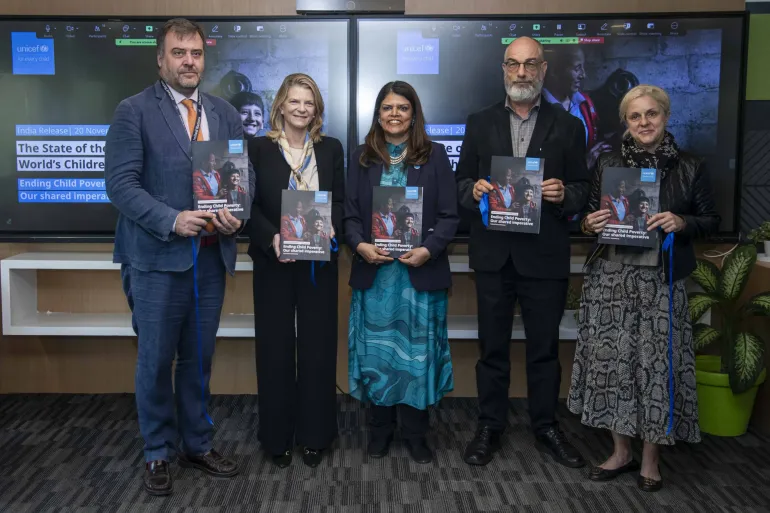
NEW DELHI — More than 1 in 5 children in low- and middle-income countries, about 400 million globally, are deprived of at least two areas critical for their health, development, and wellbeing, according to UNICEF's flagship report, The State of the World's Children 2025: Ending Child Poverty – Our Shared Imperative, released on World Children's Day today.
Globally, millions of children still lack access to basic services such as education, clean water, safe sanitation, housing, health, and nutrition, which deepens inequality, slows growth, and weakens the social fabric, leaving a lifelong impact even across generations.
The report highlights that the youngest children, those with disabilities and those living in crises are particularly vulnerable. Climate shocks, political crises and national debts are pushing families deeper into hardship, threatening to undo hard-earned gains in children's wellbeing.
India is the most populous country and home to approximately 460 million children under 18 years of age. In the keynote presentation, UNICEF India Representative, Cynthia McCaffrey, highlighted the significant progress India has made in poverty reduction and how India's flagship programmes have supported investments in children, putting India to be on track for SDG 1.2 ahead of the 2030 endline.
According to the National Multidimensional Poverty Index[1] (Niti Aayog), India helped 248 million citizens, including children, escape multidimensional poverty between 2013–14 and 2022–23, with the national MPI rate dropping from 29.2% to 11.3%. Significant increase in social protection coverage from 19 per cent in 2015 to 64.3 per cent, reaching 940 million citizens in 2025, combined with sustained social sector investments, contributes to this progress in poverty reduction.
"The State of the World's Children 2025 report reminds us that ending child poverty is achievable with the tools and knowledge we have. There is no greater return on investment than investing in children. India's progress shows that further acceleration of effective programmes can help reach the last mile and India's Vision 2047. Improving children's wellbeing isn't just about resources, it's about the collective will and leadership to prioritise children in every decision we make," said Cynthia McCaffrey, UNICEF India Representative."
She added, "Every child gaining access to healthcare, learning, nutrition, social safety,y and protection with quality takes us a step closer to reaching them all with equality and opportunity."
Flagship programmes like Poshan Abhiyaan, Samagra Shiksha, PM-KISAN, Mid-Day Meal Scheme, Beti Bachao Beti Padhao, Swachh Bharat, Jal Jeevan Missions, and India's world-leading digital public infrastructure have converged to deliver nutrition, education, income support, sanitation and financial inclusion at scale.
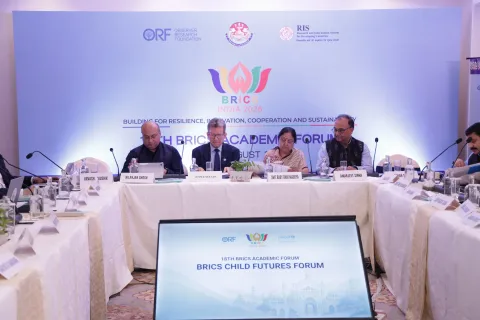
Dr Pinaki Chakraborty, Visiting Distinguished Professor, National Institute of Public Finance and Policy (NIPFP), advised, "Sustained public investments in the social sector are essential for child wellbeing. Safeguarding fiscal space for children programmes and enhancing overall spending in key sectors of health and education would be crucial for India."
Dr Nilanjan Ghosh, Vice President, Development Studies & Kolkata Head, Observer Research Foundation (ORF) emphasised, "Viksit Bharat @2047 cannot be defined through the narrow lens of per capita GDP alone. A truly developed economy must embed equity, distributive justice, and sustainability into its vision. India's real engine of transformation lies in sustained investments in children - the most vital reservoir of future human capital and socio-economic progress. By nurturing their health, nutrition, education, and opportunities today, we can unlock the demographic dividend and lay the foundations of a resilient and inclusive nation. The economic and social returns on investing in children are very high."
Highlighting the challenges faced by countries with large child populations, the report notes that about 206 million children in India still lack access to at least one of six essential services — housing, sanitation, water, nutrition, education, and health. Out of these, 62 million children experience two or more deprivations, hampering their ability to reach their full potential.
The report calls on governments and partners to:
- Make ending child poverty a national priority by embedding child rights in policies and budgets
- Expand inclusive social protection programs to safeguard vulnerable families
- Ensure equitable access to quality education, healthcare, nutrition, sanitation, and housing
- Promote decent work and economic security for caregivers, essential for children's wellbeing
- Empower children to participate in decisions affecting their futures
The release ended with a reminder that the world already has the evidence, tools, and experience needed to reduce child poverty — what is required now is the collective will to act.
[1] MPI 22, Niti Ayog 2025
Download The State of the World's Children 2025 Report Here:
https://www.unicef.org/reports/state-of-worlds-children/2025
Media contacts
About UNICEF
UNICEF strives to uphold the rights of every child, protecting them from harm and all forms of discrimination, so that they can grow up healthy and educated to reach their full potential. This work is in line with UNICEF’s globally recognized mandate and its support of national priorities.
For more information on UNICEF India and its work visit https://www.unicef.org/india/. Follow us on Twitter, Facebook, Instagram, Google+ and LinkedIn