Walking through Assam’s lush, green, tea gardens, from Dikom to Dinjoy in Dibrugarh district, I saw, first hand, how UNICEF is lifting lives.
Thanks to strong collaboration with the Government of Assam, civil society, legislators, media, the private sector, and communities, we are achieving milestones, including empowering children, women, and youth, who are now more confident in shaping their futures.
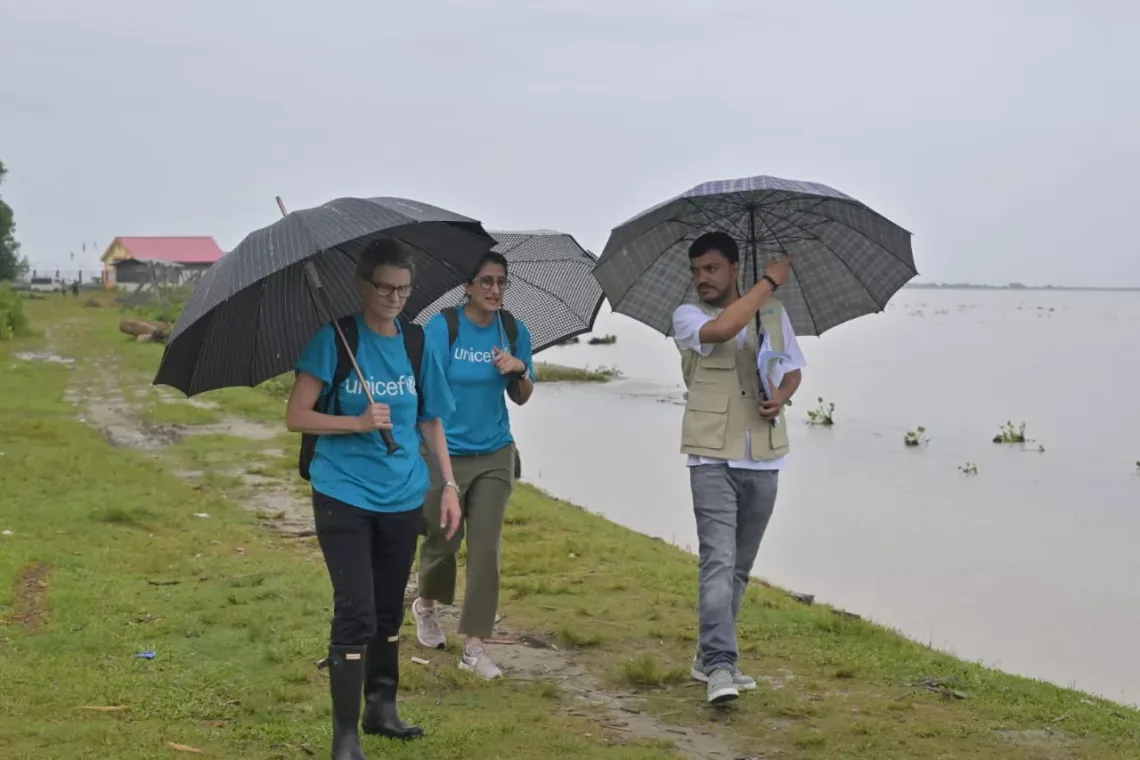
Yet, standing on the floodplains of the mighty Brahmaputra River (with an average width of 5.5 km and a maximum of 10 km in some regions), the team told me of a local saying, Jibon eti nodir sut, ji par kori jabo lage, meaning “Life is like a river’s current that must be crossed.”
It speaks literally and metaphorically of the challenges Assam faces. Climate change is here, and we must unite to find solutions for its most vulnerable communities, including children.
Way, way above where the water level should be, the fast-flowing river had me reflecting on the need for UNICEF – and all of Assam – to plan and prepare for the floods.
This means supporting the most vulnerable children and communities to build resilience across every aspect of our programming, including protection, nutrition, health, education, social security, and WASH. This cannot wait.
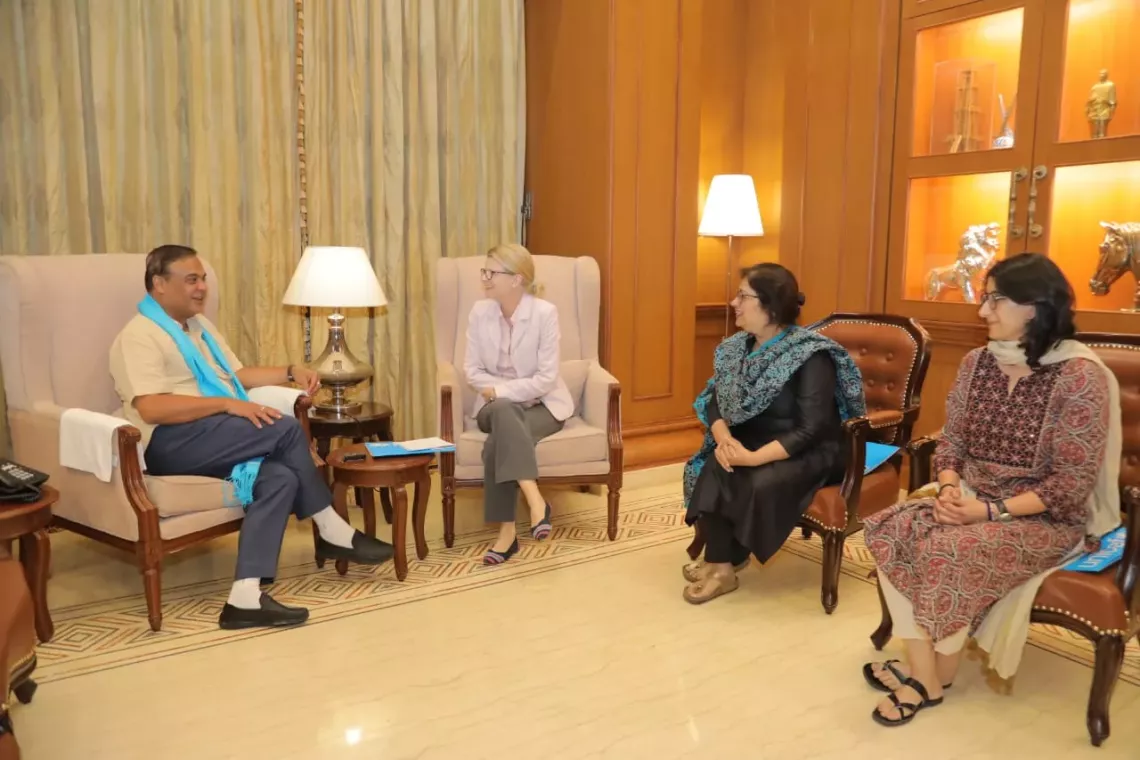
And that’s the message I took to the Honourable Chief Minister of Assam, Himanta Biswa Sarma. He acknowledged that scaling up and integrating UNICEF’s programmes can better support children’s health, education and protection. Watch this space.
A Decade of Impact in 205 Tea Gardens: Successes Rooted in Resilience
Since 2007, UNICEF has helped address historical gaps in Assam’s tea gardens, where provisions of the Plantation Labour Act on social welfare were left unenforced.
“I opened a bank account in 15 minutes! Now, I can access scholarships to study further and save for the have-nots,” 16-year-old Puja Orang told me.
A beneficiary of the Assam State Rural Livelihoods Mission (ASRLM), Puja’s ability to open a bank account via Bank Sakhis (trained self-help group members) underpins the UNICEF-ASRLM strategy: financial inclusion in five tea districts for non-working women.
This means that even during climatic shocks, women can still access funds to support learning and benefit from social protection schemes, such as cash transfers.
A short trip to the Barbaruah Lower Primary School showed me again how Assam is preparing for disasters. Ten-year-old Binita Ghatowar and her friends sat on the classroom floor, drawing a mind map on what precautions to take in case of an earthquake.
All of a sudden, the alarm sounded! Quick as foxes, the students dived under their desks. Once their teachers agreed it was safe, they lined up outside for a roll call with their backpacks on their heads to stay safe. Watching in awe at how slick they all were, I heard a student call, “Don’t take shelter next to a tree!”
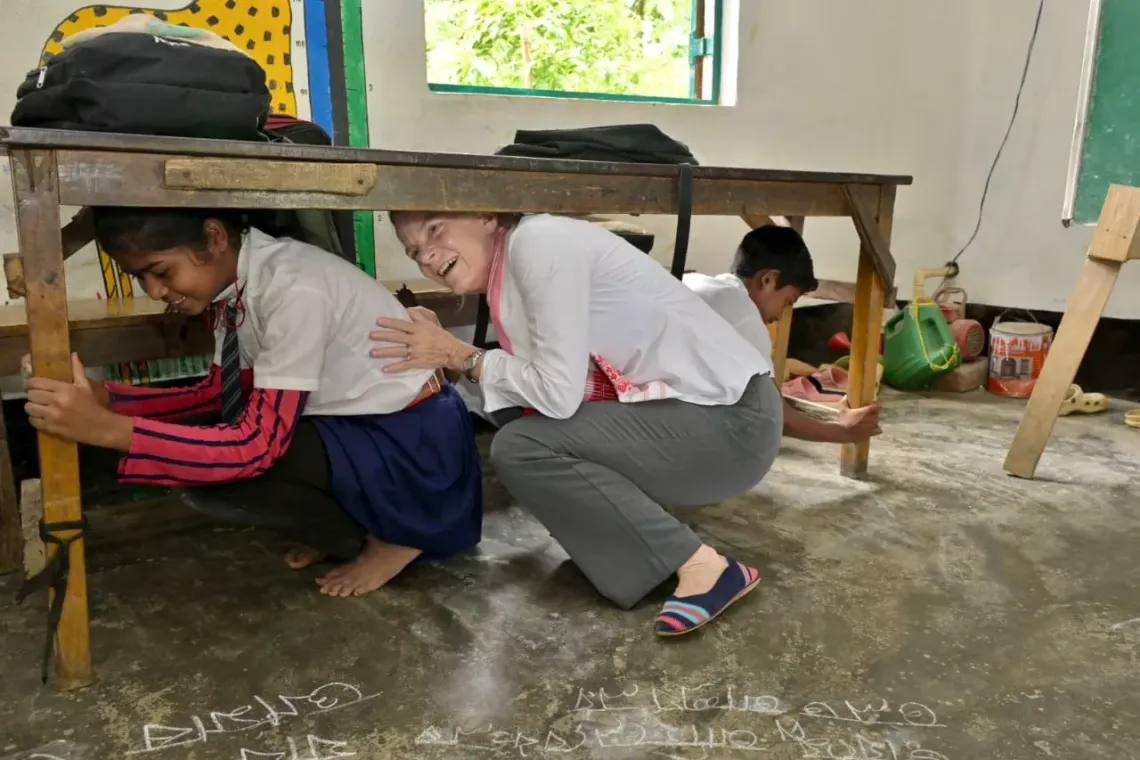
They are on it!
These localized, contextualized adaptation strategies and learnings that start from school are at the heart of UNICEF’s climate-resilient education programme.
Rooted in local knowledge and built on their foundational skills, I watched 193 young learners become more aware and more confident thanks to a learning environment that’s just right for their age.
Thanks to advocacy by the UNICEF Assam team, 419 tea garden-managed schools are now under the umbrella of the State Government’s education system - delivering textbooks, water and toilet facilities, and disaster drills.
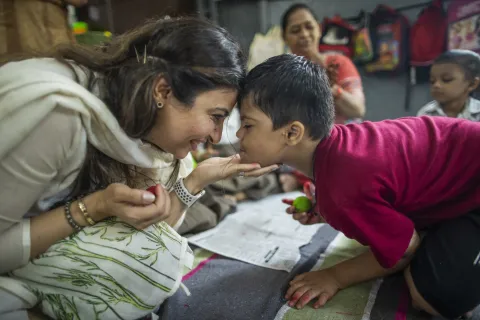
And speaking of umbrellas, we needed one when we went to the Dinjoy Tea Garden Model Anganwadi. Those pre-monsoon rains pelted us! But, inside, I saw little rays of sunshine everywhere. These centres are a lifeline in their support of mothers and their children, from the earliest moments of life.
“We’ve shifted home births to hospitals, reduced anaemia, and taught handwashing,” said Sangita Kurmi, an anganwadi worker, who works alongside Accredited Social Health Activist (ASHA) and Auxiliary Nurse Midwife (ANM). Their synergy is visible in over 60,000 Anganwadis across the state.
Thanks to the workers in over a thousand Anganwadi Centres in the tea gardens, women’s consumption of Iron Folic Acid has increased by a quarter and, today, almost all women give birth in health facilities – better for mum and better for baby.
And when these children get the best start in life, they grow up into bright, confident and articulate adolescents – like those I had the pleasure of meeting at the Jonaki Centre in Dikom Tea Garden.
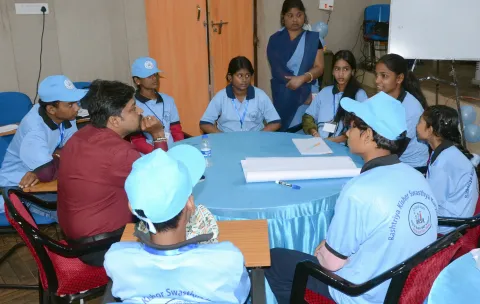
Young changemakers, such as Swaranjali, Rupanjali, and Neha, are using the power of storytelling and their local newsletter, Mukta Akash, to combat child marriage and hold leaders accountable. These girls aren’t just talking about change; they’re making it happen.
Across the tea gardens where UNICEF works, these community centres have become safe spaces where young people, girls and boys alike, learn about mental health, gender equality, and how these ideas play out in their daily lives.
Together with Tezpur University and the Samagra Shiksha Abhiyan, UNICEF leverages traditional folklore to drive change, sparking conversations on rights and equality in over 4,300 schools, reaching more than 800,000 students!
It doesn’t stop there. The Young Reporters are using their writing skills to spotlight local issues and engage local decision-makers, pushing for lasting change where it matters most—in their own communities.
These successes are not accidental; they are the result of teamwork and strong partnerships, guided by larger frameworks such as Assam’s Disaster Risk Reduction Roadmap 2030, Mission Vatsalaya, and Ending Child Marriage Mission, to name a few.
They reflect one powerful truth: resilience begins when communities are empowered.

But as the proverb guides us, life is full of currents – and crossing them is our collective challenge.
There is no doubt that climate change is an existential threat in Assam. Nearly half of its 35 districts are among India’s most climate-vulnerable.
The risks are expected to grow by 2045. Climate change also exacerbates existing vulnerabilities, including low education levels, digital literacy gaps and limited job opportunities.
That’s why we need to work together, work smarter, and invest wisely. Together we can, and so we must, break cycles of exclusion and poverty, and build a future where no one gets left behind.
A Future-Focused Vision: Opportunities for Transformation
Looking ahead, our priorities are clear: do more of what’s working, find new ways to help communities build resilience, and team up with partners to accelerate momentum.
UNICEF intends to deepen investments in climate-smart solutions, to make schools safer and keep children learning during climate crises. We aim to equip women like Sangita with the skills and knowledge to keep mothers and children safe and healthy, even during disasters.
We aim to engage young people as partners and help them develop marketable skills so they can find jobs and build a prosperous future.
And we have some strong partners in that effort. The Additional Chief Secretary to the Government of Assam, Dr. John Ekka, agreed that “Children are our biggest mission.” While academics like Dr. Bibharani Swargiary, from Assam Don Bosco University, endorsed the need for evidence to drive solutions, and lawmakers, such as Kamakya Tasa and Sanjoy Kishan, echoed UNICEF’s mandate for child-centric policies.
A Call to Action: Securing a Coalition for Child Rights
Reflecting on my mission and that proverb, my closing thoughts are that the Brahmaputra is rising high and flowing fast. Assam’s children face floods, heatwaves, storms and earthquakes. And they can’t cross these hurdles alone.
We must step up, speak up and support them. This is our moment to build a coalition of committed partners where the government scales, the private sector strengthens, communities participate, and the media raise awareness, so that together we invest in building resilience. I am confident we can do it.
We can turn Assam’s tea gardens into a place where children not only survive climate challenges but shape sustainable futures. We can be the bridge over those literal and metaphorical currents for every child. Are you with us?