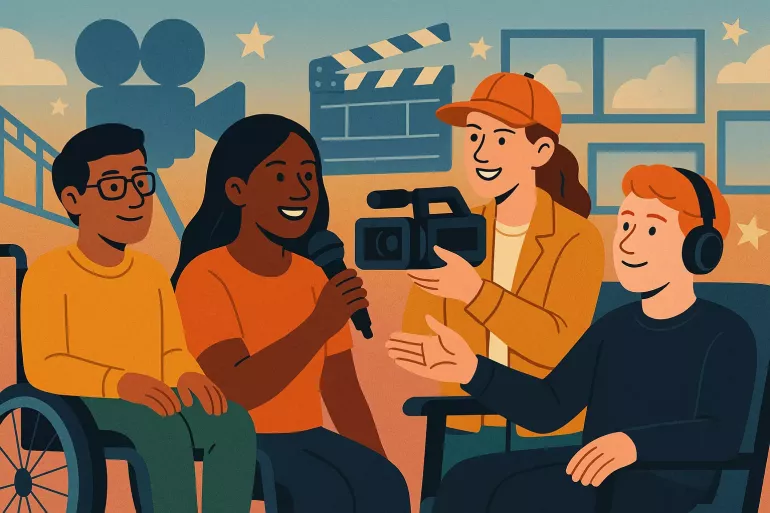
Lights. Camera. Everyone.
The world of entertainment holds the unique power to do more than entertain; it can shape how we see the world, open our minds, create empathy, and challenge outdated beliefs.
In a country as vibrant and vast as India, entertainment reaches far and wide, from bustling cities to the most remote villages.
Yet, for far too long, persons with disabilities have remained on the margins, both on-screen and behind the scenes. It’s time that changed.
True inclusion in entertainment isn’t about ticking a diversity box. It’s about reimagining the systems, the stories, and the spaces that make up the industry, so that everyone can be seen, heard, and truly celebrated.
As the world evolves, so must the stories we tell, and the way we tell them. Because the truth is, we’re all unique — and every perspective deserves the spotlight.
Cast Disabled Talent in Disabled Roles
This should go without saying: representation matters.
When disabled actors portray disabled characters, it’s not just more ethical — the storytelling becomes so much more powerful, believable, and real.
The outdated practice of “cripping up” — where non-disabled actors play disabled roles — reinforces harmful misconceptions and erases lived experience. It’s time we moved past the old belief of “but it can’t be done.”
And clearly, it can be done — beautifully. Just look at movies like Sitare Zameen Par..., which are leading the way for authentic and respectful storytelling that resonates.
Move Beyond Stereotypes
Too often, disability is painted with one of three broad brushes: pity, pain, or forced inspiration. But that’s not the whole picture — not even close.
Disability today encompasses a broad, dynamic spectrum — including visible, invisible, physical, sensory, cognitive, and neurodevelopmental differences like ADHD, speech and language challenges, and various mental health conditions.
People with disabilities aren’t here just to inspire others. They’re living whole, rich lives — filled with joy, humour, ambition, love, and yes, sometimes challenges — just like everyone else.
It’s about time our entertainment reflected that truth. Give disabled characters complete story arcs — romance, comedy, action, drama, even sci-fi. The audience is ready, and so are the stories.
Hire Disabled People Behind the Scenes
Real inclusion is not just about who is seen — it’s also about who gets to create.
From scriptwriters and editors to cinematographers, composers, makeup artists, and costume designers — people with disabilities deserve opportunities across every role.
It’s not about charity. It’s about equity, empowerment, and perspective. When disabled creatives are telling their own stories, the results are stronger, more authentic, and far more meaningful.
There are already many examples of disabled professionals excelling across industries. The entertainment world needs to catch up — not because it’s expected, but because it’s essential.
Make Sets and Productions Accessible
It might sound basic, but inclusive infrastructure is still a gap in many areas of film and content creation.
Sets should be designed with accessibility in mind — from ramps and wheelchair-friendly trailers to quiet spaces, sensory-friendly zones, and inclusive restrooms. Production houses must take responsibility to ensure that every artist and technician can do their job in a safe, respectful, and enabling environment.
This isn’t just about compliance — it’s about dignity and opportunity.
Make Viewing More Accessible
Everyone has the right to enjoy the magic of cinema or the thrill of a TV show — but in many parts of the country, especially smaller cities and towns, physical access to theatres is still a major hurdle.
And for many in the d/Deaf, blind, and neurodiverse communities, simply watching something on a screen can come with barriers.
To change that, we need to push for:
- Closed captions and subtitles
- Audio descriptions
- Sign language interpretation
- Haptic or audio-enhanced technologies
- Custom subtitle preferences across digital platforms
Streaming giants and cinema chains — this one’s for you. Small changes can have big impact.
Rewriting one Inclusive Story at a time
We know that creating a genuinely inclusive entertainment space won’t happen overnight. But the path forward is clear, and the time to start is now.
Because when we talk about diversity, we must mean everyone — regardless of ability. With genuine intention, compassion, creativity, and accountability, we can build a media industry that doesn't just include people with disabilities — it empowers them to lead, to shine, and to inspire on their own terms.
As inclusion champion Verna Myers once said, "Diversity is being invited to the party. Inclusion is being asked to dance." Let’s go one step further — let’s also hand over the mic, the pen, and the director’s chair.
Because when our stories become more inclusive... everyone wins.
Let’s roll the credits on exclusion.
About the author:
Raghav Aggarwal is a vibrant 16-year-old in his final year of school, brimming with curiosity and a passion for diverse interests. A food enthusiast with a love for culinary experiences, he is equally drawn to the world of mathematics and economics. An avid sports follower, he enjoys both watching games and analyzing them in depth.
Having travelled extensively, Raghav has gained a unique perspective on the challenges faced by differently-abled individuals in his country. He is deeply aware of the infrastructural gaps and, more importantly, the need for a shift in societal attitudes.
Eager to make a meaningful difference, Raghav hopes to use the UNICEF platform to raise awareness and foster acceptance for this cause. With a strong preference for visual storytelling, he envisions creating impactful videos featuring real-life stories and powerful messages to inspire and empower others.