Emergencies
Emergency preparedness and response

- Français
- English
The issues
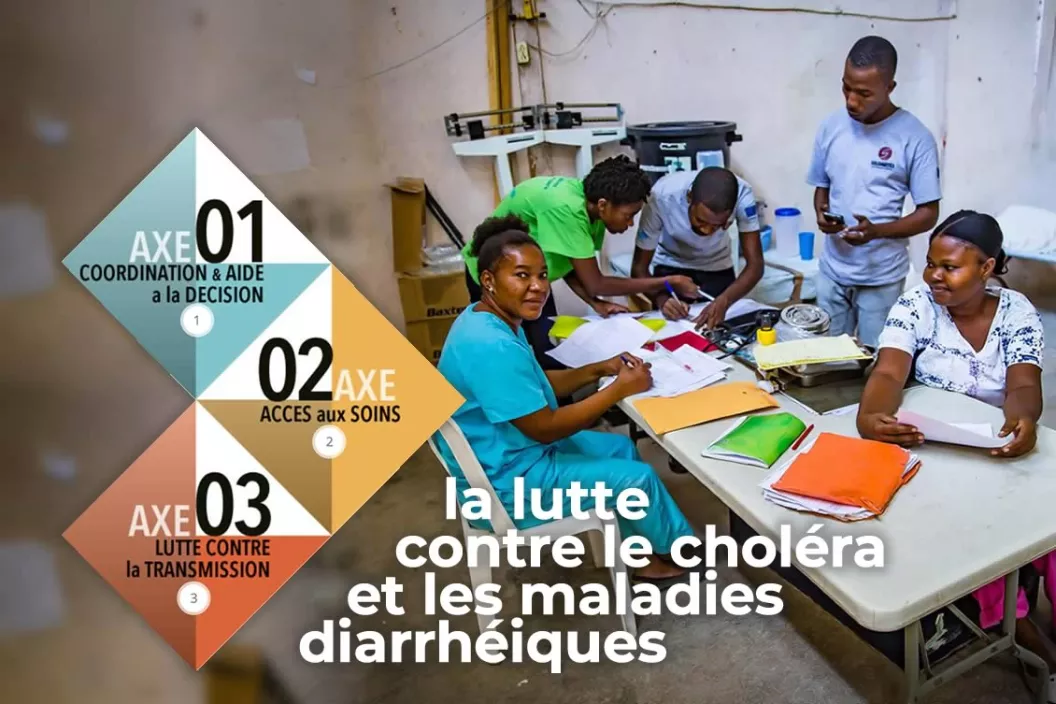
Since 2014, UNICEF has been supporting the Haitian Government's plan for the elimination of cholera, by contributing to the reduction of the disease's annual incidence and number of cases, towards the elimination of the disease in the country by 2022. The plan includes several components: coordination and surveillance, early warning and response, medical care and collaboration with local authorities and communities. UNICEF is also strengthening emergency preparedness and response (for cyclones, floods, droughts, earthquakes, etc.) by targeting the most vulnerable groups.
In 2018, children under the age of 18 accounted for around 41 per cent of suspected cholera cases in the three most affected departments (Ouest, Centre and Artibonite), with 18 per cent of suspected cases affecting children under the age of 5.
Cholera and acute diarrhoeal diseases continue to take a heavy toll on Haitian families and children.
Funding for the fight against cholera is decreasing.
Limited access to drinking water and sanitation and poor hygiene conditions increase the risk of water-borne diseases, particularly cholera.
Haiti is one of the most vulnerable countries in the world to natural disasters such as hurricanes, floods, drought, and earthquakes.
The solutions
Support for the fight against cholera: UNICEF is working jointly with and in support of the Haitian government and other partners (Pan American Health Organization/World Health Organization, national and international NGOs) to eliminate cholera throughout the country, focusing on communes at high risk of the epidemic.
Early warning and response strategy: UNICEF supports the government with 60 response teams working in coordination with 13 mobile response teams from the Ministry of Public Health and Population in areas where cholera is still present. In coordination with other partner agencies (PAHO/WHO), UNICEF supports medical care in acute diarrhoea treatment centres and acts as a last resort when care conditions are not adequate.
Preparation and positioning of stocks: UNICEF is working to strengthen the capacities of its government partners to respond to emergencies. One of the activities involves the positioning of contingency stocks, through partner NGOs, in the departments most vulnerable to climate-related hazards, to improve the level of preparedness and respond to climate-related emergencies, as well as other natural disasters.
Emergency response: When emergencies of various kinds strike the country, UNICEF immediately steps in to support government institutions and its partners, to ensure an effective response from the outset, prioritizing children, women and the most vulnerable groups of the population. UNICEF responds in line with its mandate, in the following sectors: WASH, education, nutrition and child protection.
The emergency / cholera programme in figures
- 636 suspected cases of cholera and 3 deaths notified by the Ministry of Health from 1 January to 5 October 2019 (SE40), which corresponds to the lowest level of transmission since the start of the epidemic. 3,319 suspected cases and 38 deaths had been recorded over the same period in 2018.
- 81 per cent fewer suspected cases in 2019 than in 2018 over the same period (SE01 to SE40).
- 98 per cent of suspected cases received a rapid response from community response teams, including 92 per cent within 48 hours over this period in 2019.
- No laboratory-confirmed suspected cholera cases since 4 February 2019 (SE06) or 34 weeks.
- 5,370 interventions have been carried out by mobile teams to raise awareness among almost 630,000 people.
- At least 36,792 households received an at-home water treatment product.
Resources
With actions focused on surveillance and the early warning and response system, and through its programme to develop access to drinking water and sanitation carried out in support of the National Directorate for drinking water and sanitation and the Ministry of Health, UNICEF is also fighting against all diarrhoeal diseases that still represent a heavy burden on the lives of children in Haiti.
Why are these efforts necessary?
To contribute to the elimination of cholera from the country by 2022, according to the government's plan, and to enable the Haitian population to be free of this epidemic.
Girls accounted for 48 per cent and boys for 52 per cent of cases (UNICEF estimate).
Children, whether they are ill themselves or their parents are hospitalised or die, bear the brunt of the disease.
You can access our reports and research by clicking on the link below: Ressources et publications
Take action