Tornado-hit community just wants to go home
On 21 May 2024, a tornado hit Bassin Bleu, Haiti. For many among them, the struggle has just begun.

- Français
- English
“At first, I thought it was just going to rain,” says Mireline, mother of four. “I noticed the sky had turned dark. Within moments, the roof flew off and I was hit by a strong gust of wind, right in my home.”
“I saw our mattress fly away, and then the whole house crumbled on us.”
Mireline is among the 4,000 people, including 650 children, who lost their home after a tornado hit their community in Bassin Bleu, in Haiti’s Northwest department, according to the local Council for the Management of Risks and Disasters.
Now, she and many others are displaced in an apartment block in the city; entire families crammed into small rooms, without access to running water or electricity.

The trauma experienced by those who survived the disaster is palpable. For Marie Ketya, 17 years old, mental scars are accompanied by physical ones.
“My mom was away at the time, so I was taking care of two of my three brothers,” she recalls. “I could not find them when the house collapsed onto itself. I thought they were dead.”
“I was scared, desperate. Then, one of them emerged from the rubble, and so did the other soon after,” Marie Ketya continues, emotions overpowering her. “As I went to them, they made me notice I was bleeding from my foot. I hadn’t felt the injury until then.”

“We have nothing left,” says Saintil, mother of three and current caretaker of her niece, as her sister and her brother in law were both hospitalized due to serious injuries. “I try to keep my hopes up, but I don’t know what the future holds.”
In the meantime, her son Dawensky, five years old, walks around the balconies of the apartment block, seemingly joyful. “I just want to go home,” he says.

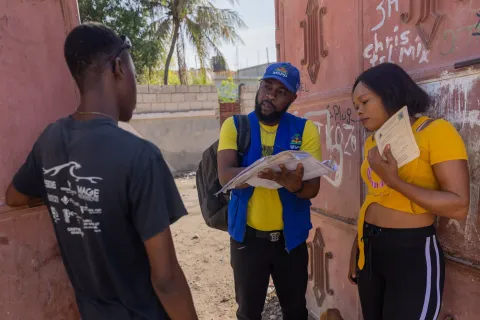
UNICEF and partners are supporting affected families to recover from the disaster. UNICEF and the DPC will distribute cash assistance to the 300 most vulnerable affected families, to ensure their recovery and that they do not sink into further poverty.
As Haiti already declared over 83,000 suspected cases of cholera – over 3,500 of which in the Northwest department – UNICEF distributed hygiene kits and sensitized communities about the importance of clean water and hygiene as well as the risks of waterborne diseases.
To avoid a further collapse of the local health system due to increasing demand and depleting supplies, UNICEF is also supported the local hospital by providing it with medical and nutrition supplies, including ready to use therapeutic food (RUTF) to ensure the continuity of the treatment for children suffering from wasting.
Finally, children aged 3 to 17 will benefit from recreational activities and psychosocial support. Families will also be sensitized on the protection of children, as well as against violence and abuse.