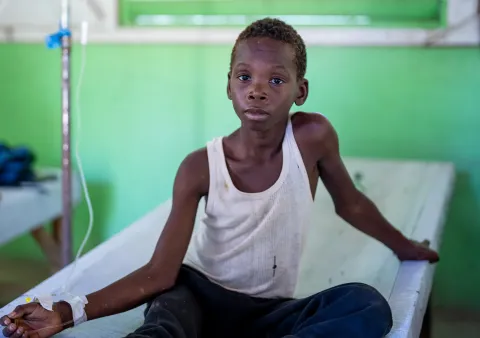
"I almost lost my daughter to cholera": in Grand-Goâve, a mother turns her pain into action
Faced with cholera and a lack of sanitation infrastructure, a mother from Grand-Goâve sparked a community movement that transformed her neighborhood and saved lives.
- Français
- English
Grand-Goave, Haiti - When her 11-year-old daughter, Noel-Dina, was struck by fever and unbearable abdominal pain, Oriata didn't Hesitate. She immediately took her child into her arms and, with no means of transportation, walked the nearest hospital. “She couldn't walk anymore because she was so weak. I had to carry her on my back. I was terribly worried and thought I was going to lose her,” says Oriata, her eyes filled with tears .
That day, Noel-Dina was diagnosed with cholera. Like many children in their rural neighborhood of Grand-Goâve, she lived without access to basic sanitation facilities. “ We had no choice but to use the outdoors as our toilet. That's how the disease entered our lives,” explains shares the girl.
An emergency that raises awareness
Noel-Dina survived thanks to timely medical care. But this painful experience was a turning point. Thanks to awareness campaigns in their area, Oriata learned that the lack of latrines was one of the main reasons for the spread of cholera and other waterborne diseases.
Without waiting for outside help, she began digging a pit in her yard. “I didn't have many resources, but I knew I had to do something, not just for my daughter, but for all the children in the neighborhood,” she explains.

Community mobilization inspired by personal experience
But Oriata didn't stop there. After seeing her daughter gradually regain her strength, she became involved in awareness-raising activities in her community. She told her story, going from house to house, to encourage other families to take action. Her commitment sparked a wave of solidarity.
“When someone started digging a pit and couldn't continue, we would get together to help them and we did this house by house until it became a movement,” she recalls.
This mutual support transformed their neighborhood. Latrines became the norm and hygiene practices such as systematic hand washing were adopted by everyone. “Today, when you walk through here, you no longer smell any bad odors because no one relieves themselves outside anymore. We collectively and successfully educated ourselves,” she says proudly.
A survivor full of dreams
Sitting on her bed, her math notebooks open in front of her, Noel-Dina smiles shyly. She dreams of becoming a nurse. “I want to take care of people in my neighborhood, give them IV fluids, like they gave me,” she says. Every day, she helps her mother at home and washes her hands thoroughly after using the toilet, actions that have become automatic.
“Before, I had to go outside. Now we have a latrine at home, and I'm glad my mom built it. She did it for me and for everyone,” she says.

A lasting impact thanks to IDB support
The story of Oriata and Noel-Dina reflects that of many families in rural areas of Haiti. Thanks to a programme funded by the Inter-American Development Bank (IDB) and implemented by DINEPA, UNICEF, and its local partner, the Fondation Voix des Communautés de Base (FVCB), nearly 3,000 households now have access to safe and hygienic latrines.
But the changes don't stop there. Awareness-raising sessions have been organized in schools and health facilities, and 30 hygiene clubs created, 22 in schools and 8 in health centres to encourage good practices among children, teachers, and medical staff.
“Before, there were bacteria everywhere, and children often got sick. Now, even when a child has a fever, it's no longer because of dirt. They are healthier and happier,” says Oriata.

Grand-Goâve's success has not gone unnoticed. On the contrary, it has inspired neighboring communities, which have observed cleanliness, fewer diseases, and greater unity in the neighborhood.
“They come to us and ask for help to do the same in their communities and we gladly show them how to do it. It's a source of great pride for me,” states Oriata, with a discreet smile.
In a region long deprived of essential services, this initiative supported by the IDB and UNICEF stands as a testament to the power of community engagement. Simple actions, carried out by ordinary people like Oriata, have brought about lasting changes in people's lives.