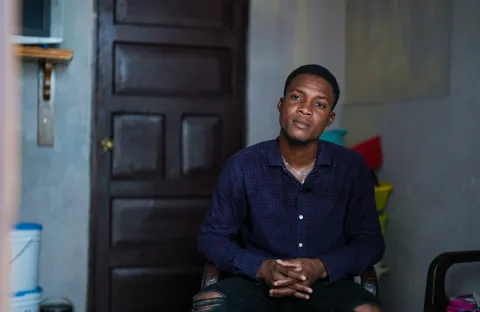
For Taïna, a latrine at home makes a difference in everyday life
In the locality of Mapou, in Grand-Goâve, families are mobilizing to put an end to open defecation and improve their children’s living conditions.

- Français
- English
Grand-Goâve, Haiti - At 14, Taïna still remembers the days when illness prevented her from going to school, playing with her friends, and taking part in her family’s daily activities. “I could not go to school,” says the eighth-grade student, who lives in Mapou, a locality in Grand-Goâve, in the West Department of Haiti.
At that time, many families in the community did not have latrines and had to relieve themselves in the open, particularly in the bushes. In this locality, where access to sanitation and drinking water was limited, children were particularly exposed to diarrheal diseases.
Taïna was not spared. Suffering from diarrhea accompanied by vomiting, dizziness, and extreme weakness, she could no longer fetch water, help her mother do the laundry, or run small errands for her family. Even playing with her friends, which had once been part of her daily routine, had become impossible.
Concerned about her daughter’s deteriorating health, her mother, Roselore, took her to the hospital. Taïna says she received oral rehydration solution there and learned from the doctor that she was suffering from cholera.
From illness to changing practices
For Roselore, Taïna’s mother, this period was particularly difficult.
“It made me very sad because I still did not know what illness she was suffering from,” she says.
In addition to worrying about her daughter’s health, families in the locality were also facing difficult hygiene conditions: “We had nowhere to relieve ourselves, and we had to draw our water from the contaminated river. When the river level dropped, the water sometimes contained fecal matter.”
With no means to treat it, families were forced to continue consuming it, exposing themselves to diarrheal diseases.

At the hospital, Taïna received care that allowed her to recover. Her mother was also made aware of the importance of treating drinking water and washing hands to prevent diarrheal diseases. But to protect children in the long term, sanitation conditions in the community also needed to improve.
The episodes of diarrhea that affected several families in Mapou strengthened residents’ awareness of the importance of sanitation.
Residents then began mobilizing to put an end to open defecation and build family latrines. Through awareness-raising activities, families became aware of the health risks associated with this practice and the importance of adopting better hygiene habits.
With the support of the Sanitation Action and Monitoring Committee (CASA), families gradually committed to building their own latrines. A collective effort whose importance Roselore now recognizes.
A community taking action for its children
“Everyone agreed to build latrines because we understood how important they were for our health. Thanks to CASA, we now have access to a latrine. This has significantly improved our living conditions and hygiene, and we are deeply grateful for their support,” says Reselore.
Today, families use their own latrines and adopt better hygiene practices to protect their health and that of their children.
Taïna remembers the construction work on the latrines that she witnessed. She particularly remembers residents digging the pits, determined to put an end to open defecation. For the adolescent, this change has also brought greater comfort and privacy.
“Now that I have a latrine at home, I feel much more comfortable,” she says. “I no longer need to look for a place outside to relieve myself, and I can use the toilet at her house in complete privacy,” she adds.
Today, Taïna has returned to her usual routine and can once again take part in her family’s daily activities, fetch water, run errands, and help her mother do the laundry. She can also return to school and enjoy playing with her friends.
For Roselore, seeing her daughter in better health is an immense relief. “I am very happy when my children are well; they are happy, they play, they live, and they are not sick,” she says.

In Mapou, community mobilisation, led by the National Directorate for Drinking Water and Sanitation (DINEPA), in partnership with UNICEF and with support from the World Bank (WB), the Inter-American Development Bank (IDB) and the UN Multi-Partner Trust Fund (MPTF), has helped improve sanitation conditions and strengthen hygiene practices within the community.
For Taïna and the other children of Mapou, having a toilet at home means much more than improved sanitation. It also gives them the opportunity to grow up in a healthier environment, maintain their privacy and fully enjoy their childhood.